
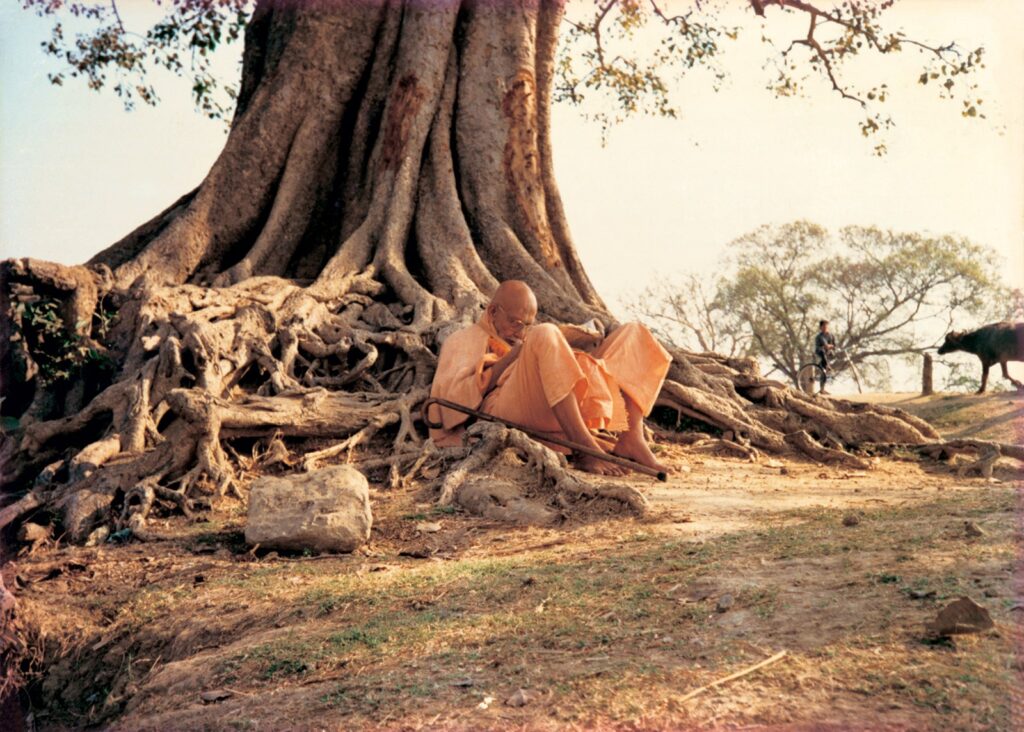
By Śrīla Bhakti Pramode Purī Gosvāmī Mahārāja
We attempt to speak about Kṛṣṇa, but what can we really say? We memorize a few verses and recite them like a parrot, and that is the extent of our glorification of the Lord. Where is our inner feeling? Everyone goes around talking about rāga-bhakti, but where is that spontaneous feeling that is the meaning of rāga? Śrī Caitanya Mahāprabhu told us to follow some simple rules, the rules of vidhi-bhakti. He said to chant the Holy Name, to chant a lakh every day.
This happened in Purī when all the brāhmaṇas there started to invite Him to accept dinner at their homes. So Mahāprabhu answered that He only ate at the houses of millionaires, which in Bengali is lākha-pati. All the brāhmaṇas were disappointed to hear Mahāprabhu say this, because they were all very poor. Then Mahāprabhu laughed and said, “You know what I mean by a lākha-pati? I mean someone who chants a hundred thousand Holy Names every day.” The brāhmaṇas were immediately relieved and said, “Is there anyone more merciful to us than You? You devise strategies like this to get us to chant the Holy Name. Of course we will chant a lakh every day, but please accept our invitation!”
Śrīla Prabhupāda also told us to chant a lakh every day. Many of our godbrothers went to him and said, “But Prabhupāda, we have to do so much service. How can we chant a lakh every day?” Prabhupāda never said, “Just chant as much as you can. That is enough.” He said, “Make the time. Somehow or another, find the time.” I heard him say this myself. But we don’t. We can’t find the time to chant. This is the extent of our capacity to do bhajana. And yet we still think that we can talk about rāga-bhakti. All these Western devotees who come here hear about something called rāga-bhakti and immediately think that they understand everything there is to know about it. But they really know nothing about the qualifications that are needed to attain rāga-bhakti. They don’t understand. This is why I have spoken about all these matters from the Śrīmad-Bhāgavatam.
At the beginning of the Śrīmad-Bhāgavatam, the following statements were made:
śṛṇvatāṁ sva-kathāḥ kṛṣṇaḥ
puṇya-śravaṇa-kīrtanaḥ
hṛdy antaḥ-stho hy abhadrāṇi
vidhunoti suhṛt satām
“Hearing and speaking about Lord Kṛṣṇa is a most pure activity, for as you engage in such activities, the Lord Himself enters your heart and destroys all the causes of inauspiciousness that are obstacles to your spiritual life. This is how Kṛṣṇa acts as a friend to the pious.”
naṣṭa-prāyeṣv abhadreṣu
nityaṁ bhāgavata-sevayā
bhagavaty uttama-śloke
bhaktir bhavati naiṣṭhikī
“When all causes of inauspiciousness or anarthas are almost completely destroyed through regular service to the devotees and hearing the Śrīmad-Bhāgavatam, then one comes to the stage of steadfast devotion to the Supreme Lord, who is glorified in the best of poetry.” (Śrīmad-Bhāgavatam 1.2.17–18)
You have to hear the Śrīmad-Bhāgavatam under the guidance of advanced devotees, who are also known as Bhāgavatas. As one does so, one will gradually attain steadfast devotion to the Supreme Lord, who is glorified in the best of poetry. What is the nature of such steadfast devotion? That is explained in the commentary to the Bhakti-rasāmṛta-sindhu with the words avikṣepena satatyam: constancy without distraction. It is not enough to carry beads in your hand and to finger them from time to time. You have to achieve constancy in chanting without allowing your mind to be distracted. Bhaktivinoda Ṭhākura writes in his Hari-nāma-cintāmaṇi:
lakṣa-nāma haile pūrṇa saṅkhyā mālā gaṇi
hṛdaye nāhila rasa-bindu guṇa māni
“One may complete chanting a lakh of Names on his japa-mālā, O Lord, but still not get a drop of the Holy Name’s ecstatic taste.”
(Hari-nāma-cintāmaṇi 12.14)
The reason is that while chanting, the mind is wandering all over the place, thinking of so many different things. What is the point of chanting the Holy Name a million times if you still don’t experience kṛṣṇa-prema? Is this rāga-bhakti? Is this what rāga-bhakti looks like? Will a rāga-bhakta have no taste for chanting the Holy Name? Where is the attachment to chanting the Holy Name? You can’t catch a worm and yet you think you can go cobra hunting?
You talk to these people about developing affection for the Holy Name and they treat it as though it were irrelevant. They are attracted to the stories of girls, but they don’t realize who these girls are. Rādhārāṇī is Kṛṣṇa’s personal potency, and the gopīs are all Her expansions, extensions of Herself. Therefore it is said that Kṛṣṇa is not engaged in dalliances with anyone but Himself. He is the self-sufficient Supreme Lord, and all these gopīs are not separate from His essence. There is no falldown, no question of material lust. The Bhāgavata (10.33.25) uses the term avaruddha-saurata to indicate that no gross sexual activity is involved in the rāsa-līlā. Therefore, Śrīdhara Svāmī concludes that the rāsa-līlā is Kṛṣṇa’s lust-conquering pastime. There is not the slightest trace of material lust in the activities shared by Kṛṣṇa and the gopīs, not the slightest tendency to selfishly seek the gratification of their own senses. We will not be able to understand this. Therefore, we must listen carefully from our spiritual masters in order to understand what qualifications are needed to enter into the Lord’s joyful world of play.
Mahāprabhu Himself relished such matters in private in the Gambhīrā with His intimate associates Svarūpa Dāmodara and Rāmānanda Rāya. There were no worldly-minded people present when these discussions went on. But what are these people doing? They say this is Rādhā-kuṇḍa, Rādhārāṇī’s realm, but how many of us can really live in Rādhā-kuṇḍa? How many of us are even able to take the dust of Rādhā-kuṇḍa on our heads? We have to take these things into account. Do we dip our hands in the holy water of Rādhā-kuṇḍa only to shake it off again?
Śrīla Prabhupāda used to tell a funny story about an opium smoker. The sun was setting and this addict felt the need to satisfy his addiction, but he was on one side of the river, while the village where there was fire to light his pipe was on the other. Our situation is something like this. We want to be united with Kṛṣṇa, the Lord of Goloka, but we are separated by a raging river of disqualifications. We have to bear all this in mind. We can dive into Rādhā-kuṇḍa as often as we like, drink the water, submerge ourselves in it, but that does not mean that we have really bathed in Rādhā-kuṇḍa. What we really have to do is plunge into the waters of Rādhārāṇī’s mood of spontaneous devotion, and to do that we must first develop enthusiasm for Kṛṣṇa’s Name. Without such enthusiasm, nothing further will be gained. This is the teaching of Śrī Caitanya Mahāprabhu.
When the sun of prema rises, then all the darkness of sin and suffering dissipates. This means lust and all it entails. This is how Viśvanātha Cakravartī Ṭhākura awards eligibility for entering the rāsa-līlā, but that does not take place until one has attained rāga-bhakti. Muslims are also listening to the rāsa-līlā while puffing on a bīḍī or some other weed. Such people are heard to applaud and ask the speaker for an encore, “Keep on speaking. Keep on speaking.” What is going on here? It is their material lusts that are being awakened, not any real mood of devotion.
One cannot steal one’s way into the highest stages of spiritual life. We must earn the right to enter the realm of Divine Love.