
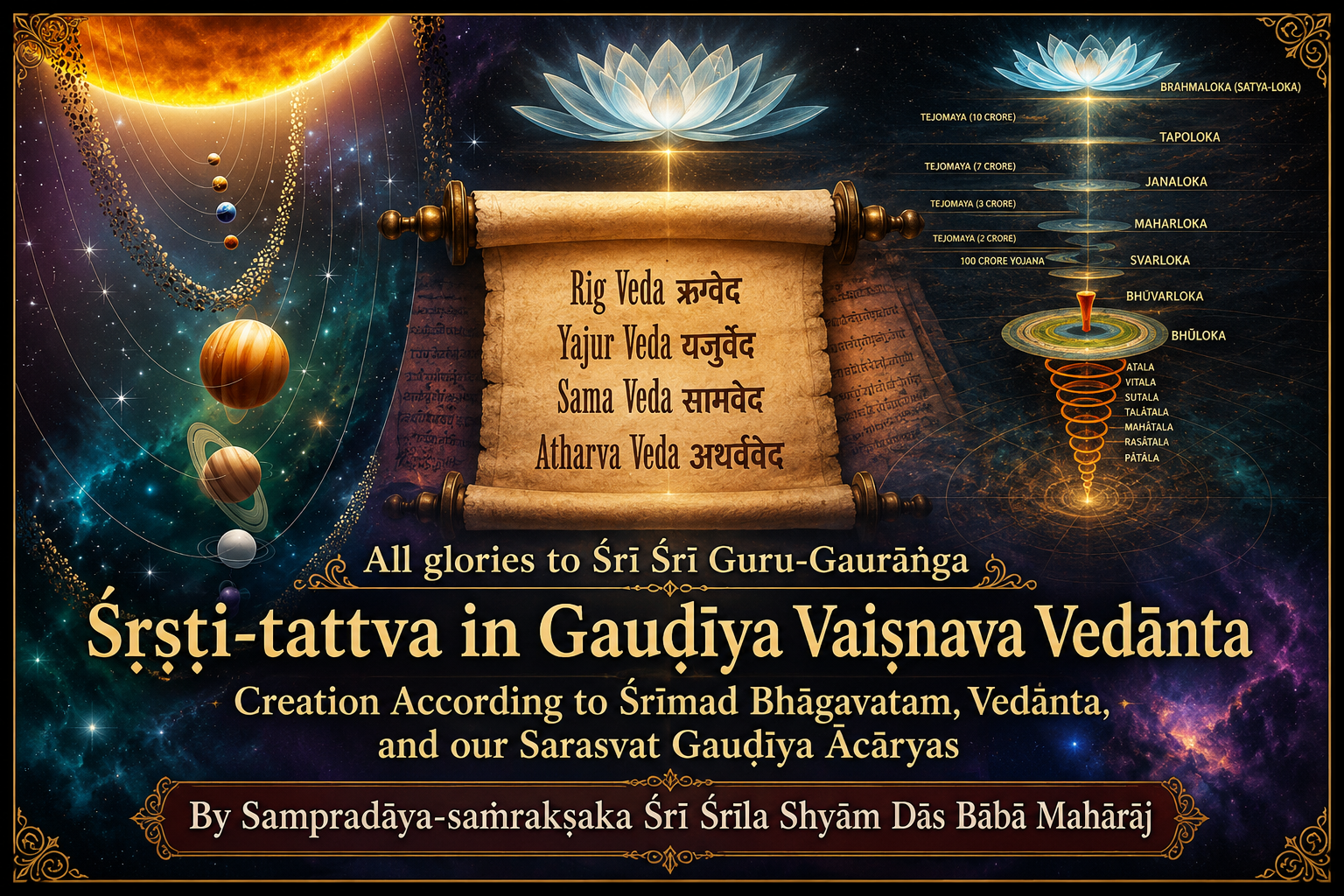
All glories to Śrī Śrī Guru-Gaurāṅga
Śṛṣṭi-tattva in Gauḍīya Vaiṣṇava Vedānta
Creation According to Śrīmad Bhāgavatam, Vedānta, and our Sarasvat Gauḍīya Ācāryas
By Sampradāya-saṁrakṣaka Śrī Śrīla Shyām Dās Bābā Mahārāj
Date 14.05.2026
Gauḍīya Goṣṭhī Pati Śrī Śrīla Bhakti Siddhānta Sarasvatī Gosvāmī Ṭhākura Prabhupāda used to say that— “Logical interpretation cannot stand in the way of that Absolute Truth. If I seek the path leading towards the ultimate good, then I must ignore the countless voices of popular wisdom, and listen only to that of the realized soul.”
To understand all those most essential and important topics in regard to sṛṣṭi-tattva (creation), there is only one way open before us all that is — we must fully depend upon guru-vaiṣṇavas, because they only are in a position to extract the essential meaning from the vast volume of Vedic literature. Though everything is recorded in the Vedas, but it still is next to impossible for ordinary jivas to understand properly the inner meaning merely by using intellectual power. First of all it is important to understand that the Vedas belong to the category of apauruṣeya— which means that Vedas are not the products of the human brain.
Regarding creation or sṛṣṭi-līlā we can find all detailed information in Vedānta, as well as Śrīmad Bhāgavatam which is the supreme Purāṇa.
artho ’yaṁ brahma-sūtrāṇāṁ
bhāratārtha-vinirṇayaḥ
gāyatrī-bhāṣya-rūpo ’sau
vedārtha-paribṛṁhitaḥ
purāṇānāṁ sāma-rūpaḥ
sākṣād-bhagavatoditaḥ
dvādaśa-skandha-yukto ’yaṁ
śata-viccheda-saṁyutaḥ
grantho ’ṣṭādaśa-sāhasraḥ
śrīmad-bhāgavatābhidhaḥ (Quotation from the Garuḍa Purāṇa)
‘The meaning of the Vedānta-sūtra can be found in applied form in Śrīmad-Bhāgavatam. The commentary of the Brahma-gāyatrī is also there and Srimad Bhagavatam is absolutely approved by Sriman Mahaprabhu. Srimad Bhagavatam is the complete explanation of Vedanta. Śrīmad-Bhāgavatam is the supreme Maha Purāṇa, and it was compiled by the Supreme Personality of Godhead in His incarnation as Vyāsadeva. There are twelve cantos, 335 chapters and eighteen thousand verses.’
Also we can find many commentaries on Śrīmad Bhāgavatam by Śrīla Śrīdhara Svāmīpāda, by Śrīla Mādhavācārya, Śrīla Vijay Rāghava, Śrīla Viśvanātha Cakravartī Ṭhākura etc., and also from our Gauḍīya Guruvarga like Śrīla Jīva Gosvāmī, Śrīla Baladeva Vidyābhūṣaṇa, Śrīla Saccidānanda Bhaktivinoda Ṭhākura, Śrīla Bhakti Siddhānta Sarasvatī Gosvāmī Ṭhākura Prabhupāda etc. etc., but still even by going through all those siddhānta vicāras which all are mercifully given to us by all those prominent ācāryas, most of us cannot be able to enter into all those deep siddhānta vicāras without receiving full kṛpā of Guru-Vaiṣṇava. Our realisations in regard to śṛṣṭi-līlā-tattva can only appear inside our heart through our absolute lovful serving mood unto the lotus feet of pure Guru-Vaiṣṇava. All these siddhānta vicāras aparently seem to be very hard, but actually it is not so. It is important to understand that śṛṣṭi-tattva — which is not only theoretical knowledge, rather it is a deep secret which can only be realized by those surrendered souls.
siddhānta baliyā citte nā kara alasa
ihā ha-ite kṛṣṇe lāge sudṛḍha mānasa (CC Ādi 2.117)
We should not show lethargy in the way of realizing all śāstra-siddhānta-vicāra, considering them as hard labour, because such discussions strengthen the mind, and in this way one’s mind becomes firmly attached unto the Lotus feet of Śrī Kṛṣṇa.
All śabda śāstras are like an endless ocean —anantaḥ param kila śabda-śāstra—, so how tiny jiva can understand all those intricate matters? For all those baddha-jīvas, śabda śāstras are like Salt Ocean, not possible to drink and digest. One may stand before such an ocean, but it is impossible to drink from it directly. The vast conclusions of śāstra can never be digested by those conditioned souls through their independent study or speculations. We always have to depend upon pure Guru-Vaishnava. Guru-Vaiṣṇavas mercifully acting as the Sun god. The Sun god absorbing the salty water of the ocean and that become transformed into clouds, so as a result we are going to get a shower of sweet water. In this way, Guru-Vaiṣṇavas can churn the ocean of śāstra to get cream for us.
Śṛṣṭi-tattva according to Gauḍīya-siddhānta-vicāra
The Absolute Truth can never be realized by searching the chain of material causes and effects. By the ascending process (āroha-panthā), one may attain partial or indirect realizations, but aprakṛta-dhāma remains beyond reach for him forever. To realize that Absolute Truth, one must depend exclusively upon the avaroha-panthā—the descending process of divine revelation, because by the development of sambandha-jñāna one can discover our eternal relationship with the Supreme Lord.
athāpi te deva padāmbuja-dvaya-
prasāda-leśānugṛhīta eva hi
jānāti tattvaṁ bhagavan-mahimno
na cānya eko ’pi ciraṁ vicinvan (ŚB 10.14.29)
My Lord, if one is favoured by even a slight trace of the mercy of Your lotus feet, he can understand the greatness of Your personality. But those who speculate to understand the Supreme Personality of Godhead are unable to know You, even though they continue to study the Vedas for many years.
In the first sloka from Śrīmad Bhāgavatam it is said that —
janmādy asya yato ’nvayād itarataś cārtheṣv abhijñaḥ svarāṭ
tene brahma hṛdā ya ādi-kavaye muhyanti yat sūrayaḥ
tejo-vāri-mṛdāṁ yathā vinimayo yatra tri-sargo ’mṛṣā
dhāmnā svena sadā nirasta-kuhakaṁ satyaṁ paraṁ dhīmahi (ŚB 1.1.1)
Let us meditate unto the Lotus Feet of that Absolute tattva, who is the Absolute Truth—The primeval cause of all causes (be it prakṛta or aprakṛta), by whom all creation-maintenance and destruction taking place. Who is directly and indirectly conscious of all manifestations simultaneously at a time—wherever whatever happening, and who is the Supreme authority of everything (I mean He need not depend upon anybody or anything), He is absolutely independent because there is no other cause beyond Him. It is He only who first imparted the aprakṛta jñāna (all the knowledge of relationship about Who is He, about How is He and His līlā etc.) into the heart of Brahmājī who is the original living being in this creation. Even those great sages and those demigods are put into a bewildering condition by His illusionary potency like assuming water in fire, or assuming land in water (like the mirage in the desert developed due to hot sunlight where someone can be in confusion that water can be found within certain distance, but this is nothing but one kind of fallacy created by the hot sunlight or teja because the adjacent air near the sand ground become hot and then the light air going up and the dense cool water from upcoming down towards the ground surface sand. In this way naturally one kind of illusion can be visible which is not at all true). Only because of Him do the material universes, temporarily manifested by the reactions of the three modes of nature, appear factual, although they are unreal (all temporary – not eternally present). We therefore meditate unto the Lotus Feet of the Supreme Lord who is eternally present in the transcendental abode, in this way we can become free forever from the illusory representations of the material world. Let us all meditate upon Him, for He is the Absolute Truth.
According to Gauḍīya Vedānta vichar, creation does not occur through the transformation of Bhagavān Himself. On the contrary it takes place through the transformation of the śakti of the Supreme Lord. Bhagavān and His śakti are inseparable (śakti-śaktimator abheda). The simultaneous oneness and difference is known as acintya-bhedābheda tattva.
Śakti and Śaktimān are non-different from each other, but still we must understand that change occurs only within śakti, never in Bhagavān Himself. That is why Gauḍīya Vaiṣṇavas reject both the Advaitic doctrine of illusory manifestation (vivarta-vāda) and the idea that Supreme undergoes material transformation. Śrīla Saccidānanda Bhaktivinoda Ṭhākura has written in his Dāsa-mūla-tattva–
parākhyaiva śakter apṛthag api sa sve mahimāni
sthito jīvākhyāṁ svām acid-abhihitāṁ tāṁ tri-padikām
sva-tantrēcchāḥ śaktim sakala-viṣaye preraṇa-paro
vikārādyaiḥ śūnyaḥ parama-puruṣo yaṁ vijayate
(Dāsa-mūla-tattva 3)
Although Śrī Bhagavān is non-different from His inconceivable transcendental potency (parā-śakti), He has His own independent nature and desires. His parā-śakti consists of three aspects – cit-śakti (spiritual potency), jīva-śakti (marginal potency), and māyā-śakti (external potency) – and He always inspires them to engage in their respective functions. That para-tattva (Supreme Absolute Truth), even after performing all these activities, still can remain immutable because he is eternally situated in the transcendental svarūpa of His own glory.
hareḥ śakteḥ sarvaṁ cid-acid akhilaṁ syāt pariṇatiḥ
vivartaṁ no satyaṁ śrutiṣu iti viruddhaṁ kali-malam
hareḥ bhedābhedau śruti-vihita-tattvaṁ suvimalaṁ
tataḥ premṇaḥ siddhir bhavati nitarāṁ nitya-viṣaye
(Dāsa-mūla-tattva 8)
The entire spiritual and material creation is a transformation of Śrī Kṛṣṇa’s śakti. The impersonal philosophy of illusion (vivarta-vāda) is not true. It is one kind of confusion that has been produced in this Kali-yuga, and is surely contrary to the teachings of the Vedas. Vedas concluding acintya-bhedābheda-tattva (which is inconceivable oneness and difference) as the pure and absolute doctrine, and one can attain perfect love for the Eternal Absolute when he accepts this principle.
There are three principal energies of the Supreme Lord. The internal energy (antaraṅga-śakti) constitutes the spiritual realm and the Lord’s own divine pastimes. The marginal energy (taṭastha-śakti) consists of all the jīvas. And the external energy, known as māyā-śakti or prakṛti, is the field in which creation takes place. The material creation belongs exclusively to this external potency, but still even māyā cannot act independently without the instruction of the Supreme Lord. Śrīla Bhaktivinoda Ṭhākura explaining that māyā can never act independently, for she remains eternally under the control of the Supreme Lord. In this way we can say only this much that prakṛti can be activated in this way.
In the Bhagavad-gītā we find the following sloka—
ahaṁ sarvasya prabhavo
mattaḥ sarvaṁ pravartate
iti matvā bhajante māṁ
budhā bhāva-samanvitāḥ (Bhagavad-gītā 10.8)
“I am the source of all spiritual and material worlds. Everything emanates from Me. The wise who perfectly understand this engage in My devotional service and worship Me with all their hearts.”
Those ignorant people, being bewildered by the illusory energy (māyā) of the Supreme Lord, arrogantly claim themselves to be competent in the way of that Absolute truth on the basis of their speculative power. But the absolute truth is always descending through the divine paramparā, which can establish the fact that the supreme authority is Śrī Kṛṣṇa Himself, Who is the cause of all that exists—both spiritual and material.
īśvaraḥ paramaḥ kṛṣṇaḥ
sac-cid-ānanda-vigrahaḥ
anādir ādir govindaḥ
sarva-kāraṇa-kāraṇam (Śrī Brahma-saṁhitā 5.1)
Kṛṣṇa who is known as Govinda is the Supreme Godhead. He has an eternal blissful spiritual body. He is the origin of all. He has no other origin and He is the prime cause of all causes.
The transcendental realm, Śrī Goloka Vṛndāvana, is not a product of mundane imagination, nor it is effected by the defects of material perception. It is the supreme abode of the Absolute Truth, wherein Śrī Kṛṣṇa eternally manifests His inconceivable pastimes. From that divine plane radiates the brahmajyoti, and by considering that effulgence as the ultimate reality those Māyāvādīs (impersonalists) get deprived by Māyā. Within that effulgence there are hidden all those Vaikuṇṭha planets. Those are the eternal abodes of different svarūpas of Bhagavān.
yasyaika-niśvasita-kālam athāvalambya
jīvanti loma-vilajā jagad-aṇḍa-nāthāḥ
viṣṇur mahān sa iha yasya kalā-viśeṣo
govindam ādi-puruṣaṁ tam ahaṁ bhajāmi
(Śrī Brahma-saṁhitā 5.48)
Brahmā and other lords of the mundane worlds, appearing from the pores of hair of Mahā-Viṣṇu, remain alive as long as the duration of one exhalation of the latter [Mahā-Viṣṇu]. I adore the primeval Lord Govinda of whose subjective personality Mahā-Viṣṇu is the portion of portion.
Then Mahā Viṣṇu entering into each and every Universe to sleep in Garbhodaka water and within each universe, the Lord again expands Himself as Garbhodakaśāyī Viṣṇu, Who is establishing the foundation for the cosmic manifestation of this Universe. From Him arises the mahat-tattva, the primordial substance that includes the ingredients of material nature along with time (kāla), the driving force of transformation. In this way all creation is not an accidental occurrence, nor the product of blind material forces, but is a deliberate and controlled manifestation of the Lord’s external energies. Those who, out of false ego (avidyā) try to express audacity to deny this divine arrangement of creation of the Supreme Lord, they can be in the trap of impersonalism or materialism. Only those who can submissively receive this knowledge through the bona fide disciplic succession can transcend illusion and can understand that the ultimate purpose of this creation is not meant for the purpose of exploitation, rather to give us the golden opportunity to serve the Supreme Lord by the help of all items all around us.
Mahā-Viṣṇu and the Beginning of Creation
Śrī Kṛṣṇa – the Supreme Lord never coming into the direct contact with māyā. The process of creation begins through Mahā-Viṣṇu, who lies in the Causal Ocean. From His breathing innumerable universes are emanating as it is mentioned in the above śloka from Brahma Saṁhitā. With a single exhalation of Mahā-Viṣṇu, countless universes come into being, but He Himself remains untouched, unchanged, and complete.
The glance of Mahā-Viṣṇu carries all the jīvas into the womb of Māyādevī (prakṛti). In this way those jīvas are placed within the womb of prakṛti to take different shape and design according to their respective karma-phala. After entering into each and every universe He is going to take shelter in the Garbhodaka water who is known as Garbhodakaśāyī Viṣṇu. After that one divine Lotus sprout out of His navel portion on which Lord Brahmā can discover himself. In this way the secondary face of creation taking place. Those jīvas are accepting their respective bodies according to their karma-phala.
At the time of dissolution, the material elements are gradually withdrawn in reverse order, but still Bhagavān always remaining unchanged at any cost. And those jīvas are fed with their karma-phala and waiting for the next creation to come. In this way creation and destruction going on, so we can realize that material life is very unstable.
Here for your clear understanding some material analogies are given. The comparison of the potter and clay is one such instructive example, though it is not complete example, still we can use it in this case.
In this analogy, Śrī Viṣṇu is the supreme controller, just as the potter is the conscious agent behind the formation of pots. The mahat-tattva, the aggregate of material ingredients, is like clay—without independent capacity to get organized itself. The factor of time (kāla), compared to the potter’s wheel, provides the dynamic force for transformation. The jīvas are like some invisible activating binding force by the help of which this whole creation can get some meaning, because just like water inside the complete pot jīvātmās are not externally visible in this creation.
mamaivāṁśo jīva-loke
jīva-bhūtaḥ sanātanaḥ
manaḥ-ṣaṣṭhānīndriyāṇi
prakṛti-sthāni karṣati (Bg. 15.7)
The living entities in this conditioned world are My eternal fragmental parts. Due to conditioned life, they are struggling very hard with the six senses, which include the mind.
īśā vāsyam idaṃ sarvaṃ yat kiñca jagatyāṃ jagat
tena tyaktena bhuñjīthā mā gṛdhaḥ kasya sviddhanam
(Śrī Īśopaniṣad 1)
In the Lord is to be veiled all this—whatsoever moves on earth. Through such renunciation do thou save (thyself); be not greedy, for whose is wealth?
Brahmā, the secondary creator, acts as the engineer of the universe, just as an assistant potter shapes the clay into various forms. However, neither the clay, nor the wheel, nor the water, nor even the assistant possesses independent potency. All get operated under the supreme will of the Lord. It is just like one big factory where all the raw materials are present, all the machines are perfectly installed, and all the workers are ready to perform their respective duties —but still, nothing can move without one special help. Why? Because there is no electricity. Without electricity (which is invisible to us), everything can become useless. In the same way, this material world may appear complete—with its elements, living beings, and systems—but without the activating glance and sanction of the Supreme Lord, nothing can function. It is only by His divine energy that everything becomes animated and purposeful. The foolish empiricists cannot understand to realise the most basic point that all those matters as a whole cannot get organized automatically. The pot cannot be created automatically from clay without the conscious direction of the potter. Similarly, the cosmos cannot manifest from inert matter without the glance (sṛṣṭi-dṛṣṭi) of the Supreme Lord. Those who advocate material causation or impersonal transformation (vivarta-vāda) are thus exposed as victims of Kali-yuga’s contamination, mistaking subordinate instruments for the ultimate cause. Such doctrines deny the supremacy of Bhagavān and thereby that can become the main obstruction for them on the path of pure bhakti. Therefore, one must reject all speculative interpretations and accept the conclusion of the Vedas — that the Supreme Personality of Godhead, Śrī Kṛṣṇa, through His expansions such as Śrī Viṣṇu, is the ultimate cause, controller, and maintainer of all manifestations. Only by accepting this truth through the guidance of a bona fide spiritual master can one transcend illusion and engage in one’s eternal function—loving service (sevā) to the Supreme Lord.
Gaura Hari Hari Bol