
Overview :
Gauḍīya Goṣṭhipati Śrī Śrīla Bhakti Siddhānta Sarasvatī Gosvāmī Ṭhākura Prabhupāda Paramahaṃsa Jagat-Guru said that,— “To get established in the ācaraṇa shown by Śrīman Mahāprabhu is the symptom of a genuine Gauḍīya-Preacher.” So, for us we Gauḍīya-devotees, this is the most important factor in the way of ācāra-pracara or ādarśa. We have no right to violate these comments passed by Śrīla Sanātana Gosvāmīpāda for Śrīla Haridāsa Ṭhākura. At present most of us in the guise of gauḍīya-devotees, always like to project ourselves as great exalted devotees in the name of solitary bhajana. Śrīla Prabhupāda wrote the following verse in his ‘Vaiṣṇava Ke?’ (‘Who is a Vaiṣṇava?’) writing,—
“ kīttana prabhāve, smaraṇa hoibe,
se-kāle bhajana nirjjana sambhava”
Translation : As a reasult of effective saṅkīrttana, smaraṇa or uninterrupted remembrance is possible and then only ‘natural nirjjana-bhajana’ (solitary bhajana) is possible.
Śrīla Saccidānanda Bhakti Vinoda Ṭhākura said in his writing titled as ‘Śaraṇāgatī’,—
“atyanta durlabha prema koribare dāna
śikhāya śaraṇāgatī bhakatera prāṇa”
Translation : “Śrī Kṛṣṇa Caitanya Mahāprabhu with His eternal associates in order to bestow the absolute prema — which is the rarest of all, teaching all the jīvas that, how to develop śaraṇāgatī which is the life & soul of a genuine bhakta.
Again Śrīla Prabhupāda writing in ‘Vaiṣṇava Ke?’,— “prāṇa ācche jāra, se hetu pracara“
Translation : “The one who has life in true sense (I mean who has śaraṇāgatī), only he can preach. Here the word ‘prāṇa’ means absolute śaraṇāgatī which is the backbone of Hari-bhajana. ”
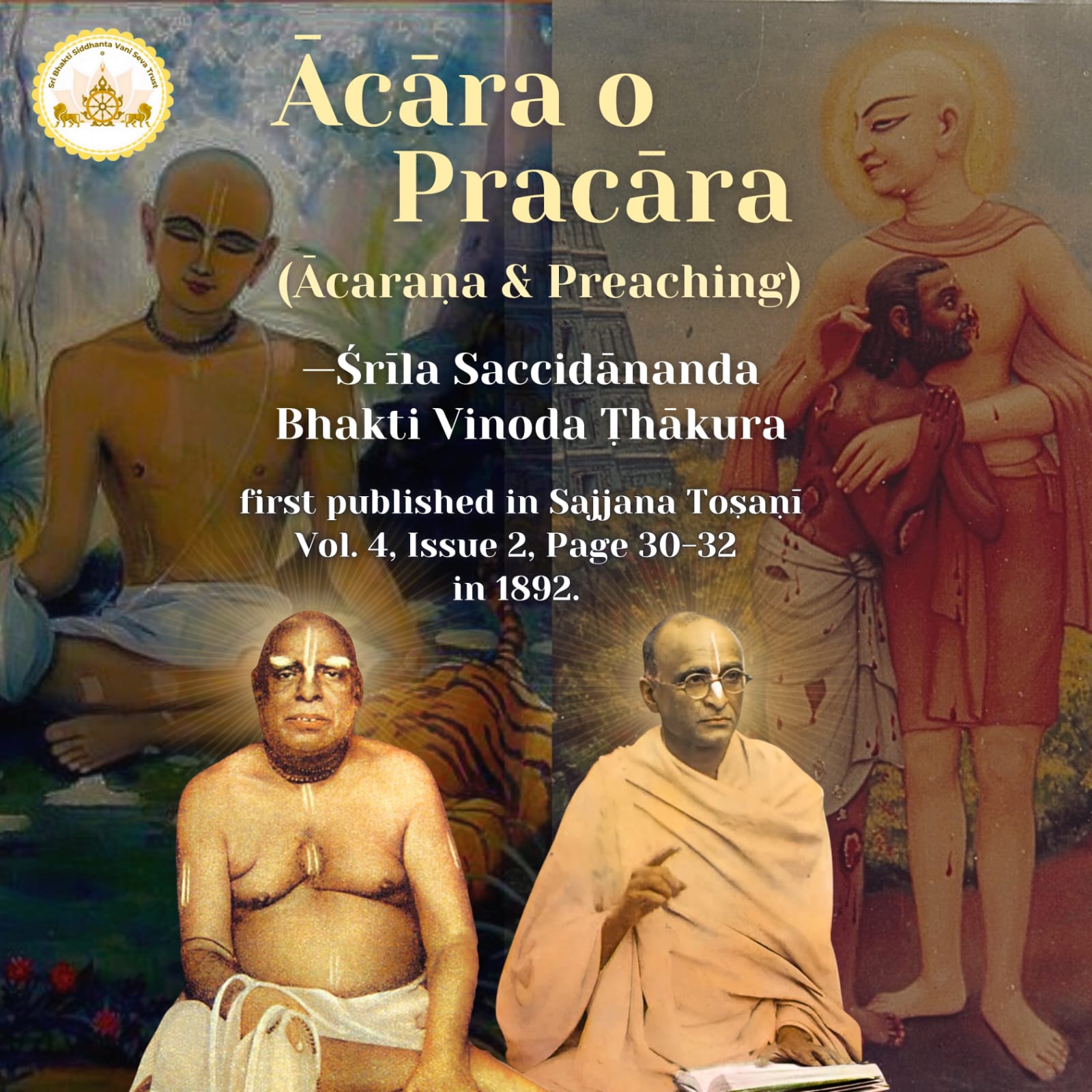
This article, Ācāra o Pracāra (Ācaraṇa & Preaching) was first published in Sajjana Toṣaṇī Vol.4, Issue 2, Page 30-32 in the year 1892.
— Śrī Śrīla Shyām Dāsa Bābā
…………………………………………………………………………………………………………………………
All glories Śrī Śrī Guru Gaurāṅga
Ācāra o Pracāra (Ācaraṇa & Preaching)
— Śrīla Bhakti Vinoda Ṭhākura
After taking darśana of the most elevated devotee— Śrī Haridāsa Ṭhākura, Śrī Sanātana Gosvāmī— the best of all paṇḍitas, said like this. From Śrī Caitanya-Caritāmṛta—
“āpani ācare keha nā kore pracāra
pracāra karaye keha nā kare ācāra (Caitanya Caritāmṛta, Antya-līlā 22.102)
Translation: Some are those who focus solely on maintaining their personal ācaraṇa (etiquette) and refrain from preaching; also, there are some who only preach and do not maintain their personal ācaraṇa.
ācāra pracāra nāmera karaha dui kārya
tumi sarva guru tumi jagatera ārya (Caitanya Caritāmṛta, Antya-līlā 22.103)
Translation : But you are always maintaining both ācāra (maintaining own vaiṣṇava atticacy) & pracāra (preaching on the strength ācaraṇa in front of other jīvas) in the absolute way; so, you are having the absolute power of acting as Guru of the whole world, you are able to give instructions to everybody.
O honest readers! Kindly consider the statement of Śrī Sanātana Gosvāmī very carefully. According to ruci (or taste), there are three categories of devotees— those who are established in ācaraṇa (practice), those who are busy with pracāra (preaching) only, and yet those devotees, who all are doing the both. Among those categories like uttama, madhyama and kaniṣṭha bhaktas, those who are simultaneously maintaining both ācaraṇa and pracara, they are the best. Those who are only busy with ācaraṇa, they are madhyama, and those who only focus on preaching are kaniṣṭha. Dharma- ācaraṇa (those who are established in Bhāgavata-Dharma-ācaraṇa or those who are practicing unalloyed Bhāgavata-Dharma without any duplicity) of those sadhus is known are ācāra. To preach that dharma in front of all other jīvas in the world is called pracāra. To get engaged in ācāra or pracāra, one must first learn the principles of dharma of those sādhus. After learning these principles, some are there, those who run for preaching even before they themselves get established in ācaraṇa. This cannot yield any sufficient result.. This is confirmed in the Brahma Vaivartta Purāṇa—
upadeśaṁ karoty eva na parīkṣāṁ karoti yaḥ
aparīkṣopadiṣṭaṁ yat loka-nāśāya tad bhavet
Translation : those who are only busy giving instructions to others which all are not tested in their own lives, all such instructions given by them can cause the destruction of the whole world.
Such instructions of dharma without the backing of acarana leads to various kinds of depredations happening in the world. There are plenty of examples of such cases seen in history as well as in the day-to-day life of mankind. Whenever and wherever gṛhastha devotees acting as ācāryas, start giving sannyāsa-vesa & mantra, etc., in that case — the recipient of the sannyāsa-veśa can develop special amaṅgala (infelicity or inauspiciousness), which can be seen everywhere at present. Those who all by accepting bhikṣa-āśrama (renounced order) have learned sannyāsa-dharma in applied form, actually they are the Gurus of bhikṣa-āśrama in true sense. Amongst the gṛhasthas, only those who are expert in all the ninefold processes of bhakti (nava-vidha-bhakti) are eligible to accept the position of an ācārya of the bhakti-kāṇḍa (the field of bhakti). Some people do not practice śuddha-bhakti themselves, rather they follow such conducts which are supported by those smārttas and honoured by the karma-kāṇḍa section; the kind of instructions which they give on bhakti-tattva are totally opposite of all the śāstra-vicaras. In order to preach, it is compulsory for one to have perfect ācaraṇa in the personal life. According to their personal taste those devotees by following the dharma of those who are absorbed in bhajanānanda and show negligence towards preaching interest – then in that case in comparison to such devotees, those who are engaged in preaching (with ācaraṇa)– they prove to be more beneficial for the whole world. Thus, in the Śri Caitanya-Bhāgavata, the statement of Śrī Haridāsa,—
“japa-kartā haite ucca-saṅkīrtana-kārī
śata-guṇādhika se purāṇete dhari
Translation : “According to the Purāṇas , one who performs loud saṅkīrtana is hundred times greater than the one who performs only japa (personal chanting).
śuna vipra mana diyā ihāra kāraṇa
japi āpanāre sabe karaye poṣaṇa
Translation : O vipra (brāhmaṇa)! listen carefully to the reason for this. One who chants japa only benefits himself.
ucca kari karile govinda-saṅkīrtana
jantu-mātra śuniyā pāye vimocana”
Translation : If one very loudly performs Govinda-saṅkīrtana, then by this every single creature or living entity around him, can get delivered simply by hearing that saṅkīrtana.”
(Caitanya-Bhāgavata, Adi-khaṇḍa 16.284-286)
Therefore, we offer countless daṇḍavat-praṇāmas unto those Vaiṣṇavas who all are endowed with both proper ācaraṇa and preaching.