
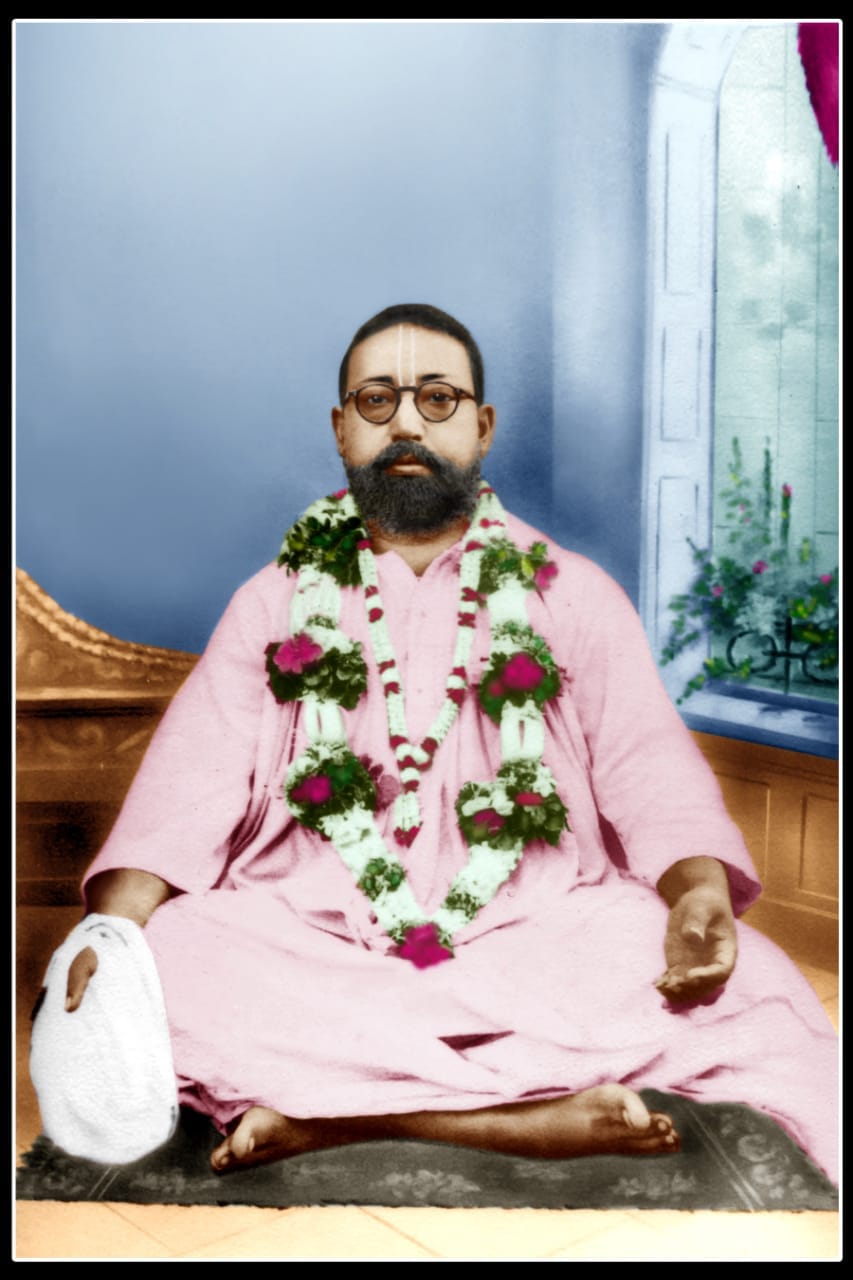
Selected Nectarean Advice of Śrī Śrīmad Bhakti Śrīrūpa Siddhānti Gosvāmī Mahārāja
1. Obtaining the shelter of the lotus feet of a genuine guru is, without a doubt, a matter of both great fortune and great dilemma for the baddha-jīva. If, however, a fortunate soul has a sincere longing and ardency to attain a true guru, he does so by the mercy of Śrī Kṛṣṇa.
2. The baddha-jīva is extremely insignificant; it is impossible for him to realize the magnitude of Śrī Guru.
3. One who, birth after birth, has accumulated bhakti-unmukhī-sukṛti, or spiritual merits leading to bhakti, will, in one birth, come face to face with the devotee of Śrī Kṛṣṇa, Śrī Guru, by Śrī Kṛṣṇa’s mercy. By the mercy of that kṛṣṇa-bhakta (Śrī Gurudeva), one hears kṛṣṇa-kathā from his mouth and gradually experiences the appearance of devotion in one’s heart. By the light of the sun, one sees the sun. Similarly, in the light of the sādhu’s mercy one can comprehend the sādhu’s svarūpa (eternal nature), and an acute hankering awakens to engage in hari-bhajana in the shelter of his lotus feet.
4. The sādhu mercifully gives mantra initiation (dīkṣā) and instructions (śikṣā) in the path of hari-bhajana to that sincere and surrendered person.
5. As a result of accepting the shelter of a sādhu’s lotus feet, a person performs hari-bhajana, and as he gradually becomes free from anarthas, he becomes cognizant of the nature of the transcendental reality.
6. Only a sādhu who knows the imports of all śāstras, who is devoted to Bhagavān and who is intent on bhajana, is a genuine guru. Those who speak in order to appease the fancies of the baddha-jīva’s mind and thus try to attract it are not worthy of the title guru; rather they are the jīva’s enemies. Never associate with them no matter how fond of their charming words you may be.
7. Know that the entirety of instructions given by the karmīs, jñānīs, yogīs, and pseudo-bhaktas to the jīva so he can obtain his own pleasure contains no message of eternal, supreme auspiciousness. The association of such persons is always to be rejected, no matter how enjoyable it is.
8. One cannot understand that the association of non-devotees brings utter inauspiciousness until, as a matter of fortune, one achieves the pure devotee’s mercy, which results from Śrī Kṛṣṇa’s grace.
9. The words of pure devotees are contrary to our sense gratification. No matter how pitiless and harsh their words may seem, if we can sincerely submit to them with our body, mind, and words, our eternal welfare is assured.
10. Mahā-bhāgavata Vaiṣṇavas are the eternal, dear associates of Gaura-Kṛṣṇa. If a jīva has not accumulated an unlimited amount of bhakti-unmukhī-sukṛti, the darśana and shelter of such Vaiṣṇavas does not come within the scope of his fortune.
11. Merely maintaining the arrogance that one has received the mercy of śuddha-bhaktas does not actually award that mercy or the position of being their disciple.
12. A genuine disciple is just as rare as a genuine guru.
13. Śrī Bhagavān, as antaryāmī, resides in the hearts of all. Since pure devotees are the antaryāmī of even Bhagavān, they can serve Him according to His internal desires and thus please Him. Thus they are known as bhagavat-preṣṭha. Even after becoming the genuine disciple of such a person, one must understand the inner desire of Śrī Gurudeva and serve him accordingly.
14. One cannot charm Śrī Gurudeva with a display of external emotions, gestures, and formalities. If one becomes a disciple without sincerely surrendering oneself at Śrī Gurudeva’s lotus feet, it is like trying to cheat a blacksmith regarding iron and one is bound to be cheated of his own welfare. (A blacksmith’s primary occupation is working with iron.)
15. Only at the time of Śrī Gurudeva’s disappearance can one recognize the actual identity of his disciples. One can then understand who has approached Śrī Guru with what intention.
16. Even after taking shelter of a sad-guru’s lotus feet, some disciples secretly strive to occupy the seat of Śrī Gurudeva at the time of his disappearance. Their acceptance of the shelter of Śrī Guru’s feet was merely deceit. They are, in fact, hostile and inimical to guru.
17. Moreover, some disciples try to misappropriate the opulence and paraphernalia intended for the service of Śrī Guru-Gaurāṅga. This is not understood while Śrī Gurudeva is still present, but after he has disappeared from this world, it assumes a terrible form. Know these disciples to be hypocrites, enjoyers, and offenders.
18. Even at the time of Śrī Gurudeva’s manifest presence, some try to control their godbrothers instead of regarding them as worshipable. Thus they become severe offenders of the Vaiṣṇavas.
19. Those who have been appointed to the position of temple-manager, but who do not serve in mutual cooperation with others and are reluctant to give due respect to their godbrothers, are sense enjoyers, that is, enjoyers of the maṭha. Instead of serving Bhagavān, they are greedy to enjoy His property. They are a disgrace to the title “disciple.”
20. Many, who are disciples in name only, even try to destroy the institution when Śrī Gurudeva disappears because the honor they receive decreases at that time. These people are most inimical to guru and most certainly condemned to hell.
21. Those disciples who deviate and engage in numerous acts of malice against Śrī Guru when he disappears were undoubtedly hidden deceivers at the time of his manifest presence.
22. Those in the stage of sādhana, who are not careful about obeying Śrī Guru and avoiding offences to Vaiṣṇavas, fall down even though they may have reached an elevated level.
23. Those who take shelter at the lotus feet of a sad-guru with a desire to do hari-bhajana should simple-heartedly follow Śrī Gurudeva’s instructions with their body, mind, and words. If they fail to drive extraneous desires from their hearts, the prohibited endeavors for karma and jñāna will present numerous deterrents to remaining on the path of śuddha-bhakti.
24. If the disciple’s heart is not clean, Śrī Guru’s heart does not reflect in it. Only out of immense fortune does the moon of bhakti that exists in the heart of Śrī Gurudeva, mahā-bhāgavata, manifest within the heart of the disciple.
25. A simple-hearted disciple, who desires his true benefit, practically never meets a bad end.
26. A disciple surrendered at the lotus feet of a sad-guru should always keep in mind the teachings from “Śrī Rūpa-śikṣā” in Śrī Caitanya-caritāmṛta. In this way, he should serve Śrī Guru without duplicity, and with utmost caution, he should cultivate the limbs of śravaṇa and kīrtana of śrī hari-kathā.
27. If the sādhaka’s life lacks simplicity and caution, he will achieve the opposite of his cherished ideal.
28. Among all the jīvas who are wandering throughout the universe, one who has accrued spiritual merit over many lifetimes obtains the seed of the creeper of bhakti, or śraddhā. This takes place when the jīva, by Kṛṣṇa’s mercy, is favored by His dear associates. Endowed with that śraddhā, the disciple as a gardener, plants that seed in his heart. He waters it by hearing and chanting the instructions flowing from the mouth of Śrī Gurudeva. Thus by these activities, the creeper sprouts and gradually climbs to the lotus feet of Śrī Kṛṣṇa.
29. That creeper of bhakti passes beyond this universe, and beyond the Virajā River, Brahma-loka, and Paravyoma, the spiritual sky, and goes to Goloka Vṛndāvana where it climbs the kalpa-vṛkṣa (wish-fulfilling tree) of Śrī Kṛṣṇa’s lotus feet. The gardener, still in this world, continues to irrigate the creeper with the water of śravaṇa and kīrtana and thus welcomes the fortune of tasting the fruit of prema.
30. If, in the stage of sādhana, innumerable weeds, such as the desire for enjoyment, liberation, material gain, worship, and fame grow, as well as the tendency to engage in prohibited behavior, cheating, violence, and so forth, then the main plant cannot grow. At the time of watering it, the sādhaka will first cautiously cut the weeds so that they don’t grow.
31. One fault can arise that is most detrimental to the bhakti-sādhaka. It is known as vaiṣṇava-aparādha, and it can either uproot or cut the creeper of devotion like a mad elephant uproots a plant. As a result, the creeper of devotion immediately dries up. Therefore, the sādhaka is to remain diligent to ensure this does not happen. If gurv-avajñā (disobeying guru) and vaiṣṇava-aparādha occur, all one’s sādhana-bhajana is destroyed.
32. I have instructed those who have taken shelter of me to always remain cautious in this regard. I have tried to the best of my ability to repeat the instructions of Śrī Śrī Mahāprabhu, His associates, and our Śrī Guru-varga. Nevertheless, those who remain inattentive and consequently not cautious about committing offences to great personalities or about uprooting the weeds cannot be helped. After I leave this body, none of you [my followers] should commit offences and thus act to cause even slight damage to the institution. If all of you cannot cooperate to perform hari-bhajana together according to my instructions, it is better that you either enter household life or move to a place of pilgrimage and perform hari-bhajana.
Published in Bengali by Śrī Saraswata Gauḍīya Āsana and Mission
From the Upadeśāmṛta of Śrī Śrīmad Bhakti Śrīrūpa Siddhānti Gosvāmī Mahārāja
Translated by the *Rays of The Harmonist team*
Published in English for the first time in *Rays of The Harmonist No. 16, Kārttika 2006