
Gaudiya Gosthipati Sri Srila Bhakti Siddhanta Sarasvati Gosvami Thakur Prabhupada
Srila Saraswati Thakur in his book of essays entitled Upākhyāneupadeśa, “Instructions in Stories”, Srila Bhaktisiddhanta Saraswati Thakur gives the following commentary on the story of Ekalavya.
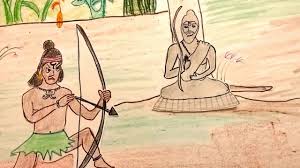
To many people, Ekalavya’s devotion to his guru is ideal, but there is a special consideration. What was Ekalavya’s fault? That should be considered. Wearing the mask of guru-bhakti, devotion to the guru, Ekalavya actually revolted against his guru. Whether his guru was actually considering him to be disqualified by birth in a low-class family, or was simply testing him — for whatever reason, when his gurudeva refused to teach him the art of Dhanur-veda [the scripture dealing with the science of warfare] it was Ekalavya’s duty to accept the instruction of his spiritual master. But Ekalavya did not like that. He wanted to become great. Externally, without a guru his work would not be considered bonafide, or perhaps it was not possible to become great without accepting a guru. It was with these considerations that Ekalavya formed an imaginary or clay material form of the guru. Actually, his main intention was to learn Dhanur-veda and become great. In this way he wanted to satisfy his own senses. He did not want to sacrifice himself to the will of his guru. That was not his honest desire.
Some may say that ultimately Ekalavya accepted the cruel order of his guru without a protest. But if we consider this issue more carefully and deeply we can see that Ekalavya considered mundane morality to be greater than transcendental devotion. It is a moral code that when the guru wants some dakshina one must offer it to him, and this sense of morality inspired Ekalavya to cut off his thumb. He did not offer it with spontaneous devotion. Otherwise he would have accepted the guru’s first order. The natural characteristic of devotion is that it is simple and spontaneous. If Ekalavya had unconditional and natural devotion for Hari, guru, and vaishnava, then the guru, Dronacarya, the best of vaishnavas, Arjuna, and Lord Hari, the Supreme Personality of Godhead Krishna, would not have been disappointed with his behavior.
Ekalavya’s endeavor to learn Dhanur-veda and his desire to become great were not accepted by his guru. In the core of Ekalavya’s heart, he desired to become better than the best of vaishnavas, Arjuna. The desire to become greater than the vaishnavas is not devotion. It is non-devotional, and this is the principle of the sahajiyā-sampradāya. By mundane consideration, this kind of desire to become great is a good desire. But devotion is the effort to remain behind and submissive to the vaishnavas. Ekalavya wanted his skill to be greater than that acquired by learning the Vedic wisdom directly from a bona fide spiritual master. By reporting Ekalavya’s skill to Drona, Arjuna showed Ekalavya his wrong approach to learning the Vedic science. If Arjuna had not mercifully pointed that out to him, then the glories of impersonalism would have prevailed. People would have created their imaginary, mundane, unconscious gurus, and learned different sciences and devotions, instead of approaching a bona fide guru. So Arjuna took care that such an atheistic principle was not established. Therefore, Arjuna was not envious of Ekalavya. It was actually a manifestation of his causeless mercy toward Ekalavya and the whole world. If Ekalavya had been an unalloyed devotee of his guru, then Krishna would not have destroyed such an earnest disciple. Krishna always protects His devotees. But finally Ekalavya was killed by the hand of Krishna.
Sri Chaitanya Mahaprabhu said that we cannot judge a devotee just by seeing his external austerities. The demons also perform austerities. Even demigods cannot perform austerities as much as the demons. [Cb. Madhya 23.46] Ekalavya wanted to become greater than a vaishnava, against his guru’s desire. That is why he was killed by Krishna and ultimately attained impersonal liberation. Only the demons are killed by Krishna. Devotees are always protected by Him. Hiranyakasipu and Prahlada are the proof. Therefore we should never try to become greater than vaishnavas and thus, wearing a mask of guru-bhakti, actually become impersonalists. That is what we should learn from the example of Ekalavya.
Proficiency in performing activities is not a symptom of devotion to the guru, or gurubhakti. Bhakti means to remain subordinate and submissive to the Lord’s loving servants, the vaishnavas.
Gaura Premanande HariHaribol