
Gauḍīya Goṣṭhī-pati Śrī Śrīla Bhaktisiddhānta Sarasvatī Gosvāmī Ṭhākura Prabhupāda said that – “We have no other duty than Kṛṣṇa-sevā.” But unfortunately, bonded jīvas discover countless other duties in their life, which are not at all related to their eternal svarūpa as nitya Kṛṣṇa-dāsa.
jīvera ‘svarūpa’ haya — kṛṣṇera ‘nitya-dāsa’
kṛṣṇera ‘taṭasthā-śakti’ ‘bhedābheda-prakāśa’
sūryāṁśa-kiraṇa, yaiche agni-jvālā-caya
svābhāvika kṛṣṇera tina-prakāra ‘śakti’ haya
(CC Madhya 20.108-109)
“It is the living entity’s constitutional position to be an eternal servant of Kṛṣṇa because she is the marginal energy of Kṛṣṇa and a manifestation simultaneously one with and different from the Lord, like a molecular particle of sunshine or fire. Kṛṣṇa has three varieties of energy.
At the time of India’s struggle for independence & political freedom, leaders like Netaji Subhas Chandra Bose and Mahatma Gandhi inspired many people to sacrifice their lives for the mission. Also around that same time another mission founded its roots in Bharat. It was the divine mission of Gauḍīya Maṭha. It was Gauḍīya Goṣṭhī-pati Śrī Śrīla Prabhupāda Bhaktisiddhanta Sarasvati Ṭhākura Prabhupāda who at the same time started to preach about absolute freedom and not just some temporary freedom as is proclaimed by those political leaders all the time.
bhidyate hṛdaya-granthiś
chidyante sarva-saṁśayāḥ
kṣīyante cāsya karmāṇi
mayi dṛṣṭe ’khilātmani (ŚB 11.20.30)
When the Supreme Lord, the all-pervading Self, is directly realized within the heart, the tightly bound knot of material attachment (hṛdaya-granthi) is cut asunder. All doubts (saṁśaya) are completely dispelled, and the chain of karmic reactions (karma-bandhana) is destroyed. In that divine vision of the Lord present everywhere (akhilātmani), the conditioned soul becomes freed from illusion and firmly situated in eternal service.
Śrīla Prabhupāda came to awaken the eternal constitution of the jivas. To remind all of us that the true suffering of the living entity lies not in solving any kind of political problem or social problem, but in the forgetfulness of Bhagavān.
vipado naiva vipadaḥ sampado naiva sampadaḥ
vipadaḥ vismaran viṣnoḥ sampadam nārāyana smṛtiḥ
(What we consider as) “danger” is actually not a danger, and (what we consider as) “prosperity” is actually not prosperity. Real danger is to forget Kṛṣṇa, and real prosperity is remembrance of Kṛṣṇa.
It is within this historical and philosophical background that the following remarkable meeting took place—a meeting that reveals, with absolute clarity, the difference between temporary duty and our eternal dharma (Sanatan dharma).
Gauḍīya Maṭha and the Freedom movement of the 1920s
(Excerpt from the book Prabhupāda Sarasvatī Ṭhākura, published by Mandala)
That fire that was burning in the hearts of the masses of India was the desire for freedom. On one hand was Mahatma Gandhi’s nonviolent movement for freedom. On the other hand was the more radical guerrilla group. There were little pockets of guerrilla resistance everywhere in India. The British government, which was very reluctant to give up India, “the jewel of the crown of the British empire,” was intimidated by both groups.
In Bengal one of the groups of guerrilla freedom fighters was called the “Anusilan Samiti” (Organization for the Cultivation of Freedom). Actually, “anusilan” means cultivation, but what was to be cultivated was not specified, for obvious reasons. Hundreds and thousands of young, educated, and talented men, with the support of their mothers, sisters, and wives, gave up their education, family life, and profession, and risked their lives to join one of these two movements: Mahatma Gandhi’s nonviolent movement or the guerrilla movement. If there was one desire that was shared by the whole nation, it was the desire for freedom from the British.
But Śrīla Prabhupāda wanted to preach about another kind of freedom which transcends any freedom of the mundane world: the freedom of the soul. While nationalistic leaders were preaching that it is the birthright of a nation to have freedom and sovereignty, Śrīla Prabhupāda was preaching that it is the birthright of every soul to seek freedom from material bondage and find its rightful place in the realm of eternity. The nationalistic leaders would argue that could wait, but Śrīla Prabhupāda insisted one should not waste one minute while reaching for the supreme goal of human life, because it can end at any moment.
“Srila Prabhupāda said—“First of all we have to know who we are. After that it will become very easy to find out what our foremost duty is. The only path to our eternal welfare is to serve the Lord and have His grace. The human birth is the root of devotional service. It is not possible to render devotional service in animal life. We all have to become free. But the state of freedom is nothing other than the state of cultivating Kṛṣṇa consciousness with the support of all our senses, being fixed in our real identity.” (Upadeśāmṛta by Srila Prabhupāda )
As one can imagine, it is easier to arouse the oppressed masses to seek political freedom than to arouse the soul to look for its eternal prospect. Yet many young men gave up the nationalistic movement and came to Śrīla Prabhupāda’s spiritual movement.
Śrīpād Vinoda Vihāri Prabhu was formerly a member of the secret organization called the Anusilan Samiti. He gave up his affiliation with it and joined Śrīla Prabhupāda’s movement, and so did a few others. But the British police remained very suspicious of their activities. So they sent undercover agents to the Gauḍīya Maṭh to spy on the activities of its members. One such undercover agent listened to Śrīla Prabhupāda’s lectures with rapt attention, and gave up his profession to become Śrīla Prabhupāda’s disciple. Before begging for Śrīla Prabhupāda’s mercy, he disclosed that he had come as a spy. He became Śrīpād Gaurendu Brahmachāri (later Śrīmad Bhakti Vardhana Sāgara Mahārāja).
After this incident, in 1924 or 1925, another very learned gentleman, Śrī Rāmenḍra Chandra Bhaṭṭācārya, who was not known to any of the devotees, began coming to the maṭh regularly. He would silently listen to Śrīla Prabhupāda’s lectures with rapt attention. One day Śrīpāda Pranavānanda Brahmacārī was giving a lecture when he arrived. One devotee, Śrīpāda Kīrtanānanda Brahmacārī, cautioned Śrīpāda Pranavānanda Prabhu about this gentleman. He said, “I have noticed that he does not ask anything, but listens to every word with rapt attention. He must be a spy.” Śrīpāda Kīrtanānanda Prabhu started keeping an eye on this gentleman. But it so happened that very soon Śrī Rāmenḍra Chandra Bhaṭṭācārya attracted Śrīla Prabhupāda’s attention. It was discovered that he was no spy, but in fact was formerly in Mahātmā Gandhi’s freedom movement. Śrīla Prabhupāda gave him initiation, and later named him Śrī Rāmananda Dāsa Brahmacārī. Within a few years he gave him sannyāsa, naming him Śrīmad Bhakti Rakṣak Śrīdhara Dev Goswāmī Mahārāja. Śrīla Prabhupāda was very fond of him, and so were his other disciples. Śrīmad Bhakti Rakṣaka Śrīdhara Dev Mahārāja was known for his extraordinary scholarship, his poetic talent, his powerful preaching, his saintly character, and his wholehearted dedication to serving his gurudeva.
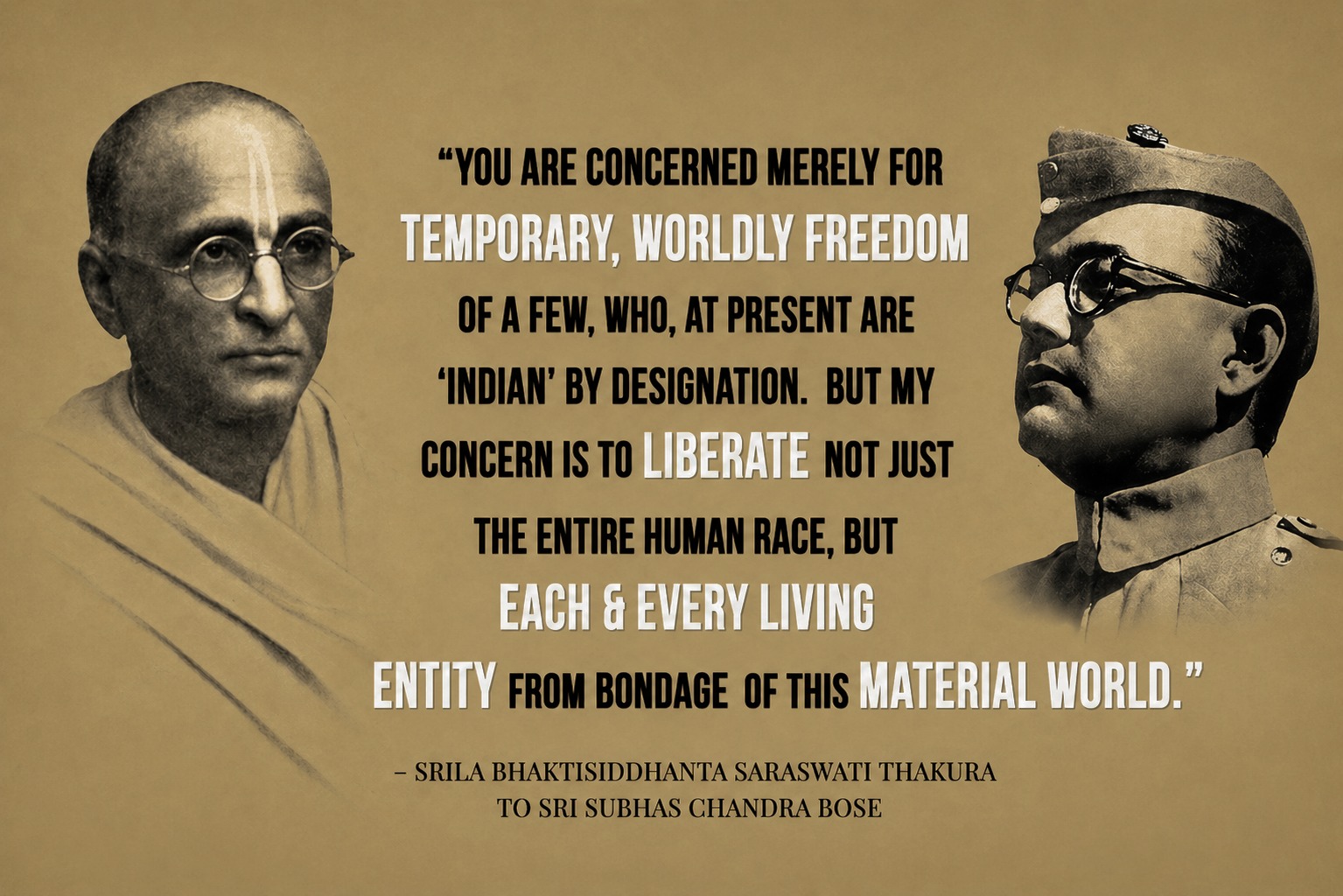
Many distinguished citizens of Calcutta admired Śrīla Prabhupāda’s unprecedented and extraordinary contribution to the Vaiṣṇava movement of Bengal. But not everyone shared their sentiment. The famous Bengali leader of the freedom movement, Netaji Subhāṣ Chandra Bose, complained to Śrīla Prabhupāda that he was diverting the attention of the youth from the freedom movement to his devotional mission. Śrīla Prabhupāda appeased him by saying, “These men are not so physically strong. They will not be of much use to you.” Of course, he did not think that Netāji would be interested in the concept of spiritual freedom at that moment.
Śrī Śrīmad Bhakti Vijñāna Bhāratī Gosvāmī Mahārāja also remembers—
My śikṣā-guru, Śrī Śrīmad Bhakti Śaraṇa Trivikrama Gosvāmī Mahārāja once related to me the account of when Śrī Subhas Chandra Bose, the famous freedom fighter of India, came to Śrī Gauḍīya Maṭha along with many distinguished personalities to meet Śrīla Prabhupāda Bhaktisiddhānta Sarasvatī Ṭhākura.
During their meeting, Śrī Subhas Chandra Bose told Śrīla Prabhupāda, “Having taken a vow to free our motherland from foreign rule, I have declared a slogan throughout the country: ‘Give me your blood and I promise you freedom.’ I have recently come to know that many young men have taken your shelter. Please entrust some of these men to me, so that they may fight for the freedom of this country.”
In reply, Śrīla Prabhupāda asked him, “Have you read Śrīmad Bhagavad-gītā?”
Śrī Subhas Chandra Bose replied, “Yes, I have.”
Śrīla Prabhupāda further inquired, “Do you remember this verse:
yaṁ yaṁ vāpi smaran bhāvaṁ
tyajaty ante kalevaram
taṁ tam evaiti kaunteya
sadā tad-bhāva-bhāvitaḥ
Śrīmad Bhagavad-gītā (8.6)
O son of Kuntī, without fail, a person attains the state of being he remembers at the time he gives up the body.
“Yes, certainly.”
“Then you must definitely believe in reincarnation.”
“Of course I do,” Śrī Subhas Chandra Bose answered. “Which Hindu in this world does not believe in reincarnation?”
Śrīla Prabhupāda then asked him, “If incidentally you happen to die today and are born in England in your next life, will you continue to fight for India’s freedom, or will you fight to maintain dominance over India?”
Śrī Subhas Chandra Bose replied, “I understand your point, but we must certainly think about the freedom of our motherland.”
To this, Śrīla Prabhupāda said, “You are concerned merely for the temporary, worldly freedom and liberation of a few persons who at the moment happen to possess the material designation of being Indian. I, however, am concerned about the liberation of not only the whole human race, but of every living entity in this world from the bondage of this material world.”
Śrī Subhas Chandra Bose replied, “I have never heard anything like this before. Before meeting you, nobody had ever described to me such meaningful explanations of the teachings of the Gītā. But I fear I have come a bit too far in my struggle for freedom to look back.” Saying this, Śrī Subhas Chandra Bose left the maṭha without making any further requests for Śrīla Prabhupāda to provide him with men to fight for India’s independence. (Excerpts taken from Viśuddha Caitanya Vāṇī)
In this way we can clearly see the contrast between deha-dharma and ātmā-dharma. Srila Prabhupāda wanted to clarify this point in front of Netaji Subhas Chandra Bose. What is the real value of freedom that can finish with the body, whereas the soul remains in bonded condition and forgeting Bhagavān? All our body dharma, social dharma, etc. changes like the seasons during the year, no stability at all. That’s why at each and every step we must always ask ourselves — Are we actually seeking the ultimate mangal of our soul, or seeking only some external change in the circumstances in which we are put into in this temporary material world?
Srila Sadananda Svami used to say that—“Many are allured by the charming picture of an utopian society, each member of which wants to serve the other – in reality to secure the proper means of the utmost degrees of aversion to the service of Krishna consisting in the desire to make this ephemeral world, at least temporarily, a place of enjoyment by the maximum elimination of the obstacles which stand in the way of such enjoyment. It is Maya in her most deluding form who comes to make men believe that it is worthwhile to fight for a homely samsara.” (Excerpt from the article –‘The Bhakta in the Age of Discord’)
Below you can find one Excerpt from the book Viśuddha Caitanya Vāṇī by Śrī Śrīmad Bhakti Vijñāna Bhāratī Gosvāmī Mahārāja —
In symbolically addressing his own mind in Manaḥ-śikṣā (7), Śrīla Raghunātha dāsaGosvāmī has advised us to always render sincere devotional service to the most beloved commanders of the army of Śrīman Mahāprabhu:
pratiṣṭhāśā dhṛṣṭā śvapaca-ramaṇī me hṛdi naṭet
kathaṁ sādhu-premā spṛśati śucir etan nanu manaḥ
sadā tvaṁ sevasva prabhu-dayita-sāmantam atulaṁ
yathā tāṁ niṣkāśya tvaritam iha taṁ veśayati saḥ
O mind, how can pure divine love appear in my heart as long as the shameless dog-eating, outcaste woman of the desire for prestige is audaciously dancing there? Therefore, always remember and serve the immeasurably powerful commanders of the army of Śrī Kṛṣṇa, the beloved devotees of the Lord. They will at once banish this outcaste woman and initiate the flow of immaculate vraja-prema in your heart.
Those intimate associates of Śrīman Mahāprabhu consider the Lord to be extremely dear like their own heart, more so than their own lives. The depth of their faith in His words and instructions have a magical effect in their life that they live strictly according to the principles He practiced and preached. Śrīman Mahāprabhu personally sent those great personalities to this planet, specifically for the absolute mangal of those fallen conditioned souls like us.
At Śrī Navadvīpa-dhāma, Śrīman Mahāprabhu gave His first marching orders to His commanders Śrī Nityānanda Prabhu and Śrīla Haridāsa Ṭhākura:
śunô śunô nityānanda, śunô haridāsa
sarvatra āmāra ājñā karahô prakāśa
prati ghare ghare giyā karô ei bhikṣā
‘bôlô kṛṣṇa, bhajô kṛṣṇa, karô kṛṣṇa-sikṣā’
ihā bai āra nā bôlibā, bôlāi
bādina-avasāne āsi’ āmāre kahibā
Śrī Caitanya-bhāgavata (Madhya-khaṇḍa 13.8-10)
The Lord said, “O Nityānanda! O Haridāsa!Listen. Make My command known everywhere. Go from house to house and beg from all the residents in the following way: ‘Chant Kṛṣṇa’s name, serve Kṛṣṇa, and learn about Kṛṣṇa!’ ” Here, ‘learn about Kṛṣṇa’ refers to the teachings spoken by Śrī Kṛṣṇa to Arjuna, Uddhava, the Vrajavāsīs and others, as well as the words spoken about Kṛṣṇa by Śrī Brahmā, Śukadeva Gosvāmī, Bilvamaṅgala Ṭhākura, Jayadeva Gosvāmī and others.
Śrīman Mahāprabhu continued, “Do not speak or cause anyone to speak about anything other than Kṛṣṇa. At the end of the day, return here and report to Me all that happened.”
Just like a king, Śrīman Mahāprabhu wanted to expand His kingdom, and He therefore expressed his desire to His commanders Śrī Nityānanda Prabhu and Śrī Haridāsa Ṭhākura to conquer the empire of māyā, or the illusory potency of Bhagavān, and to make those residents of this jagat free of Maya.
It is the duty of an army commander to defeat the enemy to protect and expand the boundaries of the country concerned. Śrī Nityānanda Prabhu, the foremost commander of Śrīman Mahāprabhu’s army group, who was always ready to take life risk for the propagation of the divine message of Sriman Mahaprabhu to deliver all those fallen souls even if they are most sinful persons like the drunkards Jagāī and Mādhāī. It was the divine feeling of Śrī Nityānanda Prabhu that I must carry out the order of my prabhu according to His instruction to deliver all fallen souls. Why should they be left out?
Śrīla Raghunātha dāsa Gosvāmī has referred to these commanders of Śrīman Mahāprabhu as atulam, or incomparable. They possess unparalleled powers and can exhibit a supreme might that can transform even the most sinful persons into not only ordinary devotees, but into a mahā-bhāgavatas, or the topmost self-realized devotees of the Lord, fully capable of rendering the highest welfare to other living entities. It is only by the causeless mercy of Śrī Nityānanda Prabhu that Jagāī and Madhāī received the mercy of Śrīman Mahāprabhu:
brahmāra durlabha āji e dõhāre dibô
e dõhāre jagatera uttama kôribô
e dui-paraśe ĵe kôrilô gaṅgā-snāna
e dõhāre bôlibe se gaṅgāra samāna
nityānanda-pratijñā anyathā nāhi haya
nityānanda-icchā ei jānihô niścaya
Śrī Caitanya-bhāgavata (Madhya khaṇḍa 13.232-34)
Śrī Caitanya Mahāprabhu said to the assembled devotees, “Today I shall reward Jagāī and Mādhāī with a benediction that is rare even for Śrī Brahmā to attain. I shall make them the most honorable devotees in the world. All those who would normally take bath in the Gaṅgā after touching them, will now say that these two men are as pure as the Gaṅgā herself. A promise or vow made by Śrī Nityānanda Prabhu can never go unfulfilled. Please know for certain that all this has happened solely because of Śrī Nityānanda’s desire.”
Those soldiers they are able to tolerate any kind of hardships for the protection of their country. They perform their duties even in the midst of most hostile conditions, such as freezing cold regions covered in snow. Sometimes they lack adequate food supplies and also they can feel separation from their loved ones. In the same manner, the army group of Śrīman Mahāprabhu can accept all different problems and can face any kind of eventualities to fulfil His most cherished desire to propagate Nama-sankirtan all over the world to arrange full protection of śuddha-bhakti to nullify the attack of those dangerous demons.
Gaura Hari Hari Bol