
(Into English, with bold letters and within square brackets: Kid Samuelsson; last changed 2.7.19..)
[…] Here [in the rasa-lila chapters of the Bhagavatam] we are given an insight into the nature of the lila and what service on the highest stage of prema in the circle of His eternal gopi-bhakta-s actually are – a form of service which is most exciting and incessantly intensified. This lila fills many persons with horror, even those who are bhakta-s of the Fullness of majesty and omnipotence [Narayana], and it is an indescribable and inconceivable wonder for everyone, yes, a wonder to Krishna Himself.
Don’t forget that not only Krishna Himself is boundless and incapable of ever coming to an end of Himself, this also concerns the highest form of His Own shakti or potency, in the form of the formless potency [yogamaya] that shapes the lila and flows through the eternal co-players as [serving] love – or in the eternal form of Radha or Her female friends. Here we have service in extreme insecurity, without the awareness that Krishna is [also] the almighty Lord of all majesty [Narayana], and the feeling: what could happen to us? Here is the Fullness of loveliness [and exhilaration, i.e. Vraja-Krishna] – the service of Whom makes one forget, be confused, bewildered and hypnotized, so that it is not certain for a moment what is going to happen in the next moment – and a constant concern for His sake, He Who does nothing but play in complete exhilaration, heedless of Himself and the consequences.
It is perfectly clear that there are only a few, very few, who are capable of understanding even a fragment of these things. Therefore, apart from moments when Mahaprabhu was not aware of the world, He never uttered a word of these things or sang of them before all groups of bhakta-s, only within the most intimate circle of the bhakta-s who belong to the gopi-lila in the fifth rasa of Krishna’s lila.
Many, even the greatest bhakta-s of Dvaraka-Krishna, Rama, Narayana etc. are completely helpless when it comes to these things. Parvati was helpless already when it came to Rama’s lila. This serving in greatest agitation and excitement in the realm of loveliness and exhilaration, and even more when this realm manifests on earth, when the agitation and excitement intensify even more, to an exceptional degree, requires a particular, singular form of Divine Grace.
It is extremely rare that a human being in this world is seized by these forms of service and then – while following God’s commands concerning the indirect form of service – is eager, once in a future life, to receive the Grace of longing for the will to serve these Krishna-gopi-s, who serve in extreme excitement and tension. But even when this Grace is not present, one must try to describe these things faithfully, as they are described [in the Word Revelation] – even though they are unattainable, i.e. are beyond every possibility to be worthy of them.
In the Gita and the Bhagavatam you hear how few bhakta-s there are even of Narayana. Then you can imagine how few bhakta-s there are of this wildly exhilarated playful God of loveliness. In India it is hard to find even bhakti to Narayana. Where is real bhakti to Krishna to be found then?
Who wants to listen to what service in the highest sense truly means, must attentively listen to what is here said about the gopi-s’ service, which, according to Krishna’s Own words, simply invalidates His Own promise that He shall respond to everyone’s seva in the same way as He is being served. […]
What is tangibly described here is the acme of service through the greatest bhakta-s of the eternal realm; in these verses they serve with thoughts, arguments, rhetoric, despair, humility, with a certainty without bewilderment – in every moment a new wave of serving, in every moment a new wave of reaction to the situation of the lila, to a word, to an intimation.
If you could convey some of this to the reader, so that he, in reverence, is amazed by this inaccessible realm of actual, fully alive and tangible service here in Vraja, so that he is struck by horror, then someone who is gifted can realize that those who have told him about Indian wisdom and “mysticism” have been cheating him out of the very best. Maybe there is some fool among the readers who becomes as enthusiastic as I over this truly great service and to whom all other religion, even the bhakti to Narayana becomes totally uninteresting, not to mention the wisdom of atma and [the formless] Brahma. The religions outside of the authority of the Word Revelation remain merely human. They give nothing but vague suggestions of the existence of something like God, and are therefore not in the least interesting.
If you don’t thoroughly reflect upon what has been said above, you cannot understand some of the Gosvami-s’ distaste for the mere thought of Narayana, because of the security of service that is prevalent in His realm. I don’t know if I will have the strength to check and correct these hastily composed lines [of mine]. It often seems to me that my breath is taken away so that I do not say or write anything about these things, as if it were not the will of Krishna – yet I have no choice. The whole body is a wild hammering of pain. Stooping, I type these pages so that, if they get lost, the copy can be sent. I am simply obliged to give you all that is needed for your understanding, and all the more as you cannot free yourself from the influences of your mind. Thus I have to explain it clearly two, three times. I don’t know for how long I will be alive, and you, over there. But it is important that you understand these things correctly and that you have an idea of what is going on so that you do not have to start with the ABC again in the next life. Don’t be frightened by the thought of having to come back to earth again! It is agonizing in this yuga [age] and yet a joy. And the more one serves with His power of serving [bhakti-shakti], the more one forgets that this service with the greatest opposition truly is joy, because it is not service for the sake of one’s own happiness. […]
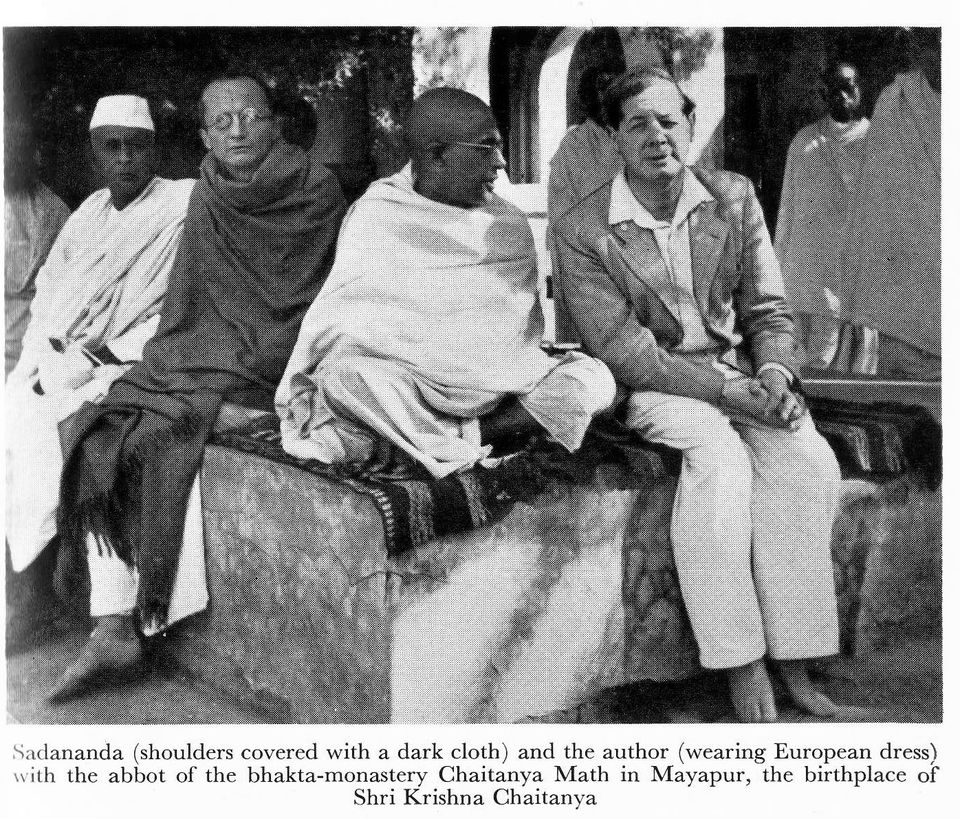
(Sadananda, Corrections, page 222 ff.)