
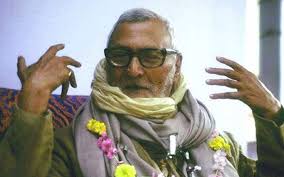
From the book Heart and Halo
By His Divine Grace Śrīla Bhakti Rakṣaka Śrīdhara Deva-Goswāmī Mahārāja
“In Gaura-līlā, Gadādhara Paṇḍita is holding the helm. Everything belongs to him, still he has to admit he’s dispossessed, that Gaurāṅga has taken everything! He is exhaustively dedicated to Gaurāṅga. So Śrīla Kavirāja Goswāmī says, ‘Teṅho Lakṣmī-rūpa, tāṅra sama keha nāi’: he represents the main potency of Gaurāṅga, and no one is to be compared with him. This is the conclusion of Śrīla Kavirāja Goswāmī about Śrī Gadādhara. He is Gaura-prema-maya, the embodiment of Śrī Gaura’s love.
Gadādhara Dāsa represents the halo of Rādhārāṇī, but Gadādhara Paṇḍita represents Her mood, Her nature—Her heart. It is as if Mahāprabhu has taken away Gadādhara Paṇḍita’s soul, and the body is still standing! That is the position of Gadādhara Paṇḍita. He is quite empty, and following Mahāprabhu. He is not full in himself. Something, the most important thing, his heart, has been taken by Mahāprabhu, so he has no other alternative but to follow Him. He is wholly given to Mahāprabhu. Gadādhara Paṇḍita’s position, the part he played, was something like that of Rādhārāṇī, Her heart stolen by Kṛṣṇa, the empty body still standing.
Rādhā-bhāva-dyuti-suvalitaṁ naumi Kṛṣṇa-svarūpam: He was fully engrossed in the conception of Śrī Gaurāṅga. Gaurāṅga had taken everything from him, so he had no other alternative. He was fully engrossed, captured completely by Him.
We find his activity throughout his whole life was like this. Of the other devotees, some were ordered to go to Vṛndāvana, and some were allowed to go there, but though Gadādhara Paṇḍita wanted to visit Vṛndāvana with Mahāprabhu Himself, he was denied: “No, you won’t go.” When Jagadānanda Paṇḍita asked to go there, Mahāprabhu, with hesitation, granted him permission, “Yes, go there, but move always under the guidance of Rūpa and Sanātana.” He also gave him some special instructions: “Do this, and this, and don’t do that.” But Gadādhara Paṇḍita was not allowed to go there.
He was the representation of Śrīmatī Rādhārāṇī Herself, yet his peculiar position was such: the Queen of Vṛndāvana, but now transferred to Navadvīpa. His position had become just the opposite; he could not enter Vṛndāvana! He prayed for permission, but Mahāprabhu did not give it. He said, “No, stay and live here.” And he had to do so. Śrī Gadādhara Paṇḍita represents the predominated moiety of the Whole. The Whole consists of predominating and predominated moieties, and he represents the predominated half. He is one half of the Absolute Truth.
In the teachings of Śrīla Bhaktivinoda Ṭhākura, whose preaching was inspired by Śrī Gadādhara Paṇḍita and Śrīmān Mahāprabhu, we also find all the substance that is present in that plane of vibration. These two personalities, Śrī Gadādhara Paṇḍita and Śrīla Bhaktivinoda Ṭhākura, are our great Gurus, our guides, and by offering our worship to them we can sow the seed of our highest benefit. By the grace of that great Guru Mahārāja, Bhakti Siddhānta Sarasvatī Goswāmī Prabhupāda, we have been able to understand this.
And Bhaktivinoda Ṭhākura, though generally he has his own position, as understood from the consideration of the disciple, Prabhupāda Bhakti Siddhānta Sarasvatī Ṭhākura has seen Śrīmatī Rādhārāṇī in him: a “relative” vision. He once said that Rādhārāṇī represents the full play of aṣṭa-nāyikā, the eight characteristics of the heroine, and we see that they are all perfectly represented in Her. In other places we may find partial representations of them, but we find them fully manifest only in Her.
He said, “I see my Gurudeva as Guṇa Mañjarī, and in that mañjarī form he has some partial representation of Rādhārāṇī. But if I attempt to look more deeply, I find him identified fully with Her. The eight kinds of qualities displayed in the service of Kṛṣṇa (aṣṭa-nāyikā) are to be found there. If I look at him with my head a little more erect, I can see that he is one with Rādhārāṇī. Ācāryaṁ māṁ vijānīyāt: know the Ācārya as Myself. If I give more attention to this śāstric rule and try to search out the meaning, I find that Rādhārāṇī comes to take Her place there, in the position of my Gurudeva.” In this way he has seen in Bhaktivinoda Ṭhākura the fullest representation of the cult of Śrī Gaurāṅga.
This realization is expressed in his poem where he says that he saw Svarūpa Dāmodara Goswāmī in Gaura Kiśora Dāsa Bābājī, and Śrī Gadādhara Paṇḍita in Śrīla Bhaktivinoda Ṭhākura. In one place he has written, “Gadādhara-dina dhari’ pāiyāchche Gaurahari.” He has accepted the day of the disappearance of Śrīla Bhaktivinoda Ṭhākura to be identified with that of Śrī Gadādhara Paṇḍita. In another place, in his poem at the conclusion of his Śrī Caitanya-caritāmṛta commentary, he has written: “Here, in Navadvīpa Dhāma, the eternal Pastimes are going on continuously. Only those who have got that deep vision can perceive it.
gadādhara mitra-vara, śrī svarūpa dāmodara
sadā kāla gaura-kṛṣṇa yaje
jagatera dekhi’ kleśa, dhariyā bhikṣuka-veśa
aharahaḥ kṛṣṇa-nāma bhaje
śrī-gaura-icchāya dui, mahimā ki kaba mui
aprākṛta-pāriṣada-kathā
prakaṭa haiyā seve, kṛṣṇa-gaurābhinna-deve
aprakāśya kathā yathā tathā
He says, “It is very difficult to perceive the sweet will of Śrī Gaurāṅga, but if we can lift ourselves to that level, we see that Svarūpa Dāmodara Goswāmī and Śrī Gadādhara Paṇḍita are always engaged in their service here in Navadvīpa. Sometimes it is suppressed, and sometimes it is appearing on the surface. In that plane all is going on by the sweet will of Śrī Gaurāṅga, without any restriction. But now I find that those two have appeared on the surface as Śrīla Gaura Kiśora Dāsa Bābājī and Śrīla Bhaktivinoda Ṭhākura. I have seen it with my own eye of divine service, but this is not to be advertised, not to be given publicity anywhere and everywhere. People will laugh at it. But this is my heartfelt conclusion.” He has written this in his poem concluding Śrī Caitanya-caritāmṛta.
So Gadādhara Paṇḍita was identified with Śrīla Bhaktivinoda Ṭhākura. That was the vision of our Gurudeva, Śrīla Bhakti Siddhānta Sarasvatī Ṭhākura. He could see in them the same identity. He considered śikṣā-guru-paramparā to be the most substantial thing. Eliminating the sahajiyāvāda, which gives much importance to the outer cover, try to look within, and see things more deeply. Try to understand the deeper vibrations of the outside environment, and see within yourself also. Dive deep, and you will find the plane of the finest vibration which will carry that news to you, and you will see that truth.”