
All glories to Śrī Śrī Guru-Gaurāṅga.
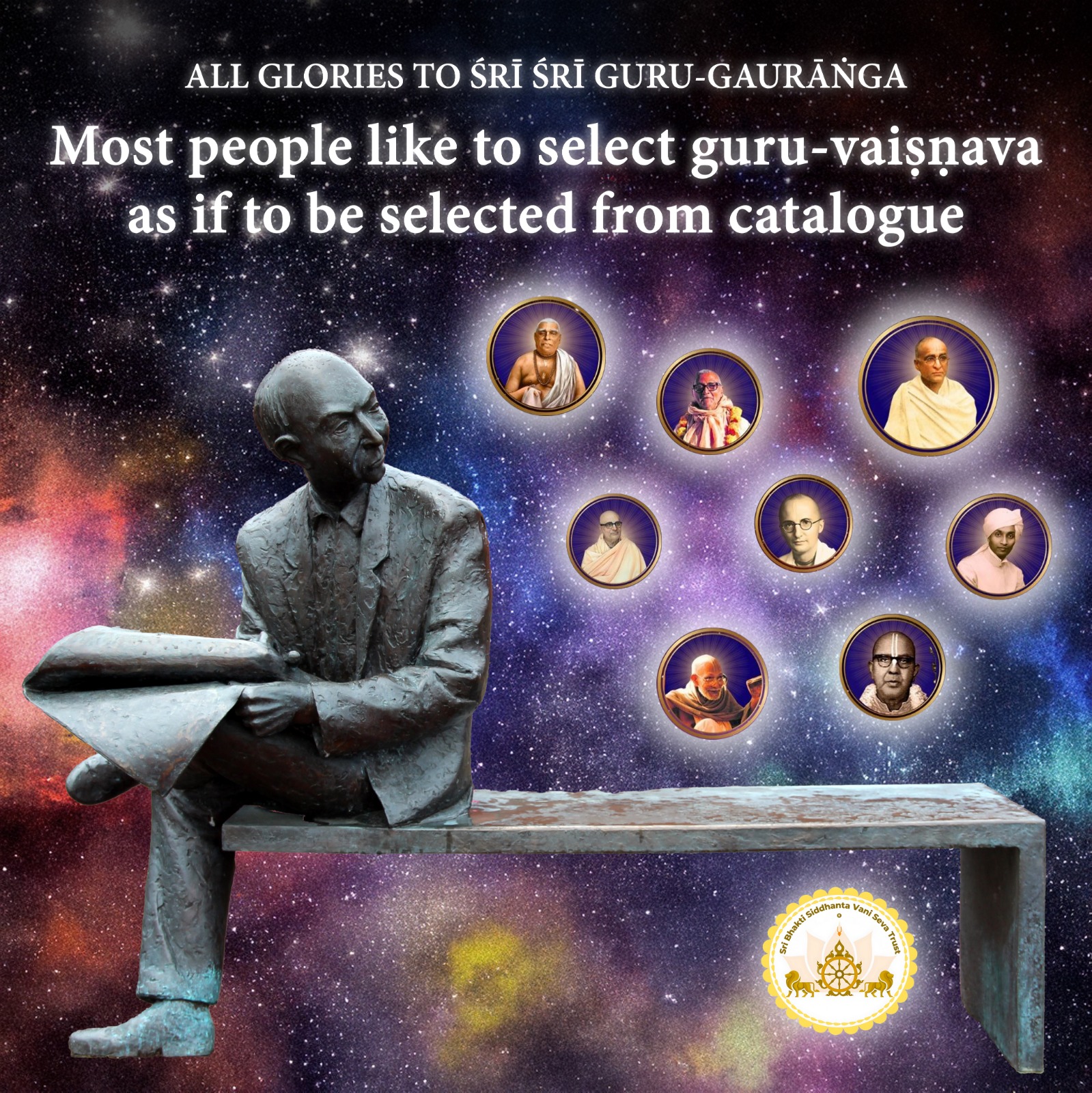
Most people like to select guru-vaiṣṇava as if to be selected from catalogue
Date 09.02.2025
By Sampradāya-saṁrakṣaka Śrī Śyām Dās Bābā Mahārāj
Gauḍīya-goṣṭhī-pati Śrī Śrīla Bhaktisiddhānta Sarasvatī Gosvāmī Ṭhākura Prabhupāda has said that that–“When we want to apply material logical interpretation, then Guru-Vaiṣṇava tattva becomes vanished.”
Svāmī Sadananda Dāsa used to say that–“Often, used in a purely negative sense, māyā is another term for enchantment or mental confusion, ignorance (moha). Māyā gives the impression that the world she supplies is independent, that there is nothing beyond her. She makes the living being believe that it is his true nature to strive for happiness, either by intensifying his ‘I’ or by radically dissolving it. In this sense she is thus the tendency, the attitude of measuring — anayā mīyate iti māyā. She is the power through which the living being measures and estimates everything he meets — internally or externally — by the measure of its potential to sustain and to intensify the happiness of his selfish ‘I’; the attitude that deprives everything in this world — the inner and outer — of its own nature, and makes it an object of his own valuation and his own enjoyment.”
The Prabhupāda said that – “We must first go out of the influence of material attraction or repulsion.”
Within this material plane, all conditioned souls are entangled in Maya. We are feeling attraction for any particular object (or for any man or woman), whereas feeling repulsion for the other object (or for any man or woman). What is attractive for me, – maybe someone can feel repulsion for that. This entire question of likes and dislikes is nothing but the reaction of one’s previous saṁskāras. Bhagavān has arranged all different varieties within this material world. Those who are having sattva-guṇa as a predominating factor in their lives – naturally they are seeking sāttvik-accosiation. Similarly the case is applicable for rajo-guṇa or tamo-guṇa also.
rajas-tamaḥ-prakṛtayaḥ sama-śīlā bhajanti vai
pitṛ-bhūta-prajeśādīn śriyaiśvarya-prajepsavaḥ (SB. 1.2.27)
Those who are desirous of progeny, dominion, and hoarded wealth—being driven by the lower currents of rajas and tamas—resort to worship befitting their own polluted inclinations. Thus they bow before the pitṛs, before Śiva, before Brahmā and others, each in correspondence with their contaminated aspiration.
It is only those who are either knowingly or unknowingly have accumulated a lot of sukriti in their previous life or in this life, they can transcend the defective calculations of mundane attraction and repulsion. All three guṇas (sattva, rajas, tamas) are nothing but the illusory play of the material world. Therefore Śrī Kṛṣṇa revealsin the Gītā that beyond these flickering stages of the material energy, there lies a superior principle — His own higher energy.
bhūmir āpo ’nalo vāyuḥ
khaṁ mano buddhir eva ca
ahaṅkāra itīyaṁ me
bhinnā prakṛtir aṣṭadhā (Bg. 7.4)
“Earth, water, fire, air, ether, mind, intelligence and false ego — all together these eight constitute My separated material energies.”
This is the inferior manifestation, the aparā-prakṛti. But Sri Kṛṣṇa does not end here. He makes the distinction clear:
apareyam itas tv anyāṁ
prakṛtiṁ viddhi me parām
jīva-bhūtāṁ mahā-bāho
yayedaṁ dhāryate jagat (Bg. 7.5)
“Besides these, O mighty-armed Arjuna, there is another, superior energy of Mine — the living entities themselves, who are sustaining and exploiting the resources of this material, inferior nature.”
Thus, the jīva is not a product of prakṛti’s deluding modes of nature. The jīva belongs to the parā-prakriti (taṭasthā-śakti) of the Supreme Lord. But by falsely identifying herself driven by sattva-rajas-tamas, the jiva is dragged into bondage and misled to imagine herself a citizen of this material word.
Although Śrī Kṛṣṇa declares that jīvas are part of His superior nature, it is extremely rare within this world to find a person who is truly free from the bondage of māyā. Until & unless we ascend to the plane of viśuddha-sattva—which is completely beyond the three modes of material nature—we become compelled to see or measure everything through the distorted lenses provided by māyā devi, driven by the three modes of nature — sattva, rajas, or tamas.
Therefore, even when a pure sādhu descends into this material world, our experience about him is filtered through the contaminated state of our own consciousness — based on sattva, rajas or tamas. It is for this reason sādhu-guru-śāstra repeatedly cautions us – ‘Never try to judge guru-vaiṣṇava by the help of your material senses’. Śrīla Prabhupāda many times told that–“We cannot give the responsibility of the judgment of who is a vaiṣṇava and who is not into the hands of those demons (materially motivated people).”
Vaiṣṇavas cannot be measured through the scales of mundane virtue or worldly recognition, because pure guru-vaiṣṇavas they are beyond material limit. Until & unless we are ready to throw away our calculative mood (I mean logical interpretation) and instead surrender completely to pure guru-vaiṣṇavas, we shall remain blind forever. Srila Prabhupada very often used to say—“Guru-Vaishnava can reserve the right of not being exposed to our material sense organs.”
Srila Prabhupāda used to say that there are different kinds of gurus—”The guru of the demons, Śukrācārya, was the guru of the material senses. Those who are in the service of the senses are like demons. The guru of the demigods is Bṛhaspati, the guru of the intellect. But only Kṛṣṇa is the guru of the pure soul, for He alone is the guru of the transcendental world.”
Here Prabhupāda is saying that Śukrācārya represents that type of guru who puts more fuel to the senses and material desires of his so-called disciples. Śukrācārya disciples are all demons looking after power and enjoyment, and his guidance was aligned with those goals. And Bṛhaspati represents the guru of the intellect; in this way he guides all towards piety and heavenly pleasures. But Sri Kṛṣṇa is the Jagad-guru, the guru of the entire universe, who alone can guide the pure soul toward its eternal relationship with the Supreme.
Most of the people like to select guru-vaiṣṇava as if to be selected from catalogue. They always like to choice Guru-Vaisnava according their whimsical nature. A person dominated by rajas can feel attraction for such a guru of the same nature. One may be inclined toward social affairs, so naturally he can prefer to accept such a guru who is having this kind of nature. A sāttvik person naturally prefers a guru who is leading peaceful sāttvik life. Again if one searches for a Guru through the lens of tamas, then for him such a guru who is indulging in all tamasik activities like intoxication, or illicit relationships may appear suitable.
For all these reasons, it is never possible for anyone enwrapped in the snares of the three guṇas to pass a clear judgment about pure Guru-Vaiṣṇava. Only a pure Vaiṣṇava can truly recognize another pure Vaiṣṇava. It is only when one looks through the lens (eyeglasses) provided by pure Guru-Vaiṣṇava, that he can see the Vani- svarupa. That is the reason for why Śrīla Prabhupāda repeatedly wanted to advise us in the following way– “Guru-Vaiṣṇavas are the transcendental medium through which we can see what is what in the transcendental world.” Everything should start with service mood backed by hearing mood, so that – ultimately that hearing mood can be converted into bhakti. And after that through bhakti-śakti we can get entry into apprakrita visaya.
Śrīla Sadananda Svāmī wrote that—“Never forget that it is impossible to experience Kṛṣṇa through the eyes. He must come into the heart through the ear. First we must listen—and bhakti only is the power to hear and understand the meaning of what one hears. And the first we hear is that God by no means is what our mentality expects. He is totally different! He completely withdraws when we have the slightest tinge of the wish to experience from our side, but He becomes completely submissive when we only want His sevā without being the least aware of our own selves.” (Letter 1955)
Only by hearing without sevā mood bhakti-devī can never be attracted. So śravaṇam kirtan and sevā both should go parallel.
Śrīla Bhakti Vijñān Bharati Gosvāmī Mahārāj used to give one nice example. He used to say that any Āyurvedic medicine works best only when it is complemented with the recommended anupāna. He used to tell the following story—“Once, the Nawāb of Ḍhākā was suffering with an extreme condition in which his whole body was burning like fire. He tried all allopathic medicines to no avail. So he came to consult Śyāmadāsa Kavirāja in Kolkata. The kavirāja felt his pulse and said, “I cannot treat you because it is difficult to find the specific anupāna.” He was very disappointed and was returning by the boat in which he had travelled there when he noticed a poisonous snake drinking rainwater that had collected in a skull. As his companions were asleep, he stepped out to drink the water from the skull [thinking, ‘Even if I die by drinking this, it doesn’t matter. It is better to die than suffer like this.’]. But soon, he felt some relief from the burning sensation in his body. So he returned to the kavirāja, who told him, “Now I can treat you and you can be cured because you have taken the appropriate anupāna. If any poisonous snake drinks rainwater accumulated in the skull of a man who has recently passed away, and if such leftover water is consumed, only then my medicine will work [for your specific health condition].” That Nawāb of Ḍhākā was eventually cured and he built a two-storied house for Śyāmadāsa Kavirāja and cited how effective his treatment was. He also instituted a hospital by the name – Aṣṭāṅga Āyurvedic Hospital.”
Also Śrīla Sadananda Svāmī somewhere else wrote that—“One must have the truly genuine love for God, the will to serve, and then only, and to the degree one has this love, one becomes capable of understanding the secret meaning of the līlā; consequently, the exact opposite of a mere romantic wallowing in emotions, where one tries to exploit God and His līlā for the sake of one’s own joy. It is obvious that this ecstatic, loving service is completely spiritual [cit], because Kṛṣṇa has already said that the very first stage of the will to serve, śraddhā, the firm conviction that serving God is the eternal meaning of life, is transcendent. One simply cannot read the Bhāgavatam or the works of the Gosvāmīs like one reads a mundane poem, with the same māyīc-selfish attitude – the only difference being that God is the subject. It is more than a coincidence that the word ‘sūśrūṣu’ means the following two things: ‘To be willing to listen and to serve’. To listen does not mean merely to hear, but to obey-sevā; both inseparably united. But all of you want to hear – not obey, not let yourself be instructed by the śāstras, not put aside what you think of God, the world and bhakti, etc. You want to adhere to what you feel and think, based on what you keep in your māyīc hearts. You want to keep this. Why does Kṛṣṇa forbid Uddhava and Arjuna to pass on the instructions they have got to non-bhaktas, to those who don’t want to serve? For selfish reasons? – No, because those who don’t want to serve are incapable of understanding what is said, actually cannot hear what is said at all.”
So in this way, it is only that divine combination of śravaṇam and sevā that gradually one can understand the inner meaning of śāstra-Guru-Vaiṣṇava.
Gaura Hari Hari Bol