
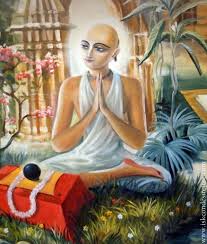
(The Harmonist or Sree Sajjanatoshani VOL.XXXVIII. No.11, By Sj. Kisori mohan Paul B. L.)
The province of Dravida is one of the holiest lands of India. She is literally the mother of jewels in every sense just as Sri Gaur Sundar, Embodiment of magnanimity by manifesting Himself with His realm and paraphernalia sanctified the country of Gauda (Bengal) which has since become the objective of pilgrimage, so the Vaishnava acharyyas who are founders of the four Vaishnava sects, by appearing in the province of Dravida scattered broadcast the rays of devotional service throughout the world.
Eternal and everlasting by its nature the principle of transcendental devotion first of all dawned upon this world to the mind of Vedavyas in its exclusive state, in the grassy land of Brahmmabarta on the bank of the Saraswati and passed through the stages of infancy and boyhood on the holy plains of the Naimisha forest on the bank of the Gomati.
By the fostering service of the four founder-acharyyas, the process manifested its adolescence on the banks of the holy streams of the province of Dravidif finally displaying its full maturity on the bank of the most sacred Ganges, in the town of Nabadwip in the country of Gauda by the touch of the holy feet of Sriman Mahaprabhu, in its perfect manifestation as the mellowing principle of higher (spiritual) amorous love (unnata ujjvala rasa).
Sree Rangakshetra lies on the beautiful bank of the Koliron, an arm of the Kaveri in the province of Dravida. The place has been designated as Sree Rangam or Rangakshetra after Vishnu or Sree Ranganath. Tirumongoi Alwar, a great saint in the order of preceptorial succession anterior to Sree Ramanuja Acharyya, made his appearance in the province of Dravida in the remote antiquity. In the Tamil language, the great Vaishnava saints go by the name of Alwar or Dibyasuri.
Etymologically the word ‘Alwar’ means administrator hence it shows that the Vaishnavas are really the universal Gurus and as such all Jivas should come under their Divinely authorized spiritual jurisdiction as Guides.
Once upon a time in course of travels with his disciples, when Tirumongoi came to the temple-yard of Sree Ranganath he was mortified to find the ruined condition of the temple which was encompassed by flourishing jungles on all sides. Finding the temple turned into an abode of bats and the haunting-ground of ferocious wild animals, Tirumongoi said to his disciples, ‘You see, volptuous people by misappropriation and misapplication of their Master’s money are getting steeped in luxury, but the master or Lord, who has manifested Himself in the form of the Sree Bigraha, stands here utterly neglected and abandoned’. Therefore, to collect funds for the restoration of the temple, Tirumongoi, with his disciples, went from door to door of all well-to-do people and accosted them thus— ‘Wealthy people, don’t you see, your wealth has become productive only of your selfish enjoyments. It should not be so, but service to Godhead alone should be rendered by the instrumentality of all your wealth’.
But all advice fell flat on deaf ears and in some instances, Tirumongoi had to meet with harsh rebuffs from people intoxicated with the arrogance of wealth. Finding the people to be in such abnormal condition Tirumongoi determined to collect by hook or by crook, from the opulent people, money which is meant for the enjoyment of its sole Enjoyer viz., Godhead alone. Although this extraordinary conduct of Tirumongoi may appear condemnable to certain schools of empiric thinkers, yet it is symptomatic of the exclusive devotion of one who-has surrendered himself body and soul to the Feet of Krishna. Having collected large funds by the method of apparently heartless exploitation he finished the work of the complete restoration of the temple of Sree Rangam, a structure on such a gigantic scale that it remains incomparable and inimitable example of its kind among the whole range of edifices dedicated to religious purposes in India. In the month of Ashada of 1433 of the Saka era, corresponding to 1511 A. D., the sky with dark clouds lit up by occasional flashes of lightning, wore a beautiful appearance. The eleventh day of the moon from which the period of vow of continence for four months (chaturmasyabrata) commences every year, was near at hand.
A young ascetic of golden hue with hands extending to the knee shedding all round the wonderful halo of His bright person, was passing along one of the roads of the country of Dravida fully absorbed in contemplation, chanting with His mouth, “Rama ! Raghava ! Rama ! Raghava ! Rama ! Raghava ! Pahi mam, Krishna ! Keshaba ! Krishna ! Keshaba ! Krishna ! Keshaba ! Raksha mam’ and a Brahmana carrying a water-pot used by ascetics following Him.
This Sannyasin passed through many holy places of pilgrimage sanctifying them by His touch. On the way he had held many discourses about Sree Hari with one of His most loved favourites, Ramananda Ray, in Vidyanagar on the bank of the Godavari. From Vidyanagar, passing through Gautami Ganga, Mallikarjuna, Ahobala Nrisingha, Siddhabat, Skandakshettra, Trimath, Briddha Kasi, Bau Idhasthan, Tripadi, Trimalla, Pana Nrisingha, Siva Kanchi, Vishnu Kanchi, Trikalhasti, Bridhaka, Siali Bhairabi etc , He now reached the beautiful bank of the Kaveri and performed His bath in her sacred water. Being most highly favoured by the touch of the holy Feet of that Sannyasin, in token of her gratitude the Kaveri showed the effusion of her delight by the deep agitation of her high-heaving waves.
After bath the Sannyasin had the sight of Sree Ranganath and danced and sang before Godhead with rapturous love. The effulgent beauty, splendour and majesty of the young Sannyasin struck unforeseen wonders into the hearts of the beholders who stood in silent awe like painted picture and gazed at Him without taking off their eyes. Reader, have you been able to recognise this young travelling Sannyasin of golden colour ? He only wears the disguise of a sannyasin. He is an Object incomprehensible to the yogins and the rishis. Even the devas are unable to have the sight of His form and are apt to get bewildered in the attempt. He is the self-revealing supreme Reality. Non-devotees overpowered by his deluding Energy cannot obtain the sight of His incomprehensible actual form.
He is unique and there is none who is either equal or superior to Him. He is Godhead Himself and all visible and invisible things are His servants, the ‘Brahman’ of the Upanishads and the ‘Paramatman’ of the yogins are the lustre of His All-holy Person and His partial Manifestations respectively.
This Sannyasin is Sree Krishna Chaitanya, the same as the Son of the chief of Braja (Brindaban), the only Saviour of this Iron Age, Who appeared in this world to give away to all souls the treasures of His Own Name and Love for Himself Who are identical with Himself. The Magnanimity of Sree Gaursundar, the Embodiment of Divine Pity in His fullnes! captured the attention of a fortunate Vaishnava belonging to the theistic community which follows the Consort of Vishnu viz., Sree Devi. Venkatta Bhatta who hailed originally from Northern India but was then a sojourner in Sree Rangakshetra, was the name of the Brahmana who now prostrated himself at the Feet of the Supreme Lord and invited him to His home for doing Him the high favour of accepting his hospitality. He had two other brothers, Trimalla or Tirumalaya Bhatta and Tridandi Swami Prabodhananda. The latter was a sannyasin of the school of Sree Ramanujacharyya. Sree Prabodhananda’s vast knowledge of the Scriptures had earned for him the scholastic title of ‘Saraswati’. Venkata Bhatta was a pious householder devoted to the service of Sree Narayana, He had a jewel like son named Gopala.
The ‘Six Goswamins’ of the Gaudiya community viz., Sree Rupa, Sanatan, Raghunath Bhatta, Jiva, Gopala Bhatta and Raghunath Das who are the traditionally recognised authorised exponents of the teachings of Srirman Mahaprabhu, are not authors and geniuses in the ordinary sense. They are spiritual teachers of the world and saints.
As spiritual teachers or Acharyyas, their function consists in expounding the Scriptures by leading the spiritual life embodied therein. The combination of Scriptural learning with spiritual life is found in all these teachers of the religion who were authorised by Sri Chaitanya to spread the knowledge of the Scriptures by their writings.
They are not merely well-versed in the Shastras but could, by their writings, speeches and conduct transmit to others the spiritual life itself. Of these authorised exponents of the teachings of the Supreme Lord, Sree Gopala Bhatta is one of the foremost. Sri Gopala Bhatta requested his disciple Srila Kaviraj Goswami, author of Sri Chaitanya Charitamrita, to omit all references to his career in his book treating of the Deeds of the Supreme Lord. Hence the author of Charitamrita has not recorded more than the name of Gopala Bhatta Goswami in that work. In the absence of any detailed information from his contemporaries only such particulars of his career as can be gleaned from his own writings and from the writings and references of authors of a subsequent date, have been collected in this short paper.
It appears that Sri Gopala Bhatta obtained his initiation from Probodhananda Saraswati, a sannyasin of the triple staff who was his uncle before he renounced the world. Gopala Bhatta went to Brindaban when his parents departed from this world. He obtained the company of Sri Rupa and Sanatan on his arrival at Brindaban. Mahaprabhu Sri Chaitanya was at Nilachal at this time. Sri Rupa and Sanatan informed Sri Chaitanya at Puri about the arrival of Gopala Bhatta at Brindaban. Sriman Mahaprabhu wrote back to them expressing His satisfaction and asked them to treat the new-comer as their brother.
Sri Gopala Bhatta Goswami is the compiler of ‘Sri Hari Bhaktibilas’ and author of ‘Satkriasaradwipika.’ He is the commentator of ‘Krishna Karnamrita’ He also established the worship of Sri Sri Radha-Ramana through the instrumentality of Sri Rupa Goswami and made over the eternal service to his disciple Gopinath. It appears from a reference by Sri Jiva Goswami in the beginning of his ‘Tattwa Sandarva’ that Sri Gopala Bhatta also wrote a book embodying a comparative treatment of the systems of the older Vaishnava Acharyyas.
‘Sri Gaurganoddesha-dwipika’ identifies Srila Gopala Bhatta Prabhu with Sri Ananga, Manjari or in the alternative, with Sri Gunamanjari, of the Dwapara Lila of Sri Krishna-Chandra. Srinibas Acharyya and Gopinath Pujari were the disciples of Sri Gopala Bhatta Goswami. Haribansa, another disciple appears to have fathered a different sect. Keeping in our mind the above meagre outline of his career let us revert to the home of Venkata Bhatta at the point when Sriman Mahaprabhu accepted his hospitality.
Gopala was then a mere boy. He was handsome and energetic. But even at that tender age Gopala was marked out by his unique devotional temperament. When this pure-hearted servant of the Lord found Sri Gaursundar, his eternal Lord, in his father’s house, he busied himself with extraordinary ardour to serve Him with all his heart. Venkata Bhatta had also welcomed the Supreme Lord to his house with the greatest enthusiasm. He washed the Feet of the Lord with his own hands and drank the water sanctified by the touch of the Lord’s Feet with his whole family. Venkata Bhatta had most hospitably offered to the Lord the alms of the most sumptuous dishes that he could provide.
After the Lord had accepted his alms of food Venkata Bhatta did not miss the opportunity of his life and proposed that as the Chaturmasya-brata was near at hand, the Lord might be graciously pleased to stay for the four rainy months under his humble roof and thereby deliver him from the bondage of the world by Krishna-talk from His own lips.
Godhead is ever subject to the wishes of His devotees. The Supreme Lord, Sri Gaursundar, could not do otherwise than comply with the sincere prayer of Venkata. He agreed to pass the rainy season at Venkata Bhatta’s house. The Lord bathed daily in the Kaveri. He passed the days in chanting the Name, discoursing about Krishna and dancing in the exclusive mood. He also visited Sri Ranganathji in His temple. Constant drinking of the nectar of pure Krishna-discourses with his ears had its inevitable effect upon Venkata Bhatta, who soon fell attracted to the worship of Shri Krishna by the method of intimate loving devotion losing his former preference for the worship of Lakshmi Narayana by the method of distant reverence. His heart was at last completely captured by the mode of worship of Braja (Brindaban). In Brindaban Sri Krishna is the only Male Lover. Though the quality of Divine Majesty is necessarily and fully present in the amorous mode of worship the former does not predominate over the loveliness of the latter. Sri Narayana, Lord of Vaikuntha, is the Manifestation of Sri Baladeva, the Alter-Ego of Sri Krishna, representing the Supreme Majesty of the Divinity in all its direct Fullness. The display of the Majesty of Godhead in Vaikuntha keeps the Object of worship at a great distance from His worshippers. There is, therefore, little scope in Vaikuntha for the play of the unreserved confidence of loving devotion. The latter is possible only in a realm where the barrier of ‘dignity’ is out of the way. It is only in the atmosphere of Sree Brindaban that one can realise the significance of Sree Krishna’s saying that even when the sweet-heart chastises Him, He prefers her admonitions to the invocations of the Vedas.
Sree Krishna as the Object of loving devotion is brought much closer to the heart of His devotee than Narayana Who is an Object of veneration, Shree Krishna is not too high to His consorts or parents and elders or to His chums and playmates. In Braja we are rid of the comparatively joyless atmosphere of the regime of a perfect King of Kings, lording it over his loving and obedient subjects from the height of His distant throne. Neither do we find in Braja any of the unwholesomenesses of this world, which are the perverted reflections of the relationships of the former. Worldly love is a purely selfish instinct in all its forms.
Unalloyed selfless love for Krishna is called ‘Prema‘ to distinguish it from worldly love which is ‘Kama‘ or carnality. Even those persons who after being freed from all the frailties of this world by being washed clean in the stream of the ‘Biraja’ and from all taint of worldly knowledge by the light of Brahmaloka have attained the plane of Vaikuntha, the realm of the Absolute ruled over by Sree Narayana Himself, are not in a position to ‘taste the lovliness of the love of Sree Krishna, what to talk of the sinful people of this mundane plane. The discourses about loving devotion to Krishna in Braja from the Lips of Sree Gaursundar, Who is identical with the Son of the Chief of Braja, evoked in the heart of Venkata Bhatta the inherent dormant love of his pure soul towards Krishnachandra.
As a house-holder vaishnava, Venkata Bhatta was not like one of the Hiranya-kasipus of these days who are inimical to their sons’ service of Sree Hari ; rather he highly rejoiced to find his son Gopala surrendering himself to the Feet of Sree Gaursundar. Father of the stamp of Venkata Bhatta is very scarce in these days. There are people who may make an ostensible display of joy at the prospect of their sons serving Godhead, but a slight encroachment on their selfish interests is often enough to disclose the hypo, crisies of their hearts. But Venkata Bhatta was not a father of this type because he was fully aware of the lessons imparted by Rishavadeva to his sons viz., that such preceptor, relative, father mother, devata, husband, is never the real Guru who can not save one from the fear of impending death born of one’s aversion to Godhead.
Noticing the wonderful serving propensity of Gopala, the supreme Lord bestowed His favour upon him in ample measure. But Gopala still suffered in his heart the agony of the coming separation from his Lord. Oftentimes he thought that Sree Gaursundar might leave them at any moment. “Alas why was I born in this distant land ?” Gopala would mourn, “Shall I not see the Lila’ of the Lord in Sree Kshetra (Puri) ?” Thus thinking one day, Gopala swooned away in the fit of intense anxiety and saw with his soul’s eye the beautiful Sree Krishna, the lover of Sree Radha and in the next moment the Sree Vigraha with the bright golden hue and lastly the lotuseyed young Sannyasin wich hands reaching down to the knee, stand in front of him and illuminating all round by the radiance of His world enchanting Form.
Gopala prostrated Himself at the Feet of the Lord “Who said, ‘Gopala, you will soon resort to the realm of Braja where you will have the company of Sree Rupa and Sanatan, my undifferentiated counterparts who will manifest to this world the religion of the pure spiritual love of Braja as taught by Myself ; and where living in their constant companionship you will have the opportunity of hearing discourses about Me and enjoying the blessings of My service.’
A great devotee has sung that the only object of pilgrimage is to obtain the association of Sadhus (Saints) and as the result thereof to receive the blessing of the service of Sri Krishna ; that the presence of a’Sadhu turns a place into a holy tirtha. Therefore what is the good of going where there is no Sadhu and undergoing the troubles of travelling long distances on the pretext of pilgrimage ? The presence of Vaishnavas turns a place into Brindabana and is the source of boundless joys to the residents thereof. At the threshold of the place where there is devotion to Krishna salvation is found to attend uncared and as a matter of course the spiritual ecstasy spontaneously manifests itself. The Realm of Goloka had, indeed, descended into the house of Venkata Bhatta in SriRanga Kshettra. How could it be otherwise ? Goloka is eternally co-existent with the presence of Sri Gaursundar and His Paraphernalia Who are also there eternally engaged in His service. During His four months’ stay in the home of Venkata Bhatta the Lord of Goloka flooded the land of Sri Ranga Kshettra with the discourses about the loving service of Sri Hari that is free from the restraints of distant reverence. This effected a relaxation of the sentiments of reverence and awe towards the Supreme Lord cherished previously by Gopala Bhatta.
The Name of Sri Gaursundar spread far and wide and attracted all people who flocked to the place to have a sight of His lotus Feet. At the sight of the Lord the Name of Krishna spontaneously danced on their souls’ tongue and they forthwith turned into devotees of Krishna. When the real Vaishnavas come to a household they do so for the purpose of showering upon the householder the real and the best blessings whereby he may be delivered from the bondage of this world. Shree Gaursundar found Venkata Bhatta a sincere Vaishnava open to receive the highest service of Shree Krishna although he himself was not aware of the same. Venkata Bhatta was a true worshipper of Shree Shree Lakshmi-Narayana. One day Shree Gaursundar by way of joke said to him ‘Bhatta, do you know why Lakshmi Thakurani, the crown-jewel of all chaste ladies, although she abides eternally in the Bosom of Shree Narayana, is so anxious for the society of the Cow-herd Who is the Lord of My Soul in as much as Shree Lakshmidevi in her anxiety, foregoing all her enjoyments of Vaikuntha, turned an ascetic by the testimony of the Bhagabatam ?’ Bhatta said ‘My Lord, there is distinction without difference between Shree Krishna and Shree Narayana. While Shree Narayana has got four hands with ‘Sankha’ (conch), ‘Chakra’ (disc), ‘Gada’ (club) and ‘Padma’ (lotus) in them, Shree Krishna has got two Hands holding the Flute. Although the Loveliness of Shree Krishna is undoubtedly in Shree Narayana, the Latter does not exhibit the humorous ‘Lila’ of Shree Krishna.
When, therefore, Shree Lakshmidevi found that her association with Shree Krishna has no chance of deviating her from her chaste course and on the other hand, makes her a gainer by association in Krishna’s Rasa Pastimes which ate not to be found in the company of Shree Narayana, she naturally coveted for the same. What harm is there in this ?” Shree Gaursundar said, ‘Bhatta, there is indeed, no harm at all in that. But the Scriptures declare that Lakshmi Thakurani could get no admission into the Rasa pastimes of Krishna. So His dearest consort, abiding in the Bosom of Shree Narayana in Vaikuntha, could not obtain the favour that fell to the lot of the milkmaids of Braja’. To this Bhatta said, ‘My Lord, how can this most insignificant creature dive into the unfathomable Leela of Shree Krishna ? Thou, Who art Shree Krishna, art alone aware of Thy Own Leela. May Thou mercifully enlighten me of the same ?’ Shree Gaursundar said “Bhatta, Shree Krishna has this unique Aptitude that by his own Loveliness He attracts not only the hearts of all others but even the Heart of Himself. The denizens of Braja do not look upon Shree Krishna as Godhead. His Divine Majesty is invisible to them by the superior power of His Loveliness. Although the Divinity is there in all His Fulness, still the Majestic display can never predominate over the Charm of His Loveliness.
Shree Krishna is the Fountainhead of all ecstacies. Everything of Him is supremely lovely. Parabrahma in the realm of Braja is the heart’s only Lord, the only dear Son, the only dear Friend, appearing as equal, inferior or superior to the denizens of Braja in the most happy familiar relationships.
He who seeks to attain this highest plane of confidential service of the Absolute is enabled to obtain it by the grace of the denizens of Braja, the eternal loving associates of the Son of the Chief of Braja. Shree Krishna is Godhead and Absolute Autocrat. He can by His own inconceivable power, with perfect consistency, by His diverse Personalities, simultaneously and eternally perform the Infinity of Divine Pastimes ranging from the Protective Function of this mundane world to the intimacies of the realm of Braja, The loving activities of the milk-maids of Braja are not the babblings of the prattler nor the licensed concoction of the poet nor the riddles of a humourist. Persons who are subject to their six senses, who nourish worldly propensities, who have lost all knowledge of the nature of their real self by preferring to wallow in the slough of worldly enjoyments and who are absorbed in the vain pursuits of the world which are quite different from the service of Godhead, must desist from attempting to swallow the deadly poison by indulging their passions in foolish imitation of Rudra, who is alone immune from their deadly consequences, if they really desire to be able to understand the true import of the sanctifying Pastimes of Shree Krishna in Braja. By following the contrary course they are sure to be brought to utter ruin.
We have hitherto missed to mention one important point in its proper place and we think we shall be failing in our duty to our readers if we do not mention it in the concluding portion of our short discourse. Sri Gopal Bhatta Goswami was entrusted by the Supreme Lord with the function of drawing up a code of rules for the guidance of neophytes in order to save them from mistaking the nature of the pure erotic emotions of Braja for the immoral passions of sensualists. It is necessary for all conditioned souls to undergo in a loyal spirit and under the direction of pure devotees the full course of preliminary training provided by the agency of Shree Gopal Bhatta Goswamin his immortal work Shree Hari-Bhakti-Vilash before one is in a position to realise the transcendental nature of the erotic performances of the milk maids of Braja.
Gaura Hari Haribol