
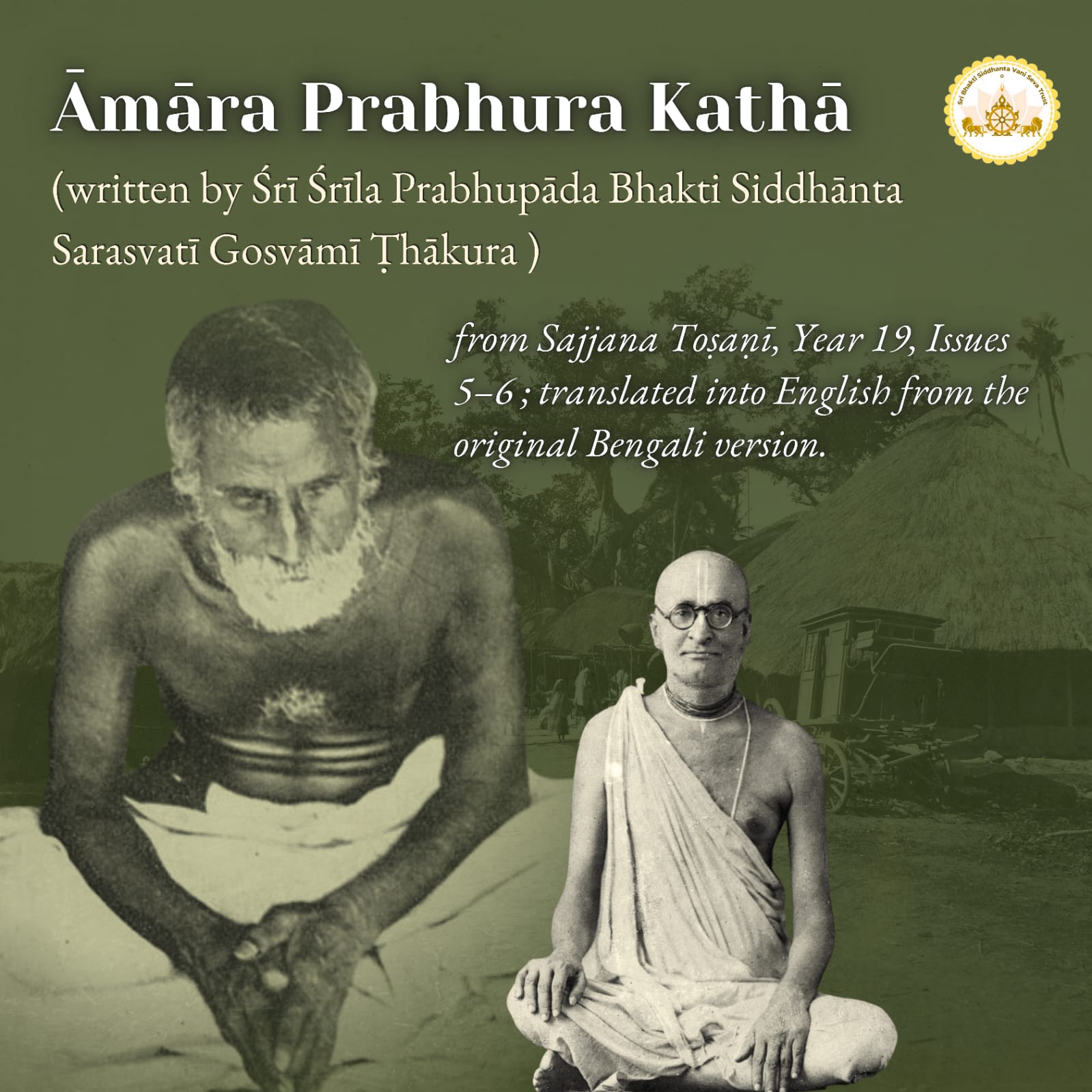
(About my Prabhu) Date –17.08.2026
— Śrīla Bhakti Siddhānta Sarasvatī Gosvāmī Ṭhākura Prabhupāda
An overview : THE PRABHUPĀDA used to say that,— “Guru-Vaiṣṇavas are the transparent & transcendental media through which we can see what is what there in Vaikunṭha jagat.”
To develop deep loveful relationship with Śrī Guru-pāda-padma is the only way to get entry into the Vaikunṭha jagat. Śrī Caitanya mana-abhīstha means Śrī Guru-Gauḍīya mana-abhīstha. Externally that was a great evolution when the topmost pandita of this whole world— Śrīla Prabhupāda took shelter unto the lotus feet of Śrīla Gaura Kiśora Dāsa Bābājī Mahārāja — who was externally not educated. Śrīla Prabhupāda was very proud of his Paramahaṃsa Guru-pāda-padma Śrīla Gaura Kiśora Dāsa Bābājī Mahārāja in whom he saw the complete reflection of Śrī Śrīla Raghunātha Dāsa Gosvāmīpāda and his absolute vairāgya. Śrīla Prabhupāda always wanted to point out the exclusive remarkable divine detachment of Śrī Śrīla Bābājī Mahārāja and he used to glorify all divine qualities of his Guru-pāda-padma. This article was written by Śrī Śrīla Prabhupāda in the separation of his Prabhu Śrīla Bābājī Mahārāja in which he specially very secretly wanted to show the absolute vicāra that Śrīla Bhakti Vinoda Ṭhākura and Śrīla Gaura Kiśora Bābā both of them are same to each other, though externally different. This article was published in the Sajjana Toṣaṇī (19th Year, 5th & 6th issue) magazine, originally in Bengali, now translated into English by the mercy of Paramahaṃsa Jagat-Guru Śrīla Prabhupāda.
Even the best person among those materialists is unqualified to become a Guru
I am a bonded jīva; therefore I am influenced by countless dissatisfactions. To fulfil those I was busy attaining many objects coming within the range of the abode of Brahma up to a tiny insignificant piece of grass [it means from the greatest up to the tiniest]. I used to think that just by getting viṣaya (material possessions) my dissatisfactions could be fulfilled. Sometimes I achieved many rare & extraordinary viṣayas, but still could not overcome my dissatisfactions. I met many greatly-charactered personalities; but by watching various dissatisfactions even in them, I could not honour them.
Accepting Śrīla Gaura Kiśora Dāsa Bābājī as the idealism in my life by the indication & direction of Śrīla Bhakti Vinoda Ṭhākura
In such a difficult time, by watching my painful condition, the absolutely merciful Śrī Gaura-sundara allowed two of His dearest associates to be graceful upon me. I had lost my own maṅgala by getting intoxicated with worldly ego and by indulging in material self-glorification. But due to some past sukṛti, I got the opportunity to meet Śrīla Ṭhākura Bhakti Vinoda as my benevolent well-wisher. Often my Prabhu [Śrīla Gaura Kiśora Bābā] used to come to him [Ṭhākura Bhakti Vinoda at Svānanda Sukhada Kuñja] and also often he use to stay with him. Being moved by compassion for me, Śrīla Ṭhākura Bhakti Vinoda, as my benevolent well-wisher, introduced my Prabhu (Srila Gaura Kisora Dasa Babaji Maharaja) to me. From the time I saw my Prabhu for the first time—from then onwards my false ego started going on in decreasing order. I used to believe previously that by taking human form everybody is inferior and worthless like me. But after observing the supramundane character of my Prabhu, gradually I could realize that ideal Vaiṣṇavas can exist in this world, even today. By the compassion of my Prabhu, gradually, I became adherently devoted to the supramundane character of Śrīla Bhakti Vinoda Ṭhākura.
Śrīla Gaura Kiśora Dāsa, Gurudeva of Śrīla Prabhupāda, his viraha tithi (disappearance day) and beginning of the discussion of his life
In this world, my Prabhu was known by the name ‘Śrī Gaura Kiśora Dāsa’. Last year, at the end of the Cāturmāsya, on the day of Utthāna Ekādaśī, he left for the aprākṛta Gaura-Dhāma. In this world, human-beings can be known by those chronological activities carried out by them. But in this case, we would not be able to collect the chronological biography of my Prabhu. Still, here, by noting down all of his activities which I successfully witnessed and whatever I heard about him, I am writing a few words about that Paramahaṃsa Bābājī Mahāsaya—who is an absolutely loved one of Śrī Gaura-Hari and who was non-different from Śrīla Bhakti Vinoda Ṭhākura. Whatsoever about this Mahā-mahodaya is unknown to me, if anybody having any information about him then kindly let me know—I will be ever grateful for that.
Absolute maṅgala can appear by the discussion of the Vākya (spoken words) & Acaraṇa (idealism) of a Sādhu
By the careful observation of those vākyas and anuṣṭhānas (divine activities) of those Sādhus, those unsatisfied & unsaturated jīvas like me can get benefitted in many ways. Simply by listening to the divine character and those activities of a Sādhu, also the hearts of many asādhu [wicked] people can get purified. Moved by this particular belief [faith], let me write a few words about Paramahaṃsa Bābājī Mahārāja.
Some information about the birth, family background and the gṛhastha (household) life of Paramahaṃsa Śrīla Gaura Kiśora Dāsa Bābājī Mahārāja
I heard that he appeared in a very lowly vaiśya family in a densely populated village on the banks of the river Padmāvatī in the district of Farida-pura [at present Bangladesh]. He appeared in this world more or less 80 years ago. His name given by his father was Vamsī Dāsa. This Mahātmā stayed for 29 years at home after his entering household life.
Leaving home and staying in various Dhāmas
He, in his gṛhastha life, received pāñca-rātrika mantra dīkṣā in the line of Śrī Advaita Ācārya Prabhu. After the passing away of his wife, by leaving the grain-dealership business, he accepted kaupīna from Śrīmad Bhāgavata Dāsa Bābājī—a veśa disciple of Śrī Jagannātha Dāsa Bābājī, an extremely celebrated devotee. After accepting veśa, for a period of almost 30 years, he absorbingly did bhajana by staying in different villages of Śrī Vraja-maṇḍala. During this time, sometimes he travelled to various tīrthas located in North India like Sri Vrindavan etc. and specially in Gauḍa-mandal [the province of undivided Bengal]. He also had the chance to meet and associate with Śrī Svarūpa Dāsa Bābājī of Śrī-Kśetra, Śrī Bhagavān Dāsa Bābājī of Kālna and Śrī Caitanya Dāsa Bābājī of Kuliā. Apart from them, he specially knew all those Mahā-ātmās of Vraja-maṇḍala. Despite having such acquaintances, he would never support or encourage anybody’s efforts to collect viṣaya (material possessions). He himself, being alone and by avoiding asat-saṅga, utilized his time in doing pure bhajana.
Arrival of Śrī Bābājī Mahārāja at Navadvīpa from Vraja
In the year 1486 February 18, (the 23rd day of Phalguna, 1407 Sakabda) when Gaura-Hari manifested at Śrī Māyāpura, which means in the month of Phālaguna of the bengali year 1300, this Mahā-ātma, by the order of Śrīla Jagannātha Dāsa Bābājī Mahāśaya, arrived at Śrī Gauḍa-manḍala from Śrī Vraja-maṇḍala and lived in various places in Śrī Dhāma Navadvīpa till he went for his mahā-prasthāna. Since the year 1311 (bengali era) we have been witnessing the weakness of his vision power (eyesight). From the year 1312 onwards, by avoiding travelling mood which is usually found in those yāyāvaras [itinerants], he accepted a kuṭīra for staying at one place. Before that, he used to collect mādhukarī from different villages of Śrī Dhāma and carry out all of his personal chores on his own. Nobody ever got the opportunity to serve him.
Śrīla Bābājī Mahāraja’s idealism of vairāgya
By hearing all about his strict vairāgya, a jīva can remember about Bhagavata-pārṣada Śrīla Raghunātha Dāsa Gosvāmī Prabhu. The Vairāgya (or the kind of absolute detachment) from anything which is not in favour of Kṛṣṇa-sevā itself was absolutely blessed by attaining a place in the heart of Paramahaṃsa Bābājī Mahāśaya as his shelter. And those who really had the chance to witness all of his exclusive activities driven by such a kind of vairāgya, definitely, more or less, they got the chance to develop vairāgya (detachment) from those viṣayas— those having no connection with Kṛṣṇa-sevā—this is an immutable truth. Such a kind of vairāgya which was present in him can melt even the heart of an extremely merciless, stone-hearted person. That is why we desire to get blessed by speaking about such a Mahā-puruṣa and endeavour to increase the bliss of all the audience.
A few instances of the life of Śrīla Bābājī Mahārāja
I saw a Tulasī-mālā [Tulasī wood neckbeads] in his neck and in his hand a Tulasī-mālā [Tulasī wood japa beads] for keeping the count of Hari-Nāma & a few books written in Bengali. At times, we saw no Tulasī-mālā in his neck at all, or instead of Tulasī japa mala in his hand we saw only an old cloth strip having knots for keeping the count of Hari-Nāma— or having no kaupīna, almost naked body, a bhāva of detestation without any reason, and a disgusted mood for nothing. Even after watching him, many immature or so-called clever intelligent people, small boys or old men, those scholars or idiots, and those who are having false ego as devotee—they could not realise him in true sense. This is the usual supernatural power of a Kṛṣṇa-Bhakta. This is true that countless anyābhilāṣīs (those people having anyābhilāṣas) received different kinds of advices related to their anyābhilāṣas from him, but those advices were simply his deceptive attitude and nothing else. Countless people can accept the guise of a Sādhu, they all can act like a Sādhu, but in true sense, they are far away—deviated from the track of a Sādhu. My Prabhu was not such a cheater like them. Unalloyed mood is the most important thing in the way of Hari-bhajana—this was very accurately expressed in his divine activities. Those who are having false pride as highly knowledgeable personalities in sāṣtras—though my Prabhu was not like them—but still, he was completely versed in the essence of all sāṣtras. Because of his unalloyed (spontaneous) Śrī Kṛṣṇa-sevā, naturally he developed the power of being sarvajña [omniscient]. It is not the purpose of this writing to describe all about his vibhūtis [which all are the by-products of his genuine bhajana], but his unalloyed affection was unparalleled, which can give someone a feeling of the futility of those kinds of vibhutis.
The niṣkiñcana-bhāva, amānī-mānada nature and indifferent mood of Śrīla Bābājī Mahārāja
This Paramahaṃsa-deva used to remain absorbed in Kṛṣṇa-Bhakti uninterruptedly. He was niṣkiñcana, so the desire for getting pratiṣṭhā could never touch his heart. He did not have any kind of distasteful attitude towards his competitors—who all were against him. Even he did not show any kind of grace externally to those who were recipients of his kṛpā. He used to say that, — “In this world, nobody is the recipient of neither my affection nor my dislike. Everyone is respectable to me.” Another spectacular thing about him is that many material people—who are against pure Bhakti and are engaged in those so-called dharmas—they, without realizing anything, use to stay around him always and by considering themselves as the near & dear ones of such a Sādhu, they always use to remain intoxicated in all dirty matters. But he neither externally threw them away nor accepted them in any way. If those kapaṭ people could at all be accepted by him, then we could feel blessed ourselves by watching their progress in the way of aprākṛta Bhāgavata-Dharma. If they were successful to receive the ‘amāyāy dayā’ (or ‘unalloyed kṛpā’), as spoken by Ṭhākura Vṛndāvana Dāsa, then surely they could attain genuine maṅgala, their bonded condition would have gone and they could attain Kṛṣṇa-Prema.
The Absolute neutral position of both Śrīla Gaura Kiśora & Śrīla Bhakti Vinoda Ṭhākura and the goal of both of them were same
What is the actual meaning of ‘neutral position’—that was clearly visible in the aprākṛta caritra of Śrīla Saccidānanda Bhakti Vinoda Ṭhākura and my Prabhu. Due to material concentration (or attachment), if someone is not able to attain a neutral platform, then one cannot realize the Excellency of those Vaiṣṇavas, those who are beyond material limits. By standing on absolute neutral position, we can clearly see that both of the above mentioned Sādhus—who belong to the ‘same’ nature—are engaging the whole world in Hari-bhajana by manifesting externally two different types of līlas by the absolute will of the ‘same’ Prabhu [I mean the one and the same— Śrī Gaura-sundara].
Some incidents related to Śrīla Bābājī Mahārāja
I have already written some things about him before, and also below I am going to jot down some special incidents related to him —
1. Teaching a lesson to a man who, out of material conception, was interested to procure a piece of land at Śrī Navadvīpa Dhāma
A new kaupīna-holder, by coming and going to Bābājī Mahāśaya for a few days, collected 5 kaṭhās [land measuring unit] of land at Kuliyā-Navadvīpa from a staff member working under the estate of the queen of Rāṇī-corā—the landlady. On hearing this, my Prabhu replied that, — “Śrī Navadvīpa Dhāma is aprākṛta, therefore, how could that landlord procure land there, so that the landlord could afford giving 5 kāṭhās of land to that new kaupīna-holder? Even if the whole treasure of this brahmāṇḍa can be gathered together at a time and given in exchange of that piece of land, still it can never become equivalent even to a dust particle of this aprākṛta Navadvīpa Dhāma; so where from can any Zamindar (landlord) arrange so much money so that he can have the right to distribute a piece of land at Śrī Navadvīpa Dhāma? And at the same time, the new kaupīna-holder—how much bhajana-bala (power) can he have so that in exchange of that bhajana power he can collect this huge amount of land? One who is going to develop material ideas in aprākṛta-tattva can then be declared a ‘sahajiyā’ by those tattva-jñānīs.”
2. Rejecting the invitation of Mahārāja Manindra Candra Nandī
Once, a very famous prominent landlord of Bengal, out of his own Bhakti-power, invited my Prabhu to participate in the devotional assembly arranged in his palace which resembled the palace of Indra [the king of heaven], by considering my Prabhu as the topmost Vaiṣṇava. On being moved by the craving prayers of that Vaiṣṇava king, Bābājī Mahāśaya invited him (that king) to reside at the banks of Gaṅgā with him to do absolute Kṛṣṇa-bhajana by arranging a straw hut and to collect mādhukarī door to door. My Prabhu further said to him that by handing over all those material transactions into the hands of his gomastas [or those appointed servants who all are taking care of all the land & property under his control], when he can get free of all those hazards of handling material things, only then he can become a Vaiṣṇava; then my Prabhu can accept the cordial invitation by him to get a place at his courtyard. At all, if by the invitation of that Vaiṣṇava King, my Prabhu had to go to the palace of that king from the aprākṛta Gaura-Dhāma, then there could be every possibility of feeling attraction for those majestic arrangements already there in his palace to develop unusual desire, like the king already have, to collect huge amount of land & property within a short period of time. As a result, within a short period of time, his Kṛṣṇa-bhajana would be finally converted into material attachment to make him the target of jealousy of that Vaiṣṇava King. But on the contrary, if the king could take the trouble to come up to Śrī Navadvīpa Dhāma to stay with my Prabhu, just beside his bhajana-kuṭīra, by arranging another kuṭīra over there, and if he can live on mādhukarī bhikṣā to lead his bhajana-life, then surely he need not lose his loveful friendship with my Prabhu and can avoid making him the target of his jealousy, anyhow. At all, if the Vaiṣṇava friend — the King, likes to show kṛpā upon him [my Prabhu], then he can do so by accepting the same lifestyle like my Prabhu is habituated to.
3. To teach those sahajiyās, strī-saṅgī (yōṣit-saṅgī) of Kuliyā, līlā of acceptance of gṛhastha-dress by Śrīla Bābājī Mahārāja
By watching the secret, dirty character of some renowned scholarly bābājī, who was a very clever so-called kaupīna-holder, a resident of Kuliyā-Navadvīpa, and by getting deeply hurt by that, my Prabhu, leaving kaupīna & bahirvāsa, manifested the līlā of wearing unusual cloth etc. in a very majestic way – like super-fine dhoti with a black border on both sides, with a premium, luxurious cadara (shawl) on the shoulder and came in front of Śrīmad Bhakti Vinoda Ṭhākura at Śrī Svānanda Sukhada Kuñja. By watching this kind of sudden unexpected change in the veśa of Bābājī Mahāśaya, out of great curiosity, Bhakti Vinoda Ṭhākura asked the reason for that. We are not feeling shy even in accepting the wives of others by wearing the dress of Śrī Kṛṣṇa-Caitanya Mahaprabhu by taking shelter of kapaṭ bhāva. So, by accepting the majestic dress of a Vṛṣali-pati having enjoying mood, at least the Absolute Truth can be protected. Such a kind of tactful protesting behaviour of Bābājī Mahāśaya can yield a positive result against those characterless groups [in our Gauḍīya bhajana field].
4. Those jāti-gosvāmīs—their Bhāgavat-paṭha is nothing but only money, money & money and no question of Bhakti at all.
Once, upon hearing about a gosvāmī who was externally well versed in Bhāgavatam, his strong affinity for money and his thirsty mood for collecting disciples very tactfully, he [Bābājī Mahārāja] wanted to know all in details about his activities regarding the preaching of Bhakti. By hearing from a foolish singer about how that honorable gosvāmī allows many people to utter “Gaura! Gaura!” and his technique to collect countless disciples tactfully, he said that surely that gosvāmī descendent did not at all explained Gosvāmī sāṣtras; rather, he was explaining indriya (sense-gratification) sāṣtras, and he never spoke “Gaura! Gaura!” rather he shouted like “Money! Money! My Money!” That can never be Hari-bhajana; rather, this is nothing but only covering of the Satya-Dharma, by the help of which the maṅgala of the whole world cannot be attained; rather, amaṅgala can only grasp the whole world.
5. Bābājī Mahārāja’s līlā of entering into public latrine and considering material transactions as stool & urine is also one kind of exemplary teaching for all of us.
Many such so-called devotees, with the excuse of Bhagavat-Bhakti Dharma, going to make a show off those sadācāras (Vaiṣṇava-etiquette) as is prescribed in śāstras in front of the public externally, but they are usually busy to gather their material interests secretly. To show their material efforts as comparable with stool & urine—as is found in those Gosvāmī sāṣtras—my Prabhu stayed there in the common public latrine of the Dharmashala for six months, where the common public used to pass stool & urine. By exhibiting the external show of following sacred teachings of Śrī Kṛṣṇa-Caitanya Deva, those who are interested to collect material possessions, which are like stool & urine, they are actually preaching only the bad smell of pratiṣṭhā-viṣṭhā already there inside them; by exhibiting the idealism of the same teachings, they are actually showing behaviour like one sweeper who is cleaning stool & urine. These people, being unable to realize the actual theme of Vaisnava Dharma, are only inviting material possessions in the guise of a Vaiṣṇava, whereas this has to be rejected completely—this he has shown to all of us through his ideal bhajana life.
6. Complete detachment from any material objects like money, clothes etc.
Many gṛhastha Vaiṣṇavas time to time used to offer money, clothes, or costly shawls, etc. By accepting some money from somebody, he used to show great care to protect that donation by arranging two or five knots in the cloth and keeping that money somewhere here & there; he used to exhibit great hankering after money. Those foolish materialistic people having great attachment for money used to think that Śrīla Bābājī Mahārāja had great attachment for money like them. By accepting costly clothes from any donor, he used to appreciate him for this kind of rare costly clothes and, at the same time, used to point out the worthlessness of those costly items [for a Sādhu].