
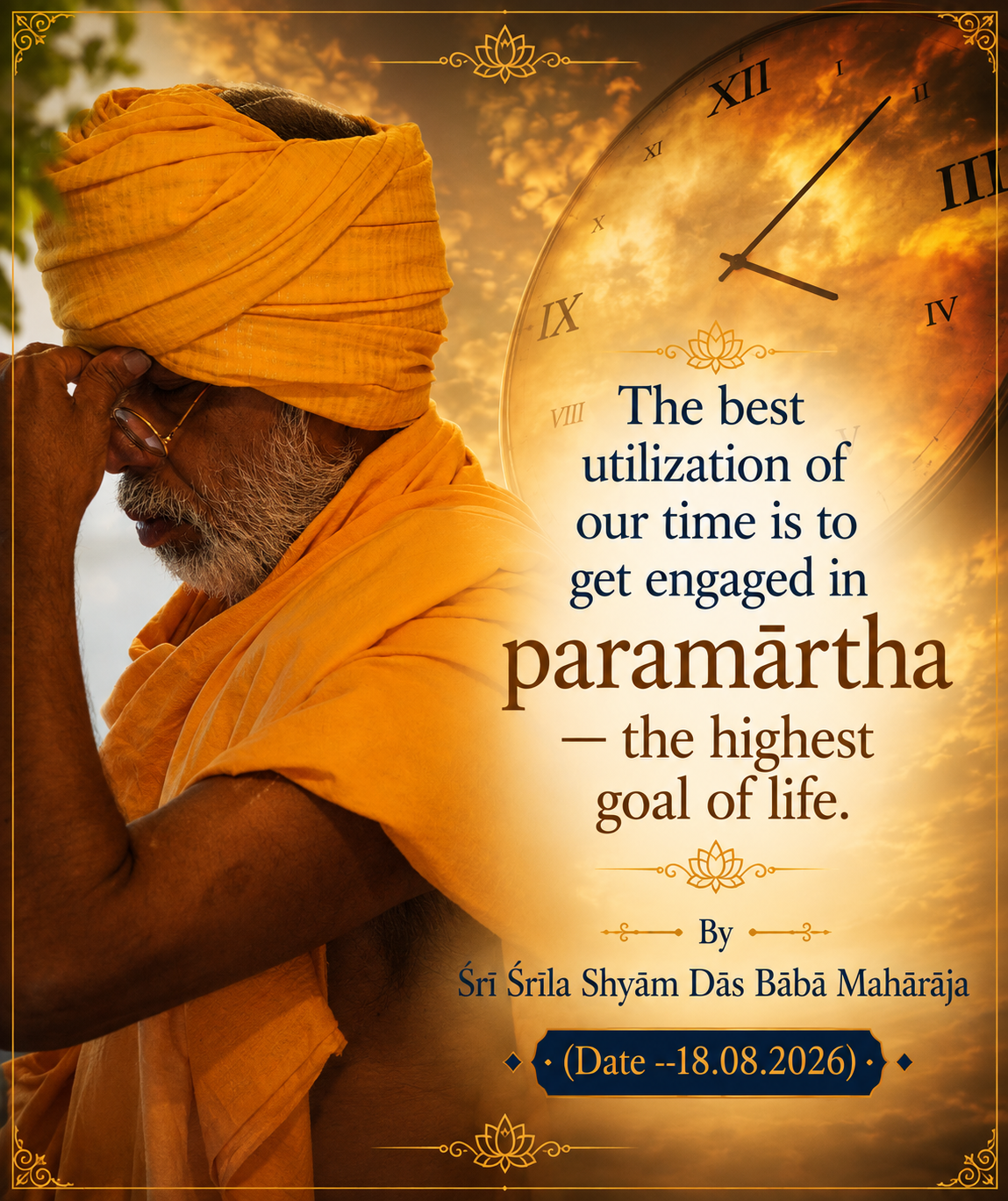
Śrī Śrīla Shyām Dās Bābā Mahārāja (Date –18.08.2026)
Gauḍīya Goṣṭhī Pati Śrī Śrīla Bhakti Siddhānta Sarasvatī Gosvāmī Ṭhākura Prabhupāda said that –“By the magic spell of Māyā Devī nobody can understand that behind the screen of this material world there lies another realm which is eternal and full of ānanda”
māyā-javanikācchannam
ajñādhokṣajam avyayam
na lakṣyase mūḍha-dṛśā
naṭo nāṭyadharo yathā (ŚB 1.8.19)
Being beyond the range of limited sense perception, You are the eternally irreproachable factor covered by the curtain of deluding energy. You are invisible to the foolish observer, exactly as an actor dressed as a player is not recognized.
People have their eyes, but what they can see with these material eyes? Only blood, flesh, stool and urine, nothing else. Only those who by the kṛpā of Guru-Vaiṣṇava can clean their dirty material darśana, they will be able to understand something about that Supreme eternal abode.
The Prabhupāda used to say that 99.99% even if not more – all are leather man, busy with skin (body & flesh) only. They only believe in their temporary material relationships with mother, wife, children, nation, etc., and all their thoughts, desires, and fleeting pleasures are only related to this physical covering. Even though the ātmā is pure and totally beyond matter, still through the influence of the three modes of material nature, the ātmā identifies with the temporary body & mind complex provided by Māyā Devī. Just think for a moment about this life?
Every century the stage of the world is swept clean. All new new generations are coming. Empires rise and fall, names once adorned in gold letters disappear just like bubbles in the ocean. All dissolves beneath the wheel of time. Even the day will come when the sun itself and all galaxies perish.
If we measure existence only by its visible form, then the naked truth is that all Generations appear for some time, struggle for some time, have relationships for some time, and finally die. If we think from now onwards, in about hundredth years this generation of humans will be flushed away by the uncompromising factor of time, and in this way making room for another cycle of ambitious dreamers. Be it the President of America or a street beggar, a religious leader or a thief — all are washed away by the uncompromising force of time. If this is the conclusion of life, then everything would seem meaningless, so surely there must be another side of the coin. What is that? The problem is not that all things perish, but that man identifies himself with what perishes. The people seek permanent shelter in that which is by nature temporary— the body, the mind, name, fame, or nation etc. — and in this way they meet only with painful amaṅgala.
Yamarāja once asked Mahārāja Yudhiṣṭhira, “What is the most wonderful thing within this world?” Mahārāja Yudhiṣṭhira replied
ahany ahani bhūtāni
gacchantīha yamālayam
śeṣāḥ sthāvaram icchanti
kim āścaryam ataḥ param (Mahābhārata, Vana-parva 313.116)
Hundreds and thousands of living entities meet death at every moment, but a foolish living being nonetheless thinks himself that he will never die. This is the most astonishing thing in this world. Everyone has to die because everyone is fully under the control of material nature, yet everyone thinks that he is independent, that whatever he likes he can do, that he will never meet death but live forever.
From the Bhagavad-gītā we also know the following śloka—
ā-brahma-bhuvanāl lokāḥ
punar āvartino ’rjuna
mām upetya tu kaunteya
punar janma na vidyate (Bg. 8.16)
From the highest planet in this material universe down to the lowest, all are realms of suffering marked by repeated birth and death. But one who reaches My abode, O son of Kuntī, never takes birth again.
When we reduce our life as humans or even the life of Lord Brahmā to a single measurable unity — called time, then we have to admit that from the moment of birth to the moment of death, every second ticks already away, like a fixed countdown, be it the life span of Lord Brahmā or the life span of an ant, everything will finally come to an end. This realization exposes the naked truth that all endeavours in this fourteen planetary systems, however great they may be according to our material calculation, are all temporary. That is the reason why the best utilization of our time is to invest it in paramārtha—the highest goal of life. The Upaniṣads are shouting —
uttiṣṭhata jāgrata prāpya varān nibodhata
kṣurasya dhārā niśitā duratyayā
durgaṁ pathas tat kavayo vadanti (Kaṭha Upaniṣad 1.3.14)
“Arise! Awake! Approach the great souls and learn the truth. The path is sharp like the edge of a razor — difficult to traverse — so say the wise.”
This verse is spoken by Yama (the Lord of Death) to Naciketā, urging him to awaken from the material slumber. But at the same time it is an urgent call to all the jīvas to leave behind the disease of material enjoyment and approach guru-vaishnava-Bhagavan for transcendental enlightenment so that finally we can discover our eternal relationship with the Supreme Lord. The Upanishads are saying –“Wake up— uttiṣṭhata jāgrata! — and approach those who have realized the truth”. For how long we want to remain in the land of death?
The jīvas are eternal parts and parcels (aṁśas) of Śrī Bhagavān. By their very constitution, their natural function (svarūpa-dharma) is to serve Him — just as each limb naturally serves the body, or each cell supports the life of the organism. However, when a jīva turns away from that service mood (sevā-bhāva), being attracted by the false promise of independent enjoyment (bhoga-vāsanā), he becomes like a diseased parasitic cell within the universal body of the Lord’s creation. Instead of harmonizing with the divine whole, he begins to exploit the resources of this material world for his own selfish end.
Forgetfulness of Kṛṣṇa and His devotees is the main disease, and the remembrance of Krsna and his devotees is the only remedy (medicine).
smartavyo nityaśaḥ viṣṇuḥ vismartavyo na jātu cit
sarve vidhi-niṣedhāḥ syur etayor eva kiṅkarāḥ
— Padma Purāṇa, Uttara-khaṇḍa 71.27
“One should always remember Viṣṇu and never forget Him at any time. All the rules and prohibitions of scripture are servants of these two principles.”
This establishes the mūla-vidhi (root injunction) of all devotional practice — constant remembrance of Viṣṇu (smaraṇa) and constant avoidance of forgetfulness (vismaraṇa). All other rules (vidhi) and prohibitions (niṣedha) are merely assistants (kiṅkarāḥ — servants) to these two.
Gaura Hari Hari Bol