
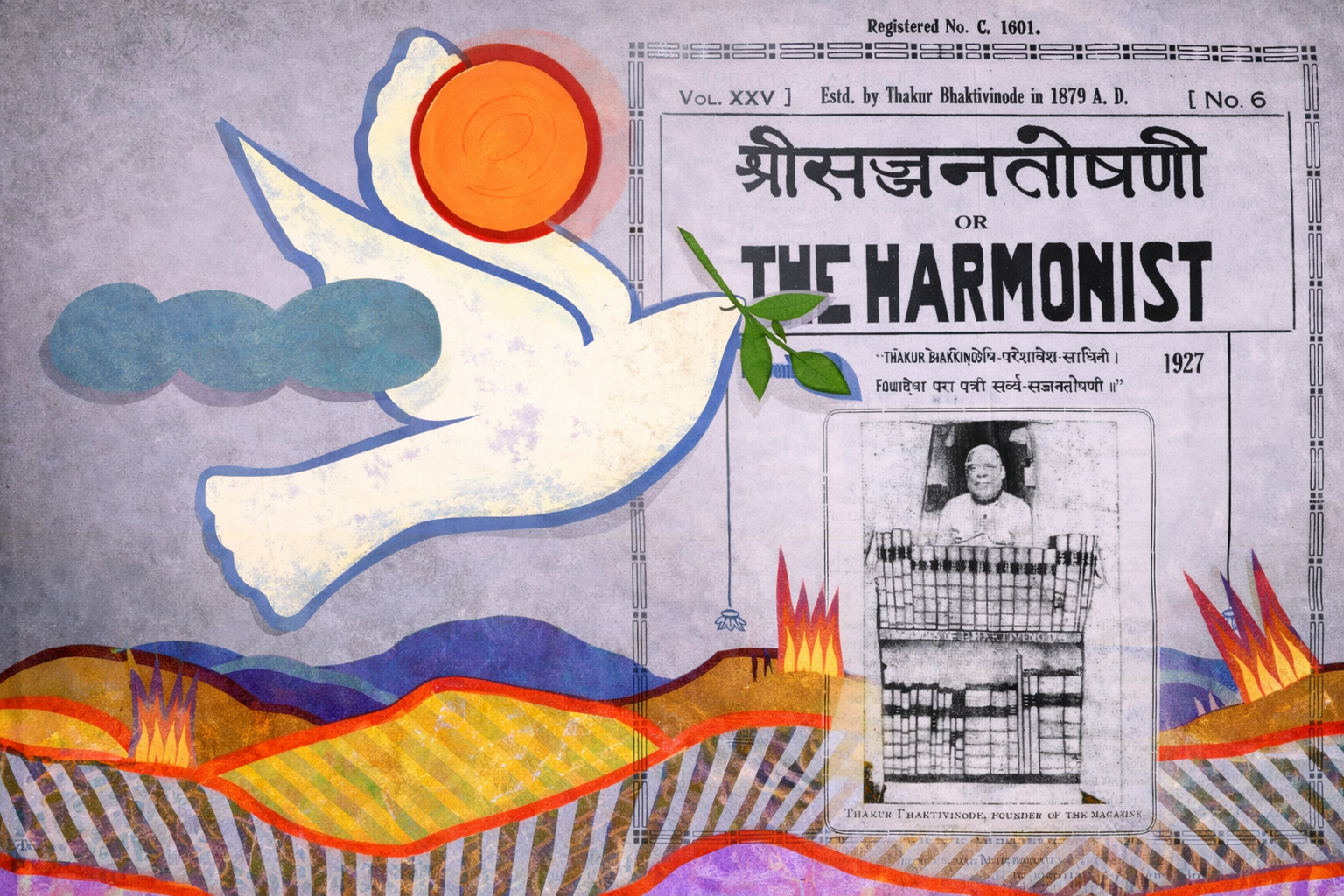
(The Harmonist — Sree Sajjanatoshani VOL XXXI, April 29, 1935, No. 17)
Religion has a regulation to offer towards international aspirations of humanity, as in other fields. The ideas of the brotherhood and natural equality of man as bases of international intercourse require to be scrutinised from the standpoint of spiritual requirements. The gospel of the French Revolution continues to be the limit of the liberal outlook in political association. Liberty, equality and fraternity seem at first sight to envisage a satisfactory ideal of international intercourse. These principles are being put to the acid test in the discussions in the committees of the League of Nations over disarmament and territorial delimitation of the frontiers of States. The administration of Dependencies and Mandated areas is another vexed question which it has hardly been possible to bring within the above principles of association.
The relation between the Macrocosm and the Microcosm, as elicited by Evolutionist thought, does not march with the notion of the unprogressive validity of the status quo or the unviolable sanctity of unrighteous treaties. Why is Germany so anxious to revert to the condition of armed equality with the greatest military Power ? What will happen to the spiritual object of the League of Nations if, instead of disarming, the demands for rearmament on the post-war scale obtain a new lease of life as the basis of international organisation ? Can the world bear the burden of these post-war armaments for any long period ?
As regards the other vexed question of the Minorities, their protection by an external power against the Majorities strikes at the root of all democratic activity and offers a fruitful source of international jealousies. But do not the Minorities sometimes certainly require to be helped within definable limits?
In the field of Commerce and Industry, present international policy has an appearance of being based on the principle of the survival of the fittest. It says in effect, “Let everybody help himself to the largest possible share of the limited good things of this world !” In these circumstances number, organisation and unscrupulousness naturally count a great deal for eventual success. It is also the worship of the status quo.
But the whole world is organising for claiming special and opposed advantages. Liberty is in revolt against morality. Advocates of equality are helping uncontrolled dictatorship for the prevention of unconquerable lethargy and impending reaction. Fraternity is often professed as a convenient method of deceiving the unwary victims of the exploiter. Even thinking has learnt to pride itself on its uncompromising particularisms, on its advocacy of the status quo. It is become inane and merely analytic. Its dynamics, if any, does not make for progress, nor even for hope.
This state of a vicious stalemate has to be recognised and actively countered by the invocation of spiritual thinking. The economic point of view should be brought under a truly harmonising programme of international activities.
We have been always emphasising the spiritual fact that the affairs of the mundane world are bound to remain unintelligible and full of active discord if they are not sought to be understood in their relation to the laws of spiritual governance. This world offers a sectional and perverted view of the reality. To seek to learn the synthetic truth from the available experience of this world is, therefore, as futile as the chasing of phantasmagoria or the mirage of the desert. The quest for truth is not the quest of any final worldly position, for the simple reason that such a consummation would be and can be only stagnation and death. All consolidating worldly attempts are frustrated sooner or later by the working of a higher power which never comes within the purview of our mundane constructive endeavours. Why should this be so? Man cannot continue to be satisfied by the endless practice of heartless and unwholesome competitive worldliness. International politics should come into its own as an organised attempt for improving the present outlook of the world. It must not merely back up any and every existing organisation on its own respective unsatisfactory and narrow selfish line.
Spiritual governance means the rule of the Absolute Person Who is All-existence, All-knowledge and All-bliss. In the Absolute Person alone these principles have at once their Source and the Goal of their functionings. Any activity that makes towards the Absolute is lifted to the realm of life and harmony. Anything that wilfully moves away from its Source and Support brings forth death, ignorance and misery. Statesmanship, which looks away from the Absolute, is also bound to be ephemeral, blundering and mischievous.
The Governance of the Absolute includes and explain the governance of this world. It is quite possible for the governance of this world to seek to cut itself off from its relationship of conscious dependence on Divine Governance. This is being done at the present moment under the impression that it is neither possible nor necessary to practise such allegiance to the Absolute in the affairs of this world. Religion is out of court. Experience, that is carefully limited to this world, is quite illogically assumed to be both final and sufficient for all ‘practical’ purposes. This is not merely irrational, it is wicked and suicidal. It is opposed to our higher nature.
For this reason it has become imperative to seek for further spiritual enlightenment and to be prepared to add to the stock of our spiritual experience. It has become necessary to be supplied with a truly workable spiritual experience. The experience of the Absolute Truth can alone enable us to find our way to the ever progressive, eternal life of the individual and the aggregate. But we should not also expect the actual discovery of the path of such solution. We must learn to move consciously towards the Absolute in obedience to the discovered spiritual law.
The religious experience of India should be of supreme importance to the world for this purpose. The central and relevant fact of that experience is supplied by the doctrine of Divine Descent. It is possible for every individual to bring about the Descent of the Absolute by the practice of His loving service. He is always coming down in this manner to the plane of our mundane experience in the form of the Transcendental Sound or Name. It is necessary to experience His Descent for being enabled to have access to the living, indivisible Truth on His transcendental plane. This is the unanimous teaching of the vast spiritual literatures of India. The spiritual Macrocosm can be served only by the release of the serving energy of the spiritual microcosm. But the Macrocosm itself may and does oppose the liberation of the energy of the microcosm. This is being done, consciously or unconsciously, by all those organisations that happen to be based on the undiluted worldly outlook. Till there is a change of heart, by the Descent of the Absolute in response to the offer of pure service by individuals and aggregates, the impending destruction of humanity, that is being contrived by the ruthless exercise of its worldly wisdom, cannot be averted.
The Absolute Truth, even when He chooses to manifest His Descent to mortal view, reserves in tact His Right of not being exposed to the mundane senses. He can only be approached by the method of unconditional, willing submission. He never brooks the domination of any rival entity. The Right of Domination belongs only to the Absolute. If we wish to have access to Him we must give up our aggressive ineligibilities, scientific and otherwise, in approaching the Divine Sound appearing on the lips of His pure servitors, for making the acquaintance of the Absolute. This is the sum and substance of the Message of the spiritual Scriptures of India. She is again awaking to the necessity of following the teaching of her own Scriptures and making the same available to mankind by the method of a truly magnanimous propaganda on a world-wide scale.