
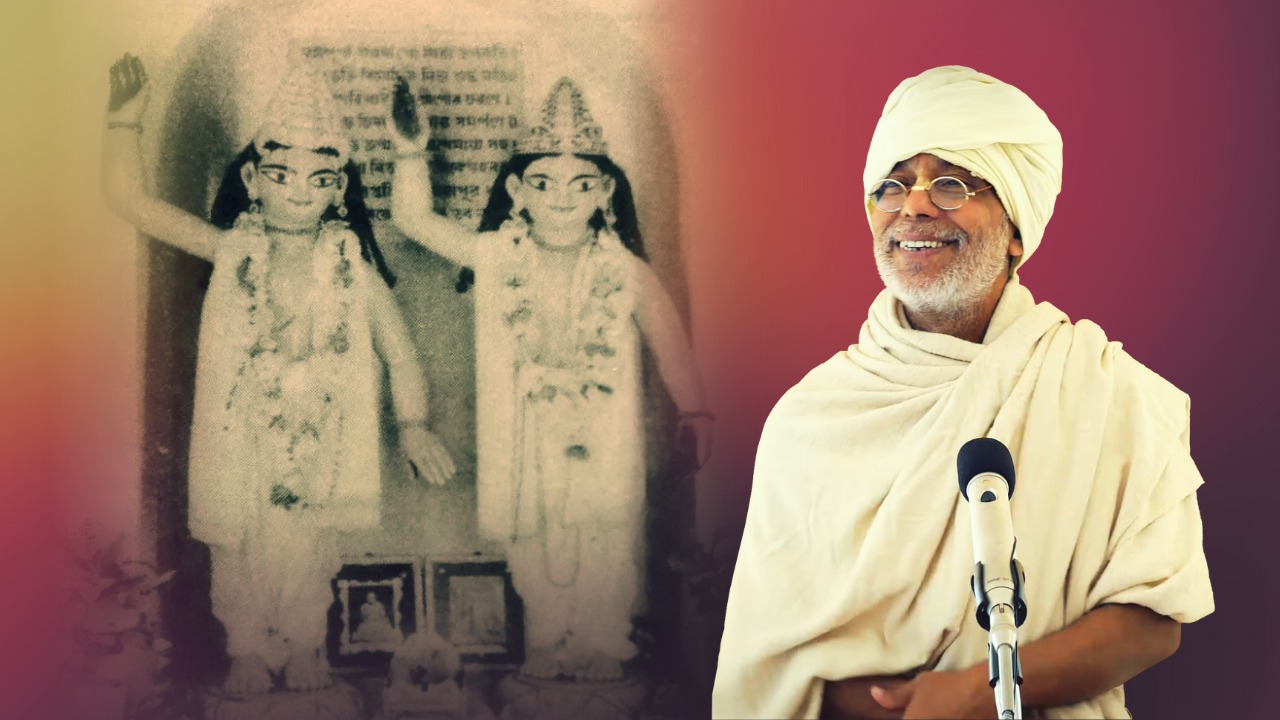
All glories to Śrī Śrī Guru and Gaurāṅga
Excerpt from the class SBen200423, Śrī Śyām Dās Baba — All the glories of Gaura Śakti – Gadādhara Paṇḍita
rādhā-kṛṣṇa-praṇaya-vikṛtir hlādinī śaktir asmād
ekātmānāv api bhuvi purā deha-bhedaṁ gatau tau
caitanyākhyaṁ prakaṭam adhunā tad-dvayaṁ caikyam āptam
rādhā-bhāva-dyuti-suvalitaṁ naumi kṛṣṇa-svarūpam
“The loving affairs of Śrī Rādhā and Kṛṣṇa are transcendental manifestations of the Lord’s internal pleasure-giving potency. Although Rādhā and Kṛṣṇa are one in Their identity, They separated Themselves eternally. Now these two transcendental identities have again united, in the form of Śrī Kṛṣṇa Caitanya. I bow down to Him, who has manifested Himself with the sentiment and complexion of Śrīmatī Rādhārāṇī although He is Kṛṣṇa Himself.” (Caitanya-caritāmṛta Adi-līlā 1.5)
Gauḍīya Goṣṭhī Patih Śrī Śrīla Bhakti Siddhānta Sarasvatī Gosvāmī Ṭhākura Prabhupāda told that Kṛṣṇa is the all predominating Absolute, and Śrīmatī Rādhārāṇī is the predominated Absolute. Actually, as per shastra siddhānta, Rādhā and Kṛṣṇa are the same. Also, as per Bhāgavata mahimā of the Skanda Purāṇa, we find it documented that “sa eva sa.”
When Rādhā and Kṛṣṇa are together in combined form, then we can see Chaitanya Mahāprabhu appearing in this material world.
Somebody might ask if Rādhā and Kṛṣṇa are combined and appear in the form of Lord Caitanya Mahāprabhu, then inside Caitanya Mahāprabhu Rādhā and Govinda are both present. If Gadādhara Paṇḍita is Rādhārāṇī, where does he fit into this equation?
Śrīla Bhakti Siddhānta Sarasvatī Ṭhākura Prabhupāda in his Śrī Guru paramparā explained:
“mahāprabhu srī chaitanya rādhā kṛṣṇa nahi anya”
We also know that Śaṅkara Bhagavān said to Pārvatī devī, “yam eva rādhikā kṛṣṇa sa eva gaura vigraha.” When Śaṅkara Bhagavān said, ‘yam eva rādhikā’ that meant that when Rādhā and Govinda combined, then that is, when they become the form of Caitanya Mahāprabhu.
Then from where does Gadādhara Paṇḍita come? For that we have to first understand for what reason Mahāprabhu came to this world. Śrī Caitanya Mahāprabhu came with the desire to taste rādhā prema vichar.
śrī-rādhāyāḥ praṇaya-mahimā kīdṛśo vānayaivā-
svādyo yenādbhuta-madhurimā kīdṛśo vā madīyaḥ
saukhyaṁ cāsyā mad-anubhavataḥ kīdṛśaṁ veti lobhāt
tad-bhāvāḍhyaḥ samajani śacī-garbha-sindhau harīnduḥ
(Caitanya-caritāmṛta Adi-līlā 1.6)
“Desiring to understand the glory of Rādhārāṇī’s love, the wonderful qualities in Him that She alone relishes through Her love, and the happiness She feels when She realizes the sweetness of His love, the Supreme Lord Hari, richly endowed with Her emotions, appeared from the womb of Śrīmatī Śacīdevī, as the moon appeared from the ocean.”
Actually, Mahāprabhu came in the form of a devotee to experience the līlā of how to get the taste of mañjarī bhāva, rāgānugā bhajana, rādhā bhāva. Caitanya Mahāprabhu is actually stealing rādhā bhāva and is also stealing Her body complexion. How can we understand this? If Rādhā’s bhāva is gone, and Her golden complexion is also gone, then somebody can ask how Rādhārāṇī can be inside Gaurāṅga Mahāprabhu. If He can be Rādhā and Govinda combined, then where does Gadādhara Paṇḍita fit in? Also, if the bhāva of Rādhārāṇī is taken away by Kṛṣṇa, and the body complexion is also taken, what remains there after that? Actually, in the transcendental world we cannot apply such logic in this way because everything is pūrṇa vastu. Everything that is taken from pūrṇa vastu is still pūrṇa itself.
oṁ pūrṇam adaḥ pūrṇam idaṁ
pūrṇāt pūrṇam udacyate
pūrṇasya pūrṇam ādāya
pūrṇam evāvaśiṣyate (Śrī Īśopaniṣad, Invocation)
“The Personality of Godhead is perfect and complete, and because He is completely perfect, all emanations from Him, such as this phenomenal world, are perfectly equipped as complete wholes. Whatever is produced of the Complete Whole is also complete in itself. Because He is the Complete Whole, even though so many complete units emanate from Him, He remains the complete balance.”
So even if Her bhāva is gone as well as Her bodily complexion, Rādhārāṇī is still there.
Gadādhara Paṇḍita always desires to assist in nourishing the sprout of mahā rasa in the heart of Śrī Caitanya Mahāprabhu. Gadādhara Paṇḍita is Rādhārāṇī herself to help in gaura-līlā. In the Gaura-gaṇoddeśa-dīpikā it has been explained by Kavi Karnapura that Śrī Gadādhara Paṇḍita is ‘śrī rādhā prema rūpa,’ the total form of prema. In vraja–līlā, Śrī Gadādhara Paṇḍita was the daughter of Vṛṣabhānu Mahāraja – Śrīmatī Rādhārāṇī. This is confirmed in the notebooks of Svarūpa Damodara as well as in the songs of Śrī Vasudeva Gosāi Ṭhākura. Also, in Caitanya-caritāmṛta it is written that Gadādhara Paṇḍita Prabhu is śakti avatāra. Gadādhara Paṇḍita is a śakti avatāra of Prabhu.
Some days ago, when I was speaking hari-kathā before going to Vṛndāvana, I was discussing one śloka.
vande gurūn īśa-bhaktān
īśam īśāvatārakān
tat-prakāśāṁś ca tac-chaktīḥ
kṛṣṇa-caitanya-saṁjñakam (Caitanya-caritāmṛta Adi. 1.1)
“I offer my respectful obeisances unto the spiritual masters, the devotees of the Lord, the Lord’s incarnations, His plenary portions, His energies and the primeval Lord Himself, Śrī Kṛṣṇa Caitanya.”
pañca-tattvātmakaṁ kṛṣṇaṁ
bhakta-rūpa-svarūpakam
bhaktāvatāraṁ bhaktākhyaṁ
namāmi bhakta-śaktikam
“Caitanya Mahāprabhu is one and single tattva but coming in five different forms, one is Caitanya Mahāprabhu Himself, then Iso Prakash, actually Nityānanda Prabhu, Iso avatāra actually Advaita Gosāi, Iso śakti, iso bhakto, Iso bhakto means?, Śrīvasadi and iso śakti means actually Gadādhara Paṇḍita.”
Right from the beginning when He was a boy, Gadādhara Paṇḍita was always in the association of Śrī Caitanya Mahāprabhu. Śrī Gadādhara Paṇḍita’s father’s name was Śrī Madhava Misra; his mother’s name was Śrī Ratnavati devī. They lived close to the house of Jagannātha Miśra in Mayapura. Śrī Ratnavati devī looked upon Śacīdevī as if Śacīdevī were her big sister. The two of them were always spending time with each other. Gaurahari always used to play with Gadādhara Paṇḍita. They both went to the village school and studied together. Gadādhara Paṇḍita was a year younger than Gaurahari and had so much affection for Gaurahari that he could not leave his company even for a moment.
According to Śrī Caitanya-caritāmṛta: No one can describe the characteristics and ecstatic love of Gadādhara Paṇḍita. Therefore, another name for Śrī Caitanya Mahāprabhu is Gadādhara prāṇanātha, the life and soul of Gadādhara Paṇḍitaa. No one can say how merciful the Lord is to Gadādhara Paṇḍita but people know the Lord as Gadaira Gaurāṅga, the Lord Gaurāṅga of Gadādhara Paṇḍita.
Śrīla Visvanath Chakravartipada also describes how in Nitya Navadvīpa līlā, the aṣṭa-kālīya- līlā of Gaurāṅga, Gadādhara Paṇḍita is always there with Gaurāṅga. We have a Yoga-pīṭha in Vṛndāvana, and we also have a Yoga-pīṭha here in Navadvīpa-dhāma. In this way, different kinds of līlās go on.
When Chaitanya Mahāprabhu was manifesting this līlā, what kind of līlā was it? After coming back from Gaya and offering funeral cake at the Lotus Feet of Viṣṇu Padapadma in the name of His father, Jagannātha Miśra, Lord Caitanya Mahāprabhu was expressing a different kind of exclusive līlā which was not possible before. So, in this way, day by day, Mahāprabhu was manifesting this vipralambha bhāva. Some could realize this fully and others could not. Gadādhara Paṇḍita and Śrīvas Paṇḍita could realize that Mahāprabhu was now going to express the actual reason why He came.
After taking sannyāsa in Katwa, Mahāprabhu left home without speaking to the other devotees. Śrīvas and Nityānanda Prabhu knew about this līlā but Mahāprabhu did not say anything about this līlā to anyone else.
After going to Katwa Mahāprabhu took sannyāsa and headed towards Vṛndāvana -dhāma but I am not giving those details here. After that, Mahāprabhu ultimately had to go to Advaita Bhāvan and then from there He went to Nīlācala-dhāma.
When Mahāprabhu took sannyāsa, Gadādhara Paṇḍita also decided to leave home. Mahāprabhu would now perform his līlā in Puruṣottama-dhāma. In order to always be with Mahāprabhu, Gadādhara took kṣetra-sannyāsa, which means that he made a vow not to leave a particular place. Once the vow was taken, Gadādhara had committed to spend the rest of his life in the dhāma without ever exiting.
In this way, Gadādhara Paṇḍita took kṣetra-sannyāsa and remained there in Puruṣottama-dhāma with Lord Caitanya Mahāprabhu. Śrī Caitanya Mahāprabhu gave Gadādhara Paṇḍita the exclusive responsibility of sevā to Ṭoṭā-Gopīnātha.
Ṭoṭā-Gopīnātha was discovered buried in some sand in Itota. By the order of Śrīman Mahāprabhu, Śrī Gadādhara Paṇḍita was engaged in the service of that Śrī Gopīnātha deity. At that time, the Lord would regularly go and visit His dear associate Gadādhara to float in the waves of rasa by hearing and discussing kṛṣṇa-kathā .
When Śrīman Mahāprabhu wanted to go to Vṛndāvana, Śrī Gadādhara Paṇḍita wanted to go with Him. But at that time, Mahāprabhu was not willing to take him with Him. Gadādhara was feeling strong and unbearable separation from Śrīman Mahāprabhu so he made the decision to break the kṣetra-sannyāsa vrata he had taken. That, in turn, was unbearable for Śrīman Mahāprabhu who tried to pacify Gadādhara with the argument that Gadādhara should not leave the sevā of Ṭoṭā-Gopīnātha and nor should he forget his kṣetra-sannyāsa resolution.
But Śrīla Gadādhara Paṇḍita was not at all ready to leave the association of his Pranantha Śrī Gaura Hari. And when Mahāprabhu made the harsh decision to leave Gadādhara with his sevā, Gadādhara Paṇḍita fell down on the ground in complete unconsciousness.
But now I want to go back to the previous līlā in Navadvīpa-dhāma. I want to point out one thing. We know that Gadādhara Paṇḍita was with Śrīman Mahāprabhu during His whole Navadvīpa-dhāma līlā. A fraction of a second of detachment was unbearable both for Gaurahari as well as for Gadādhara Paṇḍita. From the Vedānta-sūtra we know very well that “śakti śakti matayor abheda.” Since Gadādhara Paṇḍita is the śakti of the Supreme Lord Gaurahari, there can be no question of Them being separated from each other. But to get the taste of vipralambha bhāva, this kind of līlā is a must.
Śrīla Bhaktivinoda Ṭhākura in his song “Ha ha mora Gaura Kiśor” is writing about how Gadādhara Paṇḍita is always present with Gaurāṅga Mahāprabhu during his līlās in Svānanda-sukada-kunja.
ananda-sukhada,kunjer bhitore,
Gadādharae bame kori’
kancana-barana,cancara cikura,
natana suvesa dhori’ (Kalyana Kalpataru)
“Within the grove of ānanda-sukhada-kunja, You stand with Śrī Gadādhara on Your left side, radiating the effulgence of pure gold. With beautiful curling hair, You are wearing the fine dress of a dramatic actor.”
That is why Śrīla Bhaktivinoda Ṭhākura established the sevā of Gaur Gadādhara at Svānanda Sukhada kunje in Godrum. Based on which deities a mahājana installs we can understand the secrecy of his rasa bhajana. Śrīla Sachidānanda Bhaktivinoda Ṭhākura has clearly shown his sevā bhāva in this kirtana. There we see that with Gadādhara on His left, Śrī Gaurahari wanted to demonstrate the significance of His own līlā. Gaur Gadādhara give us a direct feeling of Śrī Śrī Rādhā Govinda līlā at Śrī Vṛndāvana-dhāma where likewise Rādhā stands to Kṛṣṇa’s left.
One day, Śrī Kṛṣṇa Caitanya Mahāprabhu was crying out the name of Puṇḍarīka Vidyānidhi but nobody understood anything about the significance of Puṇḍarīka Vidyānidhi. Momentarily, the devotees began to realize for whom Mahāprabhu was shouting. Within a short period of time, Śrīla Puṇḍarīka Vidyānidhi, who is Vṛṣabhānu Mahāraja in Kṛṣṇa līlā, came to join Gaur līlā but nobody knew his glories.
One day, Mukunda was singing the glories of Puṇḍarīka Vidyānidhi in front of Gadādhara Paṇḍita. Mukunda and Puṇḍarīka Vidyānidhi were from the same town, namely Śrī Hatta. They already know each other very well. On hearing the glories of Puṇḍarīka Vidyānidhi, Śrīla Gadādhara Paṇḍita was very much interested in taking the darśana of his lotus feet. So, Mukunda was obligated to take Gadādhara Paṇḍita to see Puṇḍarīka Vidyānidhi. But the external appearance of Puṇḍarīka Vidyānidhi was just like that of a king. Śrīla Gadādhara Paṇḍita was thinking to himself, “We have heard that a kṛṣṇa-bhakta is usually niṣkiñcana, but what is this!?”
Vidyānidhi looked just like a king! He was sitting on a luxurious bed with a beautiful design engraved on it. There was a nice scent emanating from his body. A costly oil was applied to his head and he was adorned with very expensive ornaments. His bed had milky white pillows strewn all over it and a fancy velvet overhead canopy. He was also chewing betel leaf like royalty. Such kings are usually habituated to lead their lives in a majestic way. Śrīla Gadādhara Paṇḍita was astounded to see so many luxuries that he started experiencing doubt as to the alleged high adhikāra of Śrīla Puṇḍarīka Vidyānidhi. Gadādhara Paṇḍita was wondering, “What kind of devotion is this!?” Mukunda understood the mind of Gadādhara Paṇḍita and he wanted to unveil to Gadādhara Paṇḍita the mystery of Śrīla Puṇḍarīka Vidyānidhi ’s high level as a kṛṣṇa-bhakta. These are all a special kind of līlā shown by Gadādhara Paṇḍita. It isn’t that he was actually unaware of the great glory of Śrīla Puṇḍarīka Vidyānidhi. This past time took place under the influence of Yogamāyā to express the taste of aprākṛta līlā. Mukunda sang a śloka from the 10th Canto of Śrīmad–Bhāgavatam (10.21.5):
barhāpīḍaṁ naṭa-vara-vapuḥ karṇayoḥ karṇikāraṁ
bibhrad vāsaḥ kanaka-kapiśaṁ vaijayantīṁ ca mālām
randhrān veṇor adhara-sudhayāpūrayan gopa-vṛndair
vṛndāraṇyaṁ sva-pada-ramaṇaṁ prāviśad gīta-kīrtiḥ Śrīmad–Bhāgavatam (10.21.5)
“Wearing a peacock-feather ornament upon His head, blue karṇikāra flowers on His ears, a yellow garment as brilliant as gold, and the vaijayantī garland, Lord Kṛṣṇa exhibited His transcendental form as the greatest of dancers as He entered the forest of Vṛndāvana, beautifying it with the marks of His footprints. He filled the holes of His flute with the nectar of His lips, and the cowherd boys sang His glories.”
As soon as Mukunda started singing this śloka, Puṇḍarīka Vidyānidhi started shouting the name of Kṛṣṇa and fell off of the bed to the ground tearing at his own chest and clothes until he became quite dirty. Then Gadādhara Paṇḍita realized very easily that, “A pure devotee can never be understood by external appearance. Really it is not possible to understand a pure devotee.”
Śrīla BhaktiSiddhānta Sarasvatī Ṭhākura a Prabhupāda used to say, “Guru- Vaiṣṇavas-Bhagavān can reserve the right of not being exposed to our sense organs.”
Though Gadādhara Paṇḍita is Rādhārāṇī and Puṇḍarīka Vidyānidhi is the father of Rādhārāṇī, this kind of līlā is nonetheless manifested for our benefit in order to unveil the mysteries and lessons of Gaura līlā. In this case, Gadādhara Paṇḍita started thinking, “I have done a great aparādhā. I shouldn’t have thought that way.” If such an aparādhā is there then what should one do? Śrīla Gadādhara Paṇḍita decided to take dīkṣā from Puṇḍarīka Vidyānidhi. In this way, Puṇḍarīka Vidyānidhi became the guru of Gadādhara Paṇḍita.
Another important point is who is Gadādhara das? He is Gaura śakti, but he is also the kanti śakti (the bodily effulgence) who has appeared in the form of Gadādhara das. His Śrīpat is at Adiadaha, Calcutta, near Daksineswara Ganga.
Śrīla Prabhupāda Bhakti Siddhānta Sarasvatī Gosvāmī Ṭhākura wanted to explain these facts in the following way:
dīpārcir eva hi daśāntaram abhyupetya
dīpāyate vivṛta-hetu-samāna-dharmā
yas tādṛg eva hi ca viṣṇutayā vibhāti
govindam ādi-puruṣaṁ tam ahaṁ bhajāmi (Śrī Brahma-saṁhitā verse 46)
I worship the original personality, Govinda. Just as when the flame of one lamp is transmitted to another lamp, the second lamp illuminates in the same manner as the original flam, although it exists separately, so does Govinda accept the form of Mahā-Viṣṇu reclining on the Causal Ocean. That Mahā Viṣṇu is the source of all the Viṣṇu expansions and incarnations in this world.
īśvaraḥ paramaḥ kṛṣṇaḥ
sac-cid-ānanda-vigrahaḥ
anādir ādir govindaḥ
sarva-kāraṇa-kāraṇam (Śrī Brahma-saṁhitā verse 1)
“Kṛṣṇa, who is known as Govinda, is the Supreme Godhead. He has an eternal blissful spiritual body. He is the origin of all. He has no other origin and He is the prime cause of all causes.”
Śrīla Prabhupāda wanted to give a very clear answer to a devotee who wrote a letter of inquiry to him about the very same issue. Śrīla Prabhupāda wrote in his reply, “Originally Kṛṣṇa is there, and from there all viṣṇu tattva is coming just like one lamp is already glowing originally and from that lamp so many other lamps get their power. In that case, externally they might all look the same but the original lamp must have some speciality.”
This way Śrīla Prabhupāda wanted to say that when the Supreme Lord comes in the form of Bala Dauji Mahāraja (Mūla Sankarasan inside Vṛndāvana līlā) then after that coming the first Catur Buhya around Goloka-dhāma, again still after that coming the second Catur Buhya expansion all around the Vaikuṇṭha plane and from within that Catur Buhya we can get Mahā-Viṣṇu as Kāraṇodakaśāyī –the original cause of all creation, all infinity brahmāṇḍas coming out of his exhalation. That Mahā Viṣṇu is again going to enter into each and every brahmāṇḍa as Garbhodakaśāyī Viṣṇu and that Garbhodakaśāyī Viṣṇu is going to sleep in the Kirsagar (Causal Ocean) as Kṣīrodakaśāyī Viṣṇu who is known as Kṣīrodakaśāyī Anirudha Viṣṇu who also sits inside the hearts of infinite jīvātmās as Paramātmā. The only difference between these Viṣṇus is regarding their līlā Vilas. Śrīla Rūpa Gosvāmī has written in Bhakti-rasāmṛta-sindhu and in Śrī Caitanya-caritāmṛta Madhya–līlā 9.1117 we can find same verse:
siddhāntatas tv abhede ’pi śrīśa-kṛṣṇa-svarūpayoḥ
rasenotkṛṣyate kṛṣṇa-rūpam eṣā rasa-sthitiḥ (Śrī Caitanya-caritāmṛta Madhya–līlā 9.1117)
From the perspective of conclusive truths, there is no difference between the forms of Nārāyaṇa and Kṛṣṇa. Yet from the viewpoint of rasa, or the capacity to engage in profound loving relationships with His devotees, Kṛṣṇa surpasses Nārāyaṇa. This is the unique characteristic of rasa.
All viṣṇu tattva is one and the same. Similarly, from ‘Rādhā-kṛpā-kaṭākṣa Stotram’ we read:
ananta-koṭi-viṣṇu-loka-namra-padmajārcite
himādrijā-pulomajā-viriñcajā-vara-prade
apāra-siddhi-ṛddhi-digdha-sat-padāṅgulī-nakhe
kadā kariṣyasīha māṁ kṛpā-kaṭākṣa-bhājanam
“O goddess worshiped by Brahmā, O goddess to whom countless millions of Vaiṣṇavas bow down, O goddess who gives blessings to Pārvatī, Śacī, and Sarasvatī, O goddess whose toenails are anointed with limitless opulence and mystic perfections, when will You cast Your merciful sidelong glance upon me?”
Actually, Śrīmatī Rādhārāṇī and Śrī Kṛṣṇa are also one and the same. There is no difference at all between them. That is why it is written in Skanda Purāṇa Bhāgavata–mahimā (Glory) “Sa eva sa.” It means “He is She.” Also, as per Vedānta-sūtra, we have some supporting siddhānta that “śakti matayor abheda.” Śakti and śaktiman are non-different from each other. The Supreme Lord Nandānandan Śrī Kṛṣṇa is the Predominating Absolute and Śrīmatī Rādhārāṇī is the Predominated Absolute. This is the only difference. From Kṛṣṇa different kinds of avatāras come and similarly from Rādhārāṇī’s Lotus Feet infinite śakti tattva comes. Of course, the original śakti tattva is Rādhārāṇī herself. In infinite brahmāṇḍas infinite Viṣṇu avatāras appear and according to their respective līlā Vilas the matching śakti tattva also comes. Just like when Varāha Deva comes then we get Lakṣmī-Varāha; when Kūrma Deva appears, we get Lakṣmī–Kūrma; when Nṛsiṁhadeva shows up we can get Lakṣmī-Nrishinga; when Śrī Ramachandra arrives, we get Sītā-Rāma as the Divine Couple. In Gaurāṅga līlā Śrīmatī Rādhārāṇī comes in the form of Gadādhara Paṇḍita. If Rādhārāṇī comes in the form of Gadādhara Paṇḍita, then how is it possible that Śrī Gaura avatāra is the combined form of Rādhā and Kṛṣṇa? We already have information from Śrī Caitanya-caritāmṛta that Śrī Kṛṣṇa has stolen the bodily complexion and bhāva of Śrīmatī Rādhārāṇī. Śrī Gaura avatāra is certainly the combined form of Rādhā and Govinda. Also, in aprākṛta jagat there can’t be any deficiency ascertainable from this material world. Although Śrīmatī Rādhārāṇī comes in the form of Gadādhara Paṇḍita, it is not incorrect siddhānta to say that Gaura avatāra is the combined form of Rādhā-Govinda.
Śrī-rādhāya pranaya-mahimā kidrso vanayaiva-
svadyo yenadbhuta-madhurima kidrso va madiyah
saukhyam casya mad-anubhāvatah kidrsam veti lobhat
tad-bhāvadhya samajani saci-garbha-sindhau harinduh (Caitanya-caritāmṛta Adi-līlā 1.6)
“Desiring to understand the glory of Rādhārāṇī’s love, the wonderful qualities in Him that She alone relishes through Her love, and the happiness She feels when She realizes the sweetness of His love, the Supreme Lord Hari, richly endowed with Her emotions, appeared from the womb of Śrīmatī Śacīdevī, as the moon appeared from the ocean.”
What is the reason that Śrīman Mahāprabhu (who is the combined form of Rādhā and Govinda) has come to this particular earth planet in this Kali-kal? The answer can be realized from the following śloka of Caitanya-caritāmṛta—
rādhā kṛṣṇa-pranaya-vikrtir hladini śakti rasmad
ekatmanav api bhuvi pura deha-bhedam gatau tau
caitan yakhyam prakatam adhuna tad-dvayam caikyam aptam
rādhā-bhāva-dyuti-suvalitam naumi Kṛṣṇa-svarūpam (Caitanya-caritāmṛta Adi-līlā 1.5)
“The loving affairs of Śrī Rādhā and Kṛṣṇa are transcendental manifestations of the Lord’s internal pleasure-giving potency. Although Rādhā and Kṛṣṇa are one in Their identity, They separated Themselves eternally. Now these two transcendental identities have again united, in the form of Śrī Kṛṣṇa Caitanya. I bow down to Him, who has manifested Himself with the sentiment and complexion of Śrīmatī Rādhārāṇī although He is Kṛṣṇa Himself.”
Somebody posed this question to Śrīla Prabhupāda: Is Viṣṇupriya-tattva Rādhārāṇī or is She not?
In Gaura-Nārāyaṇa-līlā in Navadvīpa there are three different kinds of sakti assisting gaura-līlā: nīlā-śakti, bhū-śakti. Nīlā-śakti is sometimes known as līlā sakti; bhū-śakti is Prithivi devī who comes in the form of Viṣṇupriya devī to give total nourishment to vipralambha bhāva; Śrī Śakti is Lakṣmī-priyā devī who is Lakṣmī devī Herself. Śrīla Prabhupāda also explained that Narahari Sakar Ṭhākura is Madhumati sakhī in kṛṣṇa līlā and Śivānanda Sena is Campakalata. Also, Vakesvara Paṇḍita is Tungavidya gopī in kṛṣṇa līlā. Gadādhara Paṇḍita is non different from Rādhārāṇī Herself. Yet, She has some specialty in gaura-līlā. In vraja-līlā, Rādhārāṇī sometimes expresses different kinds of maan. But in Gadādhara līlā there is no such expression of the complicated maan pastimes. Prema is always complicated like a zig-zag snake movement. Those who have no practical experience about aprākṛta prema cannot understand that mood of love. We are not discussing material love which is always contaminated. On the material platform there might be a unique example of love which demonstrates some apparent excellency but we still cannot accept such a romance as ideal. The love affair of Jim and Della or the love affair of Layla and Manju or even the love affair of Nala and Damayanti cannot be our standard because all such relationships are contaminated by personal interest. But an aprākṛta love affair between a devotee and the Supreme Lord can never be contaminated by even the scent of self-interest because that love affair is situated on the transcendental level.
Also, in Navadvīpa-līlā, we have the chance to discuss the unique love affair between Jagadānanda Paṇḍita and Mahāprabhu. For details, we can consult the book ‘Prema-vivarta’ written by Jagadānanda Paṇḍita. Their connection was unique in the expression of maan prasaṅga. We can also explore the unique maan prasaṅga of Śrī Viṣṇupriya devī. And in Nīlācala līlā, we discover the singular maan prasaṅga of Jagadānanda Paṇḍita. And so we are repeatedly exposed to the different līlās expressed by Mahāprabhu.
Even with Gadādhara Paṇḍita, Śrīman Mahāprabhu used to do different kinds of līlās were he enjoyed the maan prasaṅga of Gadādhara Paṇḍita. But since the bhāva of Rādhārāṇī had already been stolen by Kṛṣṇa, in the form of Gadādhara Paṇḍita, we do not find the complication of maan. Gadādhara Paṇḍita, like Rukmiṇī devī, is quite simple.
Rukmiṇī’s bhāva is uncomplicated to the point that when Kṛṣṇa is playing some trick on her she just starts to cry thinking that Kṛṣṇa is going to leave Her. One time, Kṛṣṇa was joking with Rukmiṇī in Dvārakā. He said, “Rukmiṇī, you are the daughter of a famous king so why did you take the trouble to marry Me when you know very well that I am niṣkiñcana (penniless)? Also, I belong to the Yadu-Dynasty where there is no ability for Me to ascend to the throne (siṁhāsana). You should not have made this mistake. It will be better for you if you go and choose for yourself a more suitable partner according to your wishes.”
When Kṛṣṇa made this joke, Rukmiṇī devī took it as serious. Fearing Kṛṣṇa would actually leave her, she fainted. Then Kṛṣṇa caught her, gave her some water to drink and attempted to revive her with a hand fan. Rukmiṇī devī suddenly came back to her consciousness. By comparison we can see that Rādhārāṇī’s mood is very complicated but Rukmiṇī’s mood is much more simple.
There is no doubt that Rukmiṇī, Satyabhāmā, Jambabhati and all of the other Lakṣmīs, whatever their mood, come from the Lotus feet of Śrīmatī Rādhārāṇī. So, we should have no problem understanding that Gadādhara Paṇḍita’s mood is very simple and uncomplicated.
One day, the prasādam was ready to be served when Lord Caitanya Mahāprabhu reached the Ṭoṭā-Gopīnāthe Temple and forcefully requested His share of the prasādam from Gadādhara Paṇḍita. Mahāprabhu jokingly demanded, “I’ll have my share of this prasādam!” It is likely that Nityānanda Prabhu was also present at that time so they wanted to divide the prasādam into three plates which they were all very happy to take.
Śrīman Mahāprabhu used His pastimes to give us guidance and examples as to how to follow the exact path of rāgānugā bhajana. He never demonstrated or approved of any shortcut procedures. Our first goal should be to get stability in our bhajana from which we can proceed. Mahāprabhu also indicated that we must try to understand the śikṣā given by Prahlāda Mahāraja and Dhruva Mahāraja. All the time he frequently asked Gadādhara Paṇḍita to explain dhruva-caritra and prahlāda-caritra, etc.
Whenever Caitanya Mahāprabhu went to the Jagannatha Mandir or to the Guṇḍicā Temple or even when He was dancing in front of the chariot at the time of Ratha-yātrā, Gadādhara Paṇḍita would always stay near to Śrīman Mahāprabhu.
Here I will add some special līlā from Śrī Caitanya-caritāmṛta, (Antya 7.113-118). Śrī Vallabhācārya very boastfully wanted to discourse in front of Mahāprabhu and said, “In my commentary on Śrīmad Bhāgavata I was bound to ignore all the siddhānta vicars of Śrīla Śrīdhar Svamipada because I cannot accept his commentary.”
On hearing such remarks against the great ācārya Śrīla Śrīdhar Svamipada, Śrīman Mahāprabhu became very angry and heavily replied, “One who is not going to obey her husband must be nothing more than a prostitute.” He then quoted—“svāmī nā māne yei jana veśyāra bhitare tāre kariye gaṇana”.” To ignore a previous ācārya who is totally in śrauta-panthā is deadly prohibited, and will be considered as a great offense.
After saying this, Śrī Caitanya Mahāprabhu became very grave. All the devotees present derived great satisfaction from hearing His statement. Śrī Caitanya Mahāprabhu descended as an incarnation for the total benefit of all the jīvas of this universe so it was naturally impossible for Him to allow Vallabhācārya to speak so erringly from his false ego without correcting him. Through various procedures of treatment and refutations, Lord Caitanya, the Supreme Personality of Godhead Himself, rectified Vallabhācārya exactly same as Kṛṣṇa had cut down the false pride of Indra.
Day by day, Vallabhācārya wanted to establish his own siddhānta and position in front of Gaura parishads. He repeatedly challenged Advaita Gosāi and Sarvabhauma Battācārya in multiple attempts to put some issue up for debate but they consistently avoided him. One day, he wrote about the glories of kṛṣṇa- nāma and wanted to explain his treatise to Śrīman Mahāprabhu. But Śrīman Mahāprabhu rejected his offer saying, “Actually, I am murka (illiterate). I don’t understand much of the meaning of kṛṣṇa-nāma. I only know that He is Nandānandana, Yaśodānandan Kṛṣṇa.” Vallabhācārya felt very insulted and he tried his best to get someone to hear his siddhānta vicar. No one would listen to him so he decided to take shelter of Gadādhara Paṇḍita who had an especially soft nature. When Vallabhācārya requested Śrīla Gadādhara Paṇḍita to hear his dissertation on the glories of kṛṣṇa-nāma, Gadādhara Paṇḍita found Himself in a great dilemma. He was trying to figure out how to avoid Vallabhācārya while at the same time not insulting an honourable person. He knew he should not hear from Vallabhācārya since Śrīman Mahāprabhu had already refused him. Śrīla Paṇḍita found no respite from his quandary.
Vallabhācārya had created this unwanted situation and Gadādhara Paṇḍita could not decide whether to rebuff his request for an audience or to risk offending the Lord. Since Śrīman Mahāprabhu is antaryāmī, he could understand the mood of Gadādhara Paṇḍita. But still He wanted to play a game with Gadādhara Paṇḍita. When Pandiji came in front of Prabhu, Prabhu started teasing him about the situation. Gadādhara simply burst into tears hoping that his crying would elicit forgiveness from Śrīman Mahāprabhu. He didn’t even try to explain himself or make an argument as to his own innocence.
Then Mahāprabhu spoke. “I just wanted to check your mood. I wanted to make you go against me, but I failed because you are so simple and plain-hearted.” Like this Gaurāṅga Mahāprabhu wanted to play with Gadādhara Paṇḍita.
Once, by the association of Gadādhara Paṇḍita, Vallabhācārya expressed an interest in doing kiśor-kṛṣṇa-bhajana. He wanted to express this mood to Gadādhara Paṇḍita in the hopes of getting mantra dīkṣā from him. But Śrīla Gadādhara Paṇḍita strictly refused him saying, “I am not independent. I am totally controlled by my Prabhu. Excuse me but I cannot do anything without His permission.”
Ultimately, Vallabhācārya was given dīkṣā mantra by the permission of Śrīman Mahāprabhu. The Vallabha-sampradāya refuses to admit the fact that they have a hundred percent link with the Gauḍīya-sampradāya. Later, when they decided to officially ignore this point, they started identifying themselves as pusthi-marg.
Gradually, Śrīla Vallabhācārya started realizing his own faults and wanted to rectify himself with a more humble mood. He began to wonder what the actual reason was that Mahāprabhu repeatedly attempted to avoid him. He recalled how in the past Caitanya Mahāprabhu went to his house at Arailgram (Allahabad triveṇī saṅgaṁ) and was very favourable to him. At that time, Mahāprabhu was bestowing so much kṛpā on him. But why had he stopped? Vallabhācārya decided to throw out his false ego and go take shelter at Śrīman Mahārabhu’s lotus feet. With this change of mood, he returned to the lotus feet of Śrīman Mahāprabhu. There he received the genuine solution for his previous aparādhās. Mahāprabhu spoke to him in a soft and sweet manner. Mahāprabhu advised him, “You are a big Paṇḍita. You come from a high family heritage. Plus, you like to do kṛṣṇa bhajana. How is it possible that you have such a strong false ego!? It seems improper!”
Mahāprabhu continued advising Vallabhācārya that we should always be humbly inclined to the Lotus feet of our previous ācārya varga. He asked him, “How dare you ignore Śrīla Śrīdhar Svamipada and his commentary on Bhāgavata! Śrīla Śrīdhar Svamipada is Jagad Guru. By the special mercy of Śrī Nṛsiṁhadeva he came to know the total meaning of the Śrīmad-Bhāgavatam Mahāpurāṇa. So, we should not insult him! Rather, you should make your commentary on the Bhāgavatam favourable to his commentary. If you use Śrīdhar Swami’s commentary as the centre point of your commentary then everybody will accept yours as bonafide. Otherwise, you will never be successful and all of your efforts will surely go in vain.”
So, after some days, Gadādhara Paṇḍita came in front of Caitanya Mahāprabhu and said, “I don’t know how I forget my mantra! Maybe I have done some aparādhā so can you please give the mantra to me again?” Mahāprabhu told Gadādhara Paṇḍita, “Your guru is Puṇḍarīka Vidyānidhi. How can I give the mantra to you? You should approach him again to get the mantra. There is no other option.”
Later, when Śrīman Mahāprabhu made a decision to go to Bengal on the way to Vṛndāvana, Gadādhara expressed his desire to go with him. But Śrīman Mahāprabhu was not at all ready to take Gadādhara with him because Gadādhara had already been given the special sevā of Ṭoṭā Gopīnātha. Plus, he had also already taken kṣetra-sannyāsa and committed not to leave Puruṣottama Kṣetra. Still Gadādhara Paṇḍita was not at all in a position to leave the association of Śrīman Mahāprabhu not even for a fraction of a second. He wanted to follow Śrīman Mahāprabhu. When Mahāprabhu departed, Gadādhara Paṇḍita started to follow him. Mahāprabhu repeatedly requested of him, “Please don’t leave because otherwise you are going to break your kṣetra-sannyāsa.” Gadādhara declined to accept His proposal due to his strong feeling of separation. He said, “Let my sannyāsa go to hell. I cannot leave You. I must go with You. All of my sannyāsa vrata, all of my sevā, everything I do is dedicated to Your Lotus feet. Then how will I live alone without You?”
Śrīman Mahāprabhu was bound to check him and started running like a lion leaving Gadādhara Paṇḍita behind. Right then and there Gadādhara Paṇḍita fainted unconscious. By this pastime we can see just how strong Śrīla Gadādhara Paṇḍita’s love was for his Prabhu Gaura Hari. Perhaps this is why we have to sing “Gadādhara prāṇanātha” so loudly.
……………………………………………
THE DISPOSSESSED HOLD THE HIGEST POSITION
– Śrīla Bhakti Rakṣaka Śrīdhar Dev Gosvāmī Mahārāja
In Gaura-līlā, Gadadhara Pandita is holding the helm: everything belongs to him. Still, he has to admit, he has been dispossessed-that Gauranga has taken everything! He is exhaustively dedicated to Gauranga. So Śrīla Kavirāja Goswāmī says: těho lakṣmi-rūpā, tara sama keha näi, that he represents the main potency of Gauranga, and no one is to be compared to him (Sri Caitanya-caritamṛta: Ādi-līlā 10.15).
This is the conclusion of Śrīla Kavirāja Goswāmī about Srī Gadadhara. He is gaura-premamaya, the embodiment of Śrī Gaura’s love.
Gadādhara Dās represents the halo of Rādhārāṇī but Gadadhara Pandita represents Her mood, Her nature – Her heart. It is as if Mahāprabhu has taken away Gadadhara Pandita’s soul and the body is still standing. That is the position of Gadadhara Pandita; he is quite empty and following Mahaprabhu. He is not full in himself. Something, the most important thing, his heart, has been taken away by Mahaprabhu. He has no other alternative but to follow Him. He is wholly given to Mahaprabhu. Gadadhara Pandita’s position, the part he played, was something like that of Rādhārāṇī. Her heart was stolen by Kṛṣṇa-the empty body still standing. Radha-bhava-dyuti-suvalitaṁ naumi kṛṣṇa-svarupam-“I bow down to Him, who has manifested Himself with the sentiment and complexion of Śrīmati Rādhārāṇī although He is Kṛṣṇa Himself.” (Śrī Caitanya-caritamṛta: Adi-lilā 1.5) He was fully engrossed in this conception of Śrī Gauranga. Gauranga had taken everything from him so he had no other alternative. He was fully engrossed – completely captured by Him.
We find his activity throughout his whole life was like this. Of the other devotees, some were ordered to go to Vṛndāvana. Still others were allowed to go there, but though Gadadhara Pandita wanted to visit Vṛndāvana with Mahaprabhu Himself, he was denied: “No, you won’t go.”
When Jagadananda Pandita asked to go there, Mahāprabhu, with hesitation, granted him permission, “Yes, go there, but move always under the guidance of Rūpa and Sanātana.” He also gave him some special instructions: “Do this, and this, and don’t do that.” But Gadadhara Pandita was not allowed to go there.
He was the representation of Śrīmatī Rādhārāṇī Herself, yet his peculiar position was such: the Queen of Vṛndāvana, but now transferred to Navadwipa. His position had become just the opposite; he could not enter Vṛndāvana! He prayed for permission, but Mahaprabhu did not give it. He said, “No, stay and live here.” And he had to do so. Śrī Gadadhara Pandita represents the predominated moiety of the whole. The Whole consists of predominating and predominated moieties, and he represents the predominated half. He is one half of the Absolute Truth.
In the teachings of Srila Bhaktivinoda Thakura, whose preaching was inspired by Śrī Gadadhara Pandita and Śrīman Mahāprabhu, we also find all the substance that is present in that plane of vibration. These two personalities, Śri Gadadhara Pandita and Srila Bhaktivinoda Thakura, are our great gurus-our guides. By offering worship to them we can sow the seed of our highest benefit. By the grace of that great Guru Mahārāja, Srila Bhaktisiddhanta Saraswati Goswami Prabhupada, we have been able to understand this.
And Bhaktivinoda Thakura, though, generally has his own position as understood from the consideration of the disciple-Prabhupada Bhaktisiddhanta Saraswati Thakura has seen śrimati Rādhārāṇī in him: a ‘relative’ vision. He once said that, “Rādhārāṇī represents the full play of asta-nāyikā” – the eight characteristics of the heroine. We see that they are all perfectly represented in Her. In other places we may find partial representations of them, but we find them fully manifest only in Her.
He said, “I see my Gurudeva as Guṇa-mañjarī and in that mañjarī form, he has some partial representation of Rādhārāṇī. But if I attempt to look more deeply, I find him identified fully with Her; the eight kind of qualities displayed in the service of Kṛṣṇa (aşṭa-nayikā) are to be found there. If I look at him with my head a little more erect, I can see that he is one with Rādhārāņi. Acāryam mām vijāniyāt: know the Acārya as Myself (Srimad Bhagavatam 11.17.27). If I give more attention to this śastric rule and try to search out the meaning, I find that Rādhārāṇī comes to take Her place there, in the position of my Gurudeva.” In this way he has seen in Bhaktivinoda Thakura the fullest representation of the cult of Sri Gauranga.
This realisation is expressed in his poem where he says that he saw Svarupa Damodara Goswami in Gaura Kisora Dāsa Bābāji Mahārāja, and Sri Gadadhara Pandita in Śrila Bhaktivinoda Thakura. In one place he has written:
gadadhara-dina dhari’ päiyacchhe gaura-hari, that he has accepted the day of the disappearance of Śrīla Bhaktivinoda Thakura to be identified with that of Śrī Gadadhara Pandita. In another place, in his poem at the conclusion of his Śrī Caitanya-charitamṛta commentary, he has written.
“Here in Navadwipa-Dhama, the eternal pastimes are going on continuously: only those who have obtained that deep vision can perceive it. gadadhara-mitra-vara, śrī svarupa damodara
sadā kāla gaura-kṛṣṇa yaje
jagatera dekhi’ klesa, dhariya bhiksuka-veśa
aharahaḥ kṛṣṇa-nāma bhaje (6)
śrī gaura kṛpāya dui, mahimā ki kaba mui
aprākṛta-pāriṣada-kathā
prakața ha-iya seve, kṛṣṇa-gaurabhinna-deve
aprakāśya kathāyathā tathā (7)
He says, “It is very difficult to perceive the sweet will of Śrī Gauranga but, if we can lift ourselves up to that level, we see that Svarūpa Damodara Goswāmī and Śrī Gadadhara Pandita are always engaged in their service here in Navadwipa. Sometimes it is suppressed and sometimes it is appearing on the surface. In that plane, all is going on by the sweet will of Śrī Gauranga, without any restriction. But now I find that those two have appeared on the surface as Śrīla Gaura Kiśora Dāsa Bābājī and Śrīla Bhaktivinoda Thākura. I have seen it with my own eye of divine service, but this is not to be advertised-not to be given publicly anywhere and everywhere. People will laugh at it. But this is my heartfelt conclusion.” He has written this in his poem concluding his commentary on Sri Caitanya-caritamṛta.
Sri Gadadhar Pandit was identified with Srila Bhaktivinoda Thakura. That was the vision of our Gurudeva, Srila Bhakti Siddhanta Saraswati Thakura. He could see in them the same identity. He considered siksa-guru-parampara to be the most substantial thing.
“Eliminating the sahajiya-vada which gives much importance to the outer cover, try to look within and see things more deeply. Try to understand the deeper vibrations of the outside environment and see within the finest vibrations which will carry that news to you, and you shall see the Truth.”
By Srila Bhakti Raksak Sridhar Dev-Goswami Maharaj
(Source: Poetry Of A Saint and Heart And Halo)
………………………………………………………………………..
(The following is from the book, ‘Follow the Angels’ as well as from recorded conversations wherein Srila B.R. Sridhara Deva Gosvami Maharaja discusses the unique position of Srila Gadadhara Pandita)
Gadadhara Pandita disappeared on Amavasya, during the dark moon. Bhaktivinoda Thakura also passed away under the dark moon. Prabhupada has written, gadadhara din dhari paiyaca gaurahari. Prabhupada noted something common to Bhaktivinoda Thakura and Gadadhara Pandita, that they disappeared on the same day. In this connection Bhaktivinoda Thakura received the grace of Sri Gauranga. Bhaktivinoda is a favorite of His; Prabhupada has revealed this.
In another place he wrote that the eternal pastimes are always going on in Navadvipa-dhama. Sometimes they are underground, invisible to us, and sometimes on the surface. Nitya-lila always is invisible to us. Now, suddenly, these two personalities have come to the surface, Gadadhara Pandita and Svarupa-damodara. Both have come. Svarupa-damodara came as Gaura-kisora and Gadadhara Pandita came as Bhaktivinoda Thakura. This is not to be given expression in any and every place. This is concealed truth, not to be expressed everywhere and anywhere. This is the fact: they are always here, continuing their own function, their participation in the lila of Gauranga. Sometimes it is underground, sometimes over-ground, but it is always difficult to recognize them.
Prabhupada wrote, “I suddenly found Svarupa-damodara as Gaura-kisora, and Gadadhara Pandita as Bhaktivinoda Thakura – they most graciously gave me that sort of vision. I could see them as two parsadas, the eternal companions of Gauranga. I found that.” It is mentioned in the conclusion to his Caitanya-caritamrta Anubhasya, “Here, in Navadvipa-dhama, the eternal pastimes are going on continuously; only those who have got that deep vision can perceive it.”
gadadhara mitra-vara, sri svarupa-damodara
sada kala gaura-krsna yaje
jagatera dekhi’ klesa, dhariya bhiksuka-vesa
aharaham krsna-nama bhaje
sri gaura icchaya dui, mahima ki kava muia
prakrta parisada-katha
prakata haiya seve, krsna-gaurabhinna-deve
aprakasya katha yatha tatha
Prabhupada says, “It is very difficult to perceive the sweet will of Sri Gauranga, but if we can lift ourselves to that level, we see that Svarupa-damodara Gosvami and Sri Gadadhara Pandita are always engaged in their service here in Navadvipa. Sometimes it is suppressed and sometimes it is appearing on the surface. In that plane all is going on by the sweet will of Sri Gauranga, without any restriction. But now I find that those two have appeared on the surface as Srila Gaura-kisora Dasa Babaji and Srila Bhaktivinoda Thakura. I have seen it with my own eye of divine service. But this is not to be advertised, not to be given publicity anywhere and everywhere; people will laugh at it. But this is my heartfelt conclusion.”
Once, I was going to compile the very gist of the Bhagavatam. Bhaktivinoda Thakura has compiled one-thousand slokas in his Bhagavad-arka Marici Mala – I had in mind half of that, at least three-hundred slokas to represent the whole Bhagavatam. I composed an introduction for that book and this sloka is there –
nilambhodhi-tate sada sva-viraha ksepanvitam bandhavam
srimad-bhagavati katha madiraya sanjivayan bhati yah
srimad-bhagavatam sada sva-nayanasru-payanaih pujayan
gosvami-pravaro gadadhara-vibhur-bhuyat mad-eka-gatih
May Gadadhara Prabhu be my exclusive goal, the destination of my whole life. He is sent to engage in a particular duty on the shore of that infinite ocean. The infinite ocean is there and just on the shore he is sitting, and what is he doing? What is his duty? Aksepanvitam bandhavam – He’s giving consolation to his friend. And who is that friend? It is Mahaprabhu, who is madly searching for His own self. He is mad! Aksepanvitam – in a very distressed condition. He is greatly afflicted with separation from His own Self. Gadadhara is such a friend! He is giving some wine to give Him relief from that pain. And what is that wine? That is bhagavati-katha – the discourse of Srimad Bhagavatam of Krsna and Vrndavana. He is distributing, serving the wine of bhagavata-katha to his friend who is suffering from the extreme pain of the separation from His own self.
Such is severe separation. Sva-viraha – He is searching in separation from His own self and it is so painful. He is afflicted and to remove His affliction, Gadadhara is serving some wine, and that wine is coming from the discourse of the Srimad Bhagavatam – the Vrndavana story.
Sanjivayan bhati yah – he is enlivening His life giving that wine of krsna-katha. Srimad bhagavatam sada sva-nayanasru-payanaih. Asru means articles of worship, and what are the articles for the worship of the Bhagavatam? His own tears – he is worshipping the Bhagavatam with his own tears.
Gosvami-pravaro gadadhara-vibhur-bhuyat – may I be blessed with the grace of Gadadhara Pandita, the master of the Bhagavatam from whom Mahaprabhu listens to the Bhagavatam. I invoke His mercy. Gadadhara Pandita…his identification was such.
…………………………………………..
Ś𝗿ī 𝗚𝗮𝗱ā𝗱𝗵𝗮𝗿āṣṭ𝗮𝗸𝗮𝗺
(by Srila Svarūpa Gosvāmī)
Verse 1
svabhakti-yoga-lāsinaṁ sadā vraje vihāriṇaṁ
hari-priyā-gaṇāgragaṁ śacī-suta-priyeśvaram |
sa-rādhā-kṛṣṇa-sevana-prakāśakaṁ mahāśayaṁ
bhajāmy ahaṁ gadādharaṁ su-paṇḍitaṁ guruṁ prabhum || 1 ||
Translation: 𝗜 𝘄𝗼𝗿𝘀𝗵𝗶𝗽 Ś𝗿ī 𝗚𝗮𝗱ā𝗱𝗵𝗮𝗿𝗮 𝗣𝗿𝗮𝗯𝗵𝘂, 𝘁𝗵𝗲 𝗺𝗼𝘀𝘁 𝗲𝘅𝗮𝗹𝘁𝗲𝗱 𝗮𝗻𝗱 𝘀𝘂𝗽𝗿𝗲𝗺𝗲𝗹𝘆 𝗹𝗲𝗮𝗿𝗻𝗲𝗱 𝘀𝗽𝗶𝗿𝗶𝘁𝘂𝗮𝗹 𝗺𝗮𝘀𝘁𝗲𝗿— 𝘄𝗵𝗼 𝗱𝗲𝗹𝗶𝗴𝗵𝘁𝘀 𝗶𝗻 𝘁𝗵𝗲 𝗴𝗿𝗮𝗰𝗲𝗳𝘂𝗹 𝗽𝗮𝘀𝘁𝗶𝗺𝗲𝘀 𝗼𝗳 𝗛𝗶𝘀 𝗼𝘄𝗻 𝗯𝗵𝗮𝗸𝘁𝗶-𝘆𝗼𝗴𝗮, 𝘄𝗵𝗼 𝗲𝘁𝗲𝗿𝗻𝗮𝗹𝗹𝘆 𝘀𝗽𝗼𝗿𝘁𝘀 𝘄𝗶𝘁𝗵𝗶𝗻 𝗩𝗿𝗮𝗷𝗮, 𝘄𝗵𝗼 𝘀𝘁𝗮𝗻𝗱𝘀 𝗳𝗼𝗿𝗲𝗺𝗼𝘀𝘁 𝗮𝗺𝗼𝗻𝗴 𝘁𝗵𝗲 𝗯𝗲𝗹𝗼𝘃𝗲𝗱 𝗮𝘀𝘀𝗼𝗰𝗶𝗮𝘁𝗲𝘀 𝗼𝗳 Ś𝗿ī 𝗛𝗮𝗿𝗶, 𝘄𝗵𝗼 𝗶𝘀 𝗺𝗼𝘀𝘁 𝗱𝗲𝗮𝗿 𝘁𝗼 𝘁𝗵𝗲 𝘀𝗼𝗻 𝗼𝗳 Ś𝗮𝗰ī, 𝗮𝗻𝗱 𝘄𝗵𝗼 𝗿𝗲𝘃𝗲𝗮𝗹𝘀 𝘁𝗵𝗲 𝗰𝗼𝗻𝗳𝗶𝗱𝗲𝗻𝘁𝗶𝗮𝗹 𝘀𝗲𝗿𝘃𝗶𝗰𝗲 𝗼𝗳 Ś𝗿ī Ś𝗿ī 𝗥ā𝗱𝗵ā-𝗞ṛṣṇ𝗮.
Verse 2
navojjvalādi-bhāvanā-vidhāna-karma-pāragaṁ
vicitra-gaura-bhakti-sindhu-rasa-saṅga-bhaṅga-lāsinam |
su-rāga-mārga-darśakaṁ vrajādi-vāsa-dāyakaṁ
bhajāmy ahaṁ gadādharaṁ su-paṇḍitaṁ guruṁ prabhum || 2 ||
Translation: 𝗜 𝘄𝗼𝗿𝘀𝗵𝗶𝗽 Ś𝗿ī 𝗚𝗮𝗱ā𝗱𝗵𝗮𝗿𝗮 𝗣𝗿𝗮𝗯𝗵𝘂, 𝘁𝗵𝗲 𝘀𝘂𝗽𝗿𝗲𝗺𝗲𝗹𝘆 𝗹𝗲𝗮𝗿𝗻𝗲𝗱 𝗴𝘂𝗿𝘂— 𝘄𝗵𝗼 𝗶𝘀 𝗲𝘅𝗽𝗲𝗿𝘁𝗹𝘆 𝘃𝗲𝗿𝘀𝗲𝗱 𝗶𝗻 𝘁𝗵𝗲 𝗲𝘃𝗲𝗿-𝗳𝗿𝗲𝘀𝗵 𝗰𝘂𝗹𝘁𝗶𝘃𝗮𝘁𝗶𝗼𝗻 𝗼𝗳 𝘂𝗷𝗷𝘃𝗮𝗹𝗮-𝗿𝗮𝘀𝗮 𝗮𝗻𝗱 𝗶𝘁𝘀 𝗱𝗶𝘃𝗶𝗻𝗲 𝘀𝗲𝗻𝘁𝗶𝗺𝗲𝗻𝘁𝘀, 𝘄𝗵𝗼 𝘀𝗽𝗼𝗿𝘁𝘀 𝗮𝗺𝗶𝗱𝘀𝘁 𝘁𝗵𝗲 𝘄𝗼𝗻𝗱𝗿𝗼𝘂𝘀 𝘄𝗮𝘃𝗲𝘀 𝗼𝗳 𝗻𝗲𝗰𝘁𝗮𝗿𝗲𝗮𝗻 𝗺𝗲𝗹𝗹𝗼𝘄𝘀 𝗶𝗻 𝘁𝗵𝗲 𝗼𝗰𝗲𝗮𝗻 𝗼𝗳 Ś𝗿ī 𝗚𝗮𝘂𝗿𝗮’𝘀 𝗱𝗲𝘃𝗼𝘁𝗶𝗼𝗻, 𝘄𝗵𝗼 𝗿𝗲𝘃𝗲𝗮𝗹𝘀 𝘁𝗵𝗲 𝘀𝘂𝗽𝗿𝗲𝗺𝗲 𝗽𝗮𝘁𝗵 𝗼𝗳 𝗿ā𝗴𝗮-𝗺ā𝗿𝗴𝗮, 𝗮𝗻𝗱 𝘄𝗵𝗼 𝗯𝗲𝘀𝘁𝗼𝘄𝘀 𝗿𝗲𝘀𝗶𝗱𝗲𝗻𝗰𝗲 𝗶𝗻 𝗩𝗿𝗮𝗷𝗮 𝗮𝗻𝗱 𝗼𝘁𝗵𝗲𝗿 𝘁𝗿𝗮𝗻𝘀𝗰𝗲𝗻𝗱𝗲𝗻𝘁𝗮𝗹 𝗮𝗯𝗼𝗱𝗲𝘀.
Verse 3
śacī-sutāṅghri-sāra-bhakta-vṛnda-vandya-gauravaṁ
gaura-bhāva-citta-padma-madhya-kṛṣṇa-su-vallabham |
mukunda-gaura-rūpiṇaṁ sva-bhāva-dharma-dāyakaṁ
bhajāmy ahaṁ gadādharaṁ su-paṇḍitaṁ guruṁ prabhum || 3 ||
Translation: 𝗜 𝘄𝗼𝗿𝘀𝗵𝗶𝗽 Ś𝗿ī 𝗚𝗮𝗱ā𝗱𝗵𝗮𝗿𝗮 𝗣𝗿𝗮𝗯𝗵𝘂,𝘁𝗵𝗲 𝘀𝘂𝗽𝗿𝗲𝗺𝗲𝗹𝘆 𝗹𝗲𝗮𝗿𝗻𝗲𝗱 𝘀𝗽𝗶𝗿𝗶𝘁𝘂𝗮𝗹 𝗺𝗮𝘀𝘁𝗲𝗿—𝘄𝗵𝗼 𝗶𝘀 𝘁𝗵𝗲 𝗺𝗼𝘀𝘁 𝘃𝗲𝗻𝗲𝗿𝗮𝗯𝗹𝗲 𝘁𝗿𝗲𝗮𝘀𝘂𝗿𝗲 𝗮𝗺𝗼𝗻𝗴 𝘁𝗵𝗲 𝗱𝗲𝘃𝗼𝘁𝗲𝗲𝘀 𝗲𝘅𝗰𝗹𝘂𝘀𝗶𝘃𝗲𝗹𝘆 𝘀𝘂𝗿𝗿𝗲𝗻𝗱𝗲𝗿𝗲𝗱 𝘁𝗼 𝘁𝗵𝗲 𝗹𝗼𝘁𝘂𝘀 𝗳𝗲𝗲𝘁 𝗼𝗳 Ś𝗮𝗰ī𝗻𝗮𝗻𝗱𝗮𝗻𝗮, 𝘄𝗵𝗼𝘀𝗲 𝗯𝗲𝗹𝗼𝘃𝗲𝗱 𝗟𝗼𝗿𝗱, Ś𝗿ī 𝗞ṛṣṇ𝗮, 𝗿𝗲𝘀𝗶𝗱𝗲𝘀 𝗶𝗻 𝘁𝗵𝗲 𝗶𝗻𝗻𝗲𝗿𝗺𝗼𝘀𝘁 𝗰𝗼𝗿𝗲 𝗼𝗳 𝗵𝗶𝘀 𝗵𝗲𝗮𝗿𝘁-𝗹𝗼𝘁𝘂𝘀, 𝗶𝗺𝗺𝗲𝗿𝘀𝗲𝗱 𝗶𝗻 𝗚𝗮𝘂𝗿𝗮-𝗯𝗵ā𝘃𝗮, 𝘄𝗵𝗼 𝗽𝗲𝗿𝗰𝗲𝗶𝘃𝗲𝘀 Ś𝗿ī 𝗠𝘂𝗸𝘂𝗻𝗱𝗮 𝗛𝗶𝗺𝘀𝗲𝗹𝗳 𝗶𝗻 𝘁𝗵𝗲 𝗳𝗼𝗿𝗺 𝗼𝗳 Ś𝗿ī 𝗚𝗮𝘂𝗿𝗮, 𝗮𝗻𝗱 𝘄𝗵𝗼 𝗯𝗲𝘀𝘁𝗼𝘄𝘀 𝘁𝗵𝗲 𝗶𝗻𝘁𝗿𝗶𝗻𝘀𝗶𝗰 𝗻𝗮𝘁𝘂𝗿𝗲 (𝘀𝘃𝗮-𝗯𝗵ā𝘃𝗮-𝗱𝗵𝗮𝗿𝗺𝗮) 𝗼𝗳 𝘁𝗵𝗮𝘁 𝗱𝗶𝘃𝗶𝗻𝗲 𝗺𝗼𝗼𝗱.
Verse 4
nikuñja-sevanādika-prakāśanaika-kāraṇaṁ
sadā sakhī-rati-pradaṁ mahā-rasa-svarūpakam |
sadāśritāṅghri-paṅkajaṁ śarīri-sad-guruṁ varaṁ
bhajāmy ahaṁ gadādharaṁ su-paṇḍitaṁ guruṁ prabhum || 4 ||
Translation: 𝗜 𝘄𝗼𝗿𝘀𝗵𝗶𝗽 Ś𝗿ī 𝗚𝗮𝗱ā𝗱𝗵𝗮𝗿𝗮 𝗣𝗿𝗮𝗯𝗵𝘂,𝘁𝗵𝗲 𝘀𝘂𝗽𝗿𝗲𝗺𝗲𝗹𝘆 𝗹𝗲𝗮𝗿𝗻𝗲𝗱, 𝗲𝘅𝗮𝗹𝘁𝗲𝗱 𝘀𝗽𝗶𝗿𝗶𝘁𝘂𝗮𝗹 𝗺𝗮𝘀𝘁𝗲𝗿— 𝘄𝗵𝗼 𝗮𝗹𝗼𝗻𝗲 𝗶𝘀 𝘁𝗵𝗲 𝗰𝗮𝘂𝘀𝗲 𝗼𝗳 𝗿𝗲𝘃𝗲𝗮𝗹𝗶𝗻𝗴 𝘁𝗵𝗲 𝗶𝗻𝘁𝗶𝗺𝗮𝘁𝗲 𝘀𝗲𝗿𝘃𝗶𝗰𝗲𝘀 𝗼𝗳 𝘁𝗵𝗲 𝗱𝗶𝘃𝗶𝗻𝗲 𝗻𝗶𝗸𝘂ñ𝗷𝗮, 𝘄𝗵𝗼 𝗲𝘁𝗲𝗿𝗻𝗮𝗹𝗹𝘆 𝗯𝗲𝘀𝘁𝗼𝘄𝘀 𝗮𝘁𝘁𝗮𝗰𝗵𝗺𝗲𝗻𝘁 𝘁𝗼 𝘁𝗵𝗲 𝗺𝗼𝗼𝗱 𝗼𝗳 Ś𝗿ī 𝗥ā𝗱𝗵𝗶𝗸ā’𝘀 𝘀𝗮𝗸𝗵ī𝘀, 𝘄𝗵𝗼 𝗶𝘀 𝘁𝗵𝗲 𝘃𝗲𝗿𝘆 𝗲𝗺𝗯𝗼𝗱𝗶𝗺𝗲𝗻𝘁 𝗼𝗳 𝘁𝗵𝗲 𝘀𝘂𝗽𝗿𝗲𝗺𝗲 𝘁𝗿𝗮𝗻𝘀𝗰𝗲𝗻𝗱𝗲𝗻𝘁𝗮𝗹 𝗺𝗲𝗹𝗹𝗼𝘄 (𝗺𝗮𝗵ā-𝗿𝗮𝘀𝗮, 𝗶.𝗲. 𝗺𝗮𝗱𝗮𝗻ā𝗸𝗵𝘆𝗮-𝗺𝗮𝗵ā𝗯𝗵ā𝘃𝗮), 𝘄𝗵𝗼 𝗳𝗼𝗿𝗲𝘃𝗲𝗿 𝗼𝗳𝗳𝗲𝗿𝘀 𝘁𝗵𝗲 𝘀𝗵𝗲𝗹𝘁𝗲𝗿 𝗼𝗳 𝗵𝗶𝘀 𝗹𝗼𝘁𝘂𝘀 𝗳𝗲𝗲𝘁 𝘁𝗼 𝘁𝗵𝗼𝘀𝗲 𝘄𝗵𝗼 𝘁𝗮𝗸𝗲 𝗿𝗲𝗳𝘂𝗴𝗲 𝗶𝗻 𝗵𝗶𝗺, 𝗮𝗻𝗱 𝘄𝗵𝗼 𝗺𝗮𝗻𝗶𝗳𝗲𝘀𝘁𝘀 𝗮𝘀 𝘁𝗵𝗲 𝗹𝗶𝘃𝗶𝗻𝗴, 𝗲𝗺𝗯𝗼𝗱𝗶𝗲𝗱, 𝘀𝘂𝗽𝗿𝗲𝗺𝗲 𝘀𝗮𝗱-𝗴𝘂𝗿𝘂.
Verse 5
mahāprabhor mahā-rasa-prakāśanāṅkuraṁ priyaṁ
sadā mahā-rasāṅkura-prakāśanādi-vāsanam |
mahāprabhor vrajāṅganādi-bhāva-moda-kārakaṁ
bhajāmy ahaṁ gadādharaṁ su-paṇḍitaṁ guruṁ prabhum || 5 ||
Translation: 𝗜 𝘄𝗼𝗿𝘀𝗵𝗶𝗽 Ś𝗿ī 𝗚𝗮𝗱ā𝗱𝗵𝗮𝗿𝗮 𝗣𝗿𝗮𝗯𝗵𝘂, 𝘁𝗵𝗲 𝘀𝘂𝗽𝗿𝗲𝗺𝗲𝗹𝘆 𝗹𝗲𝗮𝗿𝗻𝗲𝗱 𝘀𝗽𝗶𝗿𝗶𝘁𝘂𝗮𝗹 𝗺𝗮𝘀𝘁𝗲𝗿— 𝘄𝗵𝗼 𝗶𝘀 𝘁𝗵𝗲 𝗺𝗼𝘀𝘁 𝗯𝗲𝗹𝗼𝘃𝗲𝗱, 𝘁𝗲𝗻𝗱𝗲𝗿 𝘀𝗽𝗿𝗼𝘂𝘁 (𝗮ṅ𝗸𝘂𝗿𝗮) 𝗼𝗳 𝘁𝗵𝗲 𝗺𝗮𝗻𝗶𝗳𝗲𝘀𝘁𝗮𝘁𝗶𝗼𝗻 𝗼𝗳 Ś𝗿ī𝗺𝗮𝗻 𝗠𝗮𝗵ā𝗽𝗿𝗮𝗯𝗵𝘂’𝘀 𝘀𝘂𝗽𝗿𝗲𝗺𝗲 𝗺𝗮𝗵ā-𝗿𝗮𝘀𝗮, 𝘄𝗵𝗼 𝗶𝘀 𝗲𝘃𝗲𝗿 𝗶𝗻𝘄𝗮𝗿𝗱𝗹𝘆 𝗮𝗯𝘀𝗼𝗿𝗯𝗲𝗱 𝗶𝗻 𝗻𝘂𝗿𝘁𝘂𝗿𝗶𝗻𝗴 𝗮𝗻𝗱 𝘂𝗻𝗳𝗼𝗹𝗱𝗶𝗻𝗴 𝘁𝗵𝗮𝘁 𝘃𝗲𝗿𝘆 𝘀𝗽𝗿𝗼𝘂𝘁 𝗼𝗳 𝗱𝗶𝘃𝗶𝗻𝗲 𝗿𝗮𝘀𝗮, 𝗮𝗻𝗱 𝘄𝗵𝗼 𝗯𝗿𝗶𝗻𝗴𝘀 𝗱𝗲𝗹𝗶𝗴𝗵𝘁 𝘁𝗼 Ś𝗿ī 𝗠𝗮𝗵ā𝗽𝗿𝗮𝗯𝗵𝘂 𝗶𝗻 𝘁𝗵𝗲 𝗿𝗲𝗹𝗶𝘀𝗵𝗶𝗻𝗴 𝗼𝗳 𝘁𝗵𝗲 𝗺𝗼𝗼𝗱𝘀 𝗼𝗳 𝘁𝗵𝗲 𝗩𝗿𝗮𝗷𝗮-𝗴𝗼𝗽ī𝘀.
Verse 6
dvijendra-vṛnda-vandya-pāda-yugma-bhakti-vardhakaṁ
nijeṣu rādhikātmatā-vapuḥ-prakāśanāgraham |
aśeṣa-bhakti-śāstra-śikṣayojjvalāmṛta-pradaṁ
bhajāmy ahaṁ gadādharaṁ su-paṇḍitaṁ guruṁ prabhum || 6 ||
Translation: 𝗜 𝘄𝗼𝗿𝘀𝗵𝗶𝗽 Ś𝗿ī 𝗚𝗮𝗱ā𝗱𝗵𝗮𝗿𝗮 𝗣𝗿𝗮𝗯𝗵𝘂, 𝘁𝗵𝗲 𝘀𝘂𝗽𝗿𝗲𝗺𝗲𝗹𝘆 𝗹𝗲𝗮𝗿𝗻𝗲𝗱 𝘀𝗽𝗶𝗿𝗶𝘁𝘂𝗮𝗹 𝗺𝗮𝘀𝘁𝗲𝗿— 𝘄𝗵𝗼 𝗻𝗼𝘂𝗿𝗶𝘀𝗵𝗲𝘀 𝗱𝗲𝘃𝗼𝘁𝗶𝗼𝗻 𝘁𝗼 𝘁𝗵𝗲 𝗱𝗶𝘃𝗶𝗻𝗲 𝗹𝗼𝘁𝘂𝘀 𝗳𝗲𝗲𝘁 ( 𝗼𝗳 𝗚𝗮𝘂𝗿 ) 𝘄𝗼𝗿𝘀𝗵𝗶𝗽𝗽𝗲𝗱 𝗯𝘆 𝘁𝗵𝗲 𝗳𝗼𝗿𝗲𝗺𝗼𝘀𝘁 𝗯𝗿ā𝗵𝗺𝗮ṇ𝗮𝘀, 𝘄𝗵𝗼 𝗶𝘀 𝗱𝗲𝗲𝗽𝗹𝘆 𝗶𝗻𝘁𝗲𝗻𝘁 𝘂𝗽𝗼𝗻 𝗿𝗲𝘃𝗲𝗮𝗹𝗶𝗻𝗴 𝗵𝗶𝘀 𝗼𝘄𝗻 𝗶𝗻𝘁𝗿𝗶𝗻𝘀𝗶𝗰 𝗶𝗱𝗲𝗻𝘁𝗶𝘁𝘆 𝗮𝘀 𝗻𝗼𝗻-𝗱𝗶𝗳𝗳𝗲𝗿𝗲𝗻𝘁 𝗳𝗿𝗼𝗺 Ś𝗿ī𝗺𝗮𝘁ī 𝗥ā𝗱𝗵𝗶𝗸ā (𝗿ā𝗱𝗵𝗶𝗸ā𝘁𝗺𝗮𝘁ā) 𝘁𝗼 𝗵𝗶𝘀 𝗶𝗻𝘁𝗶𝗺𝗮𝘁𝗲 𝗮𝘀𝘀𝗼𝗰𝗶𝗮𝘁𝗲𝘀, 𝗮𝗻𝗱 𝘄𝗵𝗼 𝗯𝗲𝘀𝘁𝗼𝘄𝘀 𝘁𝗵𝗲 𝗿𝗮𝗱𝗶𝗮𝗻𝘁 𝗻𝗲𝗰𝘁𝗮𝗿 𝗼𝗳 𝗱𝗶𝘃𝗶𝗻𝗲 𝗹𝗼𝘃𝗲 𝘁𝗵𝗿𝗼𝘂𝗴𝗵 𝘁𝗵𝗲 𝘁𝗲𝗮𝗰𝗵𝗶𝗻𝗴𝘀 𝗼𝗳 𝗮𝗹𝗹 𝘁𝗵𝗲 𝘀𝗰𝗿𝗶𝗽𝘁𝘂𝗿𝗲𝘀 𝗼𝗳 𝗯𝗵𝗮𝗸𝘁𝗶.
Verse 7
mudā nija-priyādika-sva-pāda-padma-sīdhubhir
mahā-rasārṇavāmṛta-pradeṣṭa-gaura-bhaktidam |
sadāṣṭa-sāttvikānvitam nijeṣṭa-bhakti-dāyakaṁ
bhajāmy ahaṁ gadādharaṁ su-paṇḍitaṁ guruṁ prabhum || 7 ||
Translation: 𝗜 𝘄𝗼𝗿𝘀𝗵𝗶𝗽 Ś𝗿ī 𝗚𝗮𝗱ā𝗱𝗵𝗮𝗿𝗮 𝗣𝗿𝗮𝗯𝗵𝘂, 𝘁𝗵𝗲 𝘀𝘂𝗽𝗿𝗲𝗺𝗲𝗹𝘆 𝗹𝗲𝗮𝗿𝗻𝗲𝗱 𝘀𝗽𝗶𝗿𝗶𝘁𝘂𝗮𝗹 𝗺𝗮𝘀𝘁𝗲𝗿— 𝘄𝗵𝗼, 𝘄𝗶𝘁𝗵 𝗷𝗼𝘆, 𝗻𝗼𝘂𝗿𝗶𝘀𝗵𝗲𝘀 𝗵𝗶𝘀 𝗯𝗲𝗹𝗼𝘃𝗲𝗱 𝗮𝘀𝘀𝗼𝗰𝗶𝗮𝘁𝗲𝘀 𝘄𝗶𝘁𝗵 𝘁𝗵𝗲 𝗵𝗼𝗻𝗲𝘆𝗲𝗱 𝗻𝗲𝗰𝘁𝗮𝗿 𝗳𝗹𝗼𝘄𝗶𝗻𝗴 𝗳𝗿𝗼𝗺 𝗵𝗶𝘀 𝗼𝘄𝗻 𝗹𝗼𝘁𝘂𝘀 𝗳𝗲𝗲𝘁, 𝘄𝗵𝗼 𝗯𝗲𝘀𝘁𝗼𝘄𝘀 𝘁𝗵𝗲 𝗮𝗺𝗯𝗿𝗼𝘀𝗶𝗮 𝗮𝗿𝗶𝘀𝗶𝗻𝗴 𝗳𝗿𝗼𝗺 𝘁𝗵𝗲 𝘃𝗮𝘀𝘁 𝗼𝗰𝗲𝗮𝗻 𝗼𝗳 𝗺𝗮𝗵ā-𝗿𝗮𝘀𝗮, 𝗮𝗹𝗼𝗻𝗴 𝘄𝗶𝘁𝗵 𝗱𝗲𝘃𝗼𝘁𝗶𝗼𝗻 𝘂𝗻𝘁𝗼 Ś𝗿ī 𝗚𝗮𝘂𝗿𝗮, 𝘄𝗵𝗼 𝗶𝘀 𝗲𝘁𝗲𝗿𝗻𝗮𝗹𝗹𝘆 𝗮𝗱𝗼𝗿𝗻𝗲𝗱 𝘄𝗶𝘁𝗵 𝘁𝗵𝗲 𝗲𝗶𝗴𝗵𝘁 𝗲𝗰𝘀𝘁𝗮𝘁𝗶𝗰 𝘁𝗿𝗮𝗻𝘀𝗳𝗼𝗿𝗺𝗮𝘁𝗶𝗼𝗻𝘀 (𝗮ṣṭ𝗮-𝘀ā𝘁𝘁𝘃𝗶𝗸𝗮-𝗯𝗵ā𝘃𝗮𝘀), 𝗮𝗻𝗱 𝘄𝗵𝗼 𝗴𝗿𝗮𝗻𝘁𝘀 𝗵𝗶𝘀 𝗰𝗵𝗲𝗿𝗶𝘀𝗵𝗲𝗱, 𝗶𝗻𝗻𝗲𝗿𝗺𝗼𝘀𝘁 𝗳𝗼𝗿𝗺 𝗼𝗳 𝗱𝗲𝘃𝗼𝘁𝗶𝗼𝗻 𝘁𝗼 𝗵𝗶𝘀 𝗼𝘄𝗻 𝘀𝘂𝗿𝗿𝗲𝗻𝗱𝗲𝗿𝗲𝗱 𝘀𝗼𝘂𝗹𝘀.
Verse 8
yadīya-rīti-rāga-raṅga-bhaṅga-digdha-mānaso
naro ’pi yāti tūrṇam eva nārya-bhāva-bhājanam |
tam ujjvalākta-cittam etu citta-matta-ṣaṭpado
bhajāmy ahaṁ gadādharaṁ su-paṇḍitaṁ guruṁ prabhum || 8 ||
Translation: 𝗜 𝘄𝗼𝗿𝘀𝗵𝗶𝗽 Ś𝗿ī 𝗚𝗮𝗱ā𝗱𝗵𝗮𝗿𝗮 𝗣𝗿𝗮𝗯𝗵𝘂—𝘁𝗵𝗲 𝘀𝘂𝗽𝗿𝗲𝗺𝗲𝗹𝘆 𝗹𝗲𝗮𝗿𝗻𝗲𝗱 𝘀𝗽𝗶𝗿𝗶𝘁𝘂𝗮𝗹 𝗺𝗮𝘀𝘁𝗲𝗿 , 𝘄𝗵𝗼𝘀𝗲 𝗽𝗮𝘁𝗵 𝗼𝗳 𝗿ā𝗴ā𝗻𝘂𝗴ā-𝗯𝗵𝗮𝗸𝘁𝗶, 𝘀𝗮𝘁𝘂𝗿𝗮𝘁𝗲𝗱 𝘄𝗶𝘁𝗵 𝘁𝗵𝗲 𝗽𝗹𝗮𝘆 𝗼𝗳 𝗱𝗶𝘃𝗶𝗻𝗲 𝗽𝗮𝘀𝘀𝗶𝗼𝗻, 𝘀𝗼 𝗱𝗲𝗲𝗽𝗹𝘆 𝗮𝗻𝗼𝗶𝗻𝘁𝘀 𝘁𝗵𝗲 𝗰𝗼𝗻𝘀𝗰𝗶𝗼𝘂𝘀𝗻𝗲𝘀𝘀 𝘁𝗵𝗮𝘁 𝗲𝘃𝗲𝗻 𝗮 𝗺𝗮𝗻 𝘀𝘄𝗶𝗳𝘁𝗹𝘆 𝗯𝗲𝗰𝗼𝗺𝗲𝘀 𝗲𝗹𝗶𝗴𝗶𝗯𝗹𝗲 𝗳𝗼𝗿 𝘁𝗵𝗲 𝗺𝗼𝗼𝗱 𝗼𝗳 𝘁𝗵𝗲 𝗩𝗿𝗮𝗷𝗮-𝗴𝗼𝗽ī𝘀 (𝗻ā𝗿𝘆𝗮-𝗯𝗵ā𝘃𝗮). 𝗠𝗮𝘆 𝘁𝗵𝗲 𝗺𝗮𝗱𝗱𝗲𝗻𝗲𝗱 𝗯𝘂𝗺𝗯𝗹𝗲𝗯𝗲𝗲 𝗼𝗳 𝗺𝘆 𝗵𝗲𝗮𝗿𝘁 𝗲𝗻𝘁𝗲𝗿 𝗮𝗻𝗱 𝗯𝗲𝗰𝗼𝗺𝗲 𝗮𝗯𝘀𝗼𝗿𝗯𝗲𝗱 𝗶𝗻 𝘁𝗵𝗮𝘁 𝗿𝗮𝗱𝗶𝗮𝗻𝘁, 𝘂𝗷𝗷𝘃𝗮𝗹𝗮-𝗶𝗺𝗯𝘂𝗲𝗱 𝗰𝗼𝗻𝘀𝗰𝗶𝗼𝘂𝘀𝗻𝗲𝘀𝘀 𝗼𝗳 𝗵𝗶𝘀.
Verse 9 (Phala-śruti)
mahā-rasāmṛta-pradaṁ sadā gadādharāṣṭakaṁ
paṭhet tu yaḥ su-bhaktito vrajāṅganā-gaṇotsavam |
śacī-tanuja-pāda-padma-bhakti-ratna-yogyatāṁ
labheta rādhikā-gadādharāṅghri-padma-sevayā || 9 ||
Translation: 𝗧𝗵𝗶𝘀 𝗚𝗮𝗱ā𝗱𝗵𝗮𝗿āṣṭ𝗮𝗸𝗮𝗺, 𝘄𝗵𝗶𝗰𝗵 𝗯𝗲𝘀𝘁𝗼𝘄𝘀 𝘁𝗵𝗲 𝗻𝗲𝗰𝘁𝗮𝗿𝗲𝗮𝗻 𝗲𝘀𝘀𝗲𝗻𝗰𝗲 𝗼𝗳 𝘁𝗵𝗲 𝘀𝘂𝗽𝗿𝗲𝗺𝗲 𝗺𝗮𝗵ā-𝗿𝗮𝘀𝗮—𝘁𝗵𝗲 𝘃𝗲𝗿𝘆 𝗳𝗲𝘀𝘁𝗶𝘃𝗮𝗹 𝗼𝗳 𝘁𝗵𝗲 𝗩𝗿𝗮𝗷𝗮-𝗴𝗼𝗽ī𝘀— 𝘄𝗵𝗼𝗲𝘃𝗲𝗿 𝗿𝗲𝗰𝗶𝘁𝗲𝘀 𝗶𝘁 𝗮𝗹𝘄𝗮𝘆𝘀 𝘄𝗶𝘁𝗵 𝗱𝗲𝗲𝗽 𝗱𝗲𝘃𝗼𝘁𝗶𝗼𝗻, 𝗯𝗲𝗰𝗼𝗺𝗲𝘀 𝗾𝘂𝗮𝗹𝗶𝗳𝗶𝗲𝗱 𝘁𝗼 𝗮𝘁𝘁𝗮𝗶𝗻 𝘁𝗵𝗲 𝗷𝗲𝘄𝗲𝗹 𝗼𝗳 𝗱𝗲𝘃𝗼𝘁𝗶𝗼𝗻 𝗮𝘁 𝘁𝗵𝗲 𝗹𝗼𝘁𝘂𝘀 𝗳𝗲𝗲𝘁 𝗼𝗳 Ś𝗮𝗰ī𝗻𝗮𝗻𝗱𝗮𝗻𝗮. 𝗕𝘆 𝗿𝗲𝗻𝗱𝗲𝗿𝗶𝗻𝗴 𝘀𝗲𝗿𝘃𝗶𝗰𝗲 𝘁𝗼 𝘁𝗵𝗲 𝗹𝗼𝘁𝘂𝘀 𝗳𝗲𝗲𝘁 𝗼𝗳 Ś𝗿ī 𝗚𝗮𝗱ā𝗱𝗵𝗮𝗿𝗮 𝘄𝗵𝗼 𝗶𝘀 𝗻𝗼𝗻-𝗱𝗶𝗳𝗳𝗲𝗿𝗲𝗻𝘁 𝗳𝗿𝗼𝗺 Ś𝗿ī𝗺𝗮𝘁ī 𝗥ā𝗱𝗵𝗶𝗸ā, 𝘀𝘂𝗰𝗵 𝗮 𝘀𝗼𝘂𝗹 𝗮𝘁𝘁𝗮𝗶𝗻𝘀 𝘁𝗵𝗮𝘁 𝘀𝘂𝗽𝗿𝗲𝗺𝗲 𝗲𝗹𝗶𝗴𝗶𝗯𝗶𝗹𝗶𝘁𝘆.