
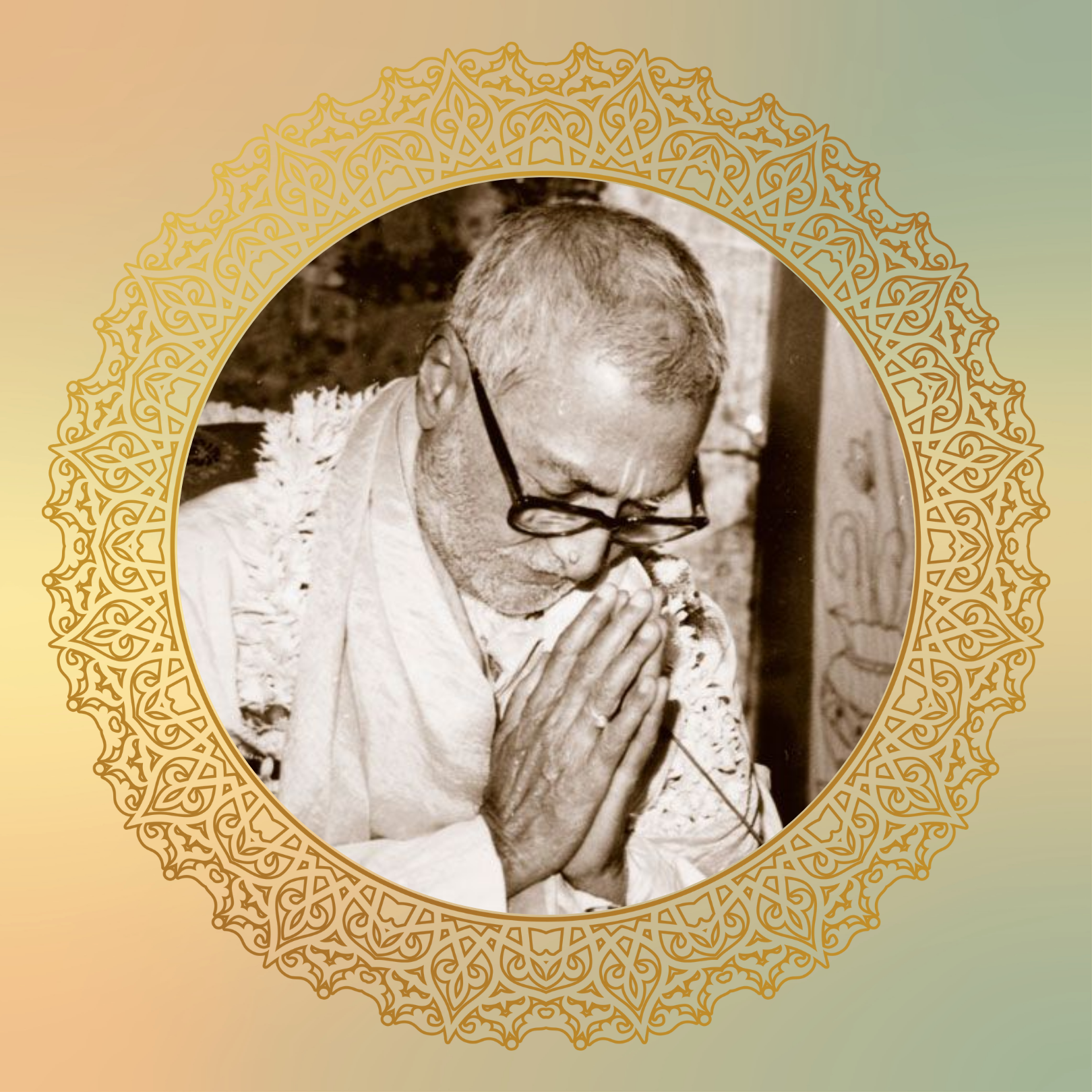
by Śrīla Bhakti Rakṣaka Śrīdhara Dev Gosvami Mahārāja
We must try to cast ourselves at the divine feet of the Lord saying, “I am the lowest of the low, I am willing to believe that I am the most helpless. I want the shelter of your lotus feet. Please take charge of me. I am unfit to take any responsibility for my own good. This should be our humble attitude. We should feel that, “I can’t tolerate this life of independence any longer. I can’t go on. I am disgusted with my life of independence. I want slavery. I want slavery dāsa.
Others may think themselves fit, but I do not think myself sufficiently developed to take responsibility for myself. I am the most reckless, mean, worthless and useless. Please accept me and give me any service at your feet. I can no longer rely on myself. I have come to take shelter of your holy feet. You are my guardian.” This is śaraṇāgati, to accept Kṛṣṇa as one’s absolute guardian.
No process of service can be perfect without śaraṇāgati, and certainly there can be no entrance into the higher domain. As such, śaraṇāgati is the very life and essence of devotion. It must be present in every form of service. Without śaraṇāgati our devotion will only be an imitation of service, not devotion proper. It will only be a lifeless activity. Therefore śaraṇāgati is the first condition.
If one is unable or does not have the opportunity to perform different types of service in the beginning, but he has only śaraṇāgati, he will get everything in the near future. Śaraṇāgati will give us everything. It is the most basic and fundamental substance in the devotional world. The whole structure of devotional service is based on śaraṇāgati. Prahlāda Mahārāja says that the whole of Vedic knowledge is based on ātma-nivedanam. You must give yourself wholly.
You must give yourself to the Lord. The substance of all devotional activity is to give yourself in surrender. Śrīdhara Svāmī in his commentary about śaraṇāgati mentions that everything is dedicated to Him then all these things can be recognized as bhakti, otherwise it is all bogus. If I hear, chant, etc., to fulfill my own purposes then it is no longer bhakti. Whatever I shall do, it is for Him. Then whatever will be done will be accepted as bhakti. It is the foundation on which bhakti stands.
Without śaraṇāgati all karma, jñāna, yoga will not be bhakti. Bhakti means that the result will go to the Lord. I am a slave to my Lord. I have got no independent personality to keep any independent property. I am wholly His servant. Whatever I shall acquire, everything is His. He has got the right to do anything with me that He likes, according to His sweet will. With this feeling if we perform any karma or smaraṇam, etc., that will be devotional activity. When that is withdrawn, everything will go to hell. Just as when the stage, where the dancing is performed, is drawn away, then the whole thing comes down.
Śaraṇāgati means self-dedication. Then the activity of the dedicated self will be bhakti. He must do everything on behalf of Kṛṣṇa, keeping Kṛṣṇa in sight, having no separate interest. Consciousness of separate interest has made us separate from Kṛṣṇa. Only when the common interest of everything is with Kṛṣṇa, then it will be bhakti. Śravaṇam, kīrtanam, etc., are mere forms, not life. In order to have a living devotion śaraṇāgati must be there.
Exclusive connection with Kṛṣṇa means exclusive identification with the interest of Kṛṣṇa. Since Kṛṣṇa is not seen there must be connection with guru and vaiṣṇava. First there must be self-abnegation to the degree of surrender, then the positive side will come and we shall be considered such as santa, dāsya, sakhya, etc. And in each of these there will also be subdivisions. But without śaraṇāgati all are mere formal activities, devoid of the very life therein, and they will be something other than bhakti, or rather self-dedication. The land of dedication is what we want, not the plane of exploitation or renunciation.
There is a sound in the śāstra that if we satisfy our Gurudeva we will satisfy Kṛṣṇa. And if Gurudeva is dissatisfied with me then Kṛṣṇa is surely dissatisfied. In Purāṇas we find a good example written there. Lord Kṛṣṇa is the sun, the lotus is the disciple, and guru is the water around the lotus. If the guru withdraws then the sun will destroy the lotus. If the guru is happy as long as the water is supplying the lotus, the sun’s rays will cheer the lotus. So the position of Gurudeva has been depicted nicely here.
The guru may be seen in different rasas of different types, but not much should be made of the differentiations. According to the situations there may be seen in changing moods, figures, etc. In so many ways the guru may be seen in Kṛṣṇa is the one with many waterways there, my guide to the absolute. Kṛṣṇa is one but there is a difference in their functions. Similarly Guru is there with different function. Thus in Nārāyaṇa, Lakṣmī, gopīs, etc. we find distinction and non-distinction. The gopīs when they are in the form of Lakṣmī they serve Nārāyaṇa in a particular way, so her inner heart has got the function of serving Kṛṣṇa in a particular way. So maintained simultaneously, we should have distinction and non-distinction. Both should be there. We should have respect for the differences, but we must not make them absolute, otherwise it will hamper the real devotion in the inner substance. The relative and absolute should go in the way we always have to harmonize both these great teachings: sarva dharmān parityajya and sva dharma.
Gaura Hari bol! Gaura Hari bol!