
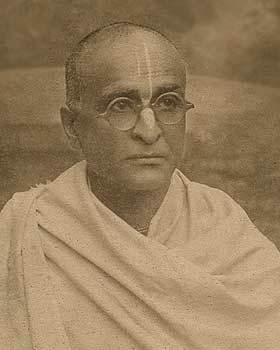
On 8 October 1932 in Mathura, in the presence of pilgrims assembled for the upcoming Vraja-mandala Parikrama, Srila Bhaktisiddhanta Sarasvati requested Srimad Bhakti Vilasa Gabhastinemi Maharaja to sing from Prarthana the song beginning “ara kabe palatibe dasa” and then himself explained some words from the song. The following extracts from that speech were published in the Gaudiya 11.218-21.
Bhramiba dvadasa bane rasakeli ye ye sthane: “I will wander throughout the twelve forests of Vraja, to all the places of nectarean pastimes.” Sri Gaurasundara said, anyera hr day a—mana, mora mana—vrndavana: “For others, the mind and heart are one, yet because My mind is never separated from Vrndavana, I consider My mind and Vrndavana one.”
Rasa arises in the pure mind from the mixing of the four elements vibhhava, anubhava, sattvika, and vyabhicari-bhava, with the sthayi-bhava rati. Krsna, the very form of all rasas, is completely satisfied when the five major rasas nourished by the seven secondary rasas, skirting the method of contemplation, manifest in a most amazing deep form within the heart blazing with sattva. Such a heart, called the “forest,” is a receptacle of, and serves as the support for, the twelve rasas. Wherever rasa-lila was performed has become smeared with rasa and flooded with prema. If a particle of any other desire occludes like a dam the current of rasa, the fountain of rasa cannot properly flow. The description and details of the appearance of material rasas in the unconscious receptacle, the material mind, which gives rise to thoughts, can be found in Bhava-prakasa, Sahitya- darpana, or the rasa-sastra of Bharata Muni. Rasas that arise from reading of heroes and heroines in such stories as Naisadha-carita, Savitri-Satyavan, Sani’s Pancali, Othello and Desdemona, or the story of Nala, are merely impermanent material emotions. In those affairs the subject of rasa is not the unsurpassable Lord who has no equal. But the subject of rasa in the twelve forests is Krsna, the Supreme Absolute Truth, the form of all rasas. He is the only subject of genuine rasa. The subject of the five rasas—santa, dasya, sakhya, vatsalya, and madhurya—is only Sri Vrajendra-nandana.
Sudhaiba jane jane vraja-vasi-gana-sthane nivediba carana dhariya: “I will clutch the feet of each Vraja-vasi and supplicate him.” Vraja-vasis know Krsna because at every moment, uninterruptedly, they serve Him in pure love. The cows and calves serve Krsna. Being toys for satisfying Krsna’s senses, they increase His pleasure. They are the play-dolls of His milking pastimes. Citraka, Raktaka, Patraka, Bakula and other servants serve Krsna, His cows, and His mother and father. They wash Krsna’s feet with the spiritual water of the Yamuna, a liquid form of Brahman. When Krsna returns from pasturing, all His limbs are covered with Vraja dust. At that time His servants wash Him with Yamuna water. What do Krsna’s cows know? They are actually very great sages. Those who after many births of austerity and reading the Vedas desired service to the Lord became cows in Vraja. They learned to serve Krsna by giving milk. They were not the so-called sages who study Vedanta. To attain Vraja-vasa one must be subservient to all Vraja-vasis Sri Rupa Gosvami Prabhu said:
tan-nama-rupa-caritadi-sukirtananu-
smrtyoh kramena rasana-manasi niyojya
tisthan vraje tad-anuragi-jananugami
kalam nayed akhilam ity upadesa-saram
One should reside in Vraja, carefully chanting about Krsna’s name, form, qualities, associates, and pastimes, gradually meditating upon them till he can realize preyah (that which is desired as presently enjoyable) and sreyah (the long-term goal) as nondifferent. Regulating all endeavors conceived of by the mind, one should aspire to develop a particular kind of affection for Krsna similar to that possessed by an inhabitant of Vraja. This is the essence of all instructions. (Upadesamrta 8)
Vraja-vasi means a servant of Hari possessed of spiritual understanding— not an enjoyer of material objects who is averse to serving Him. If I am not subservient to Citraka, Patraka, and Bakula, if I am not a follower of Krsna, if I become a material enjoyer subservient to the objects of the eyes and ears, then I do not live in Vraja and do not have spiritual love. “I am enjoying; this object is giving me pleasure”—that is called material enjoyment, the opposite of service to Krsna. If I do not have love for such shelters of dasya-rasa as Citraka, Raktaka, and Patraka, shelters of sakhya-rasa such as Sridama and Sudama, shelters of vatsalya-rasa like Nanda and Yasoda, and shelters of madhurya-rasa like Rupa Manjari and others, then how can there be Vraja-vasa? All of them are nitya- siddha Vraja-vasis.
Sudhaiba jane jane vraja-vasi-gana-sthane: “I will inquire from every Vraja- vasi” One should ask about a particular rasa from one who possesses it. If I ask about madhura-rasa then you should take me to a Vraja-vasi who exemplifies madhura-rasa. If you ask about it from those who have not associated with Lalita and Visakha, or who have not met Sri Rupa Manjari, they may start talking about the rasa of Ravana stealing Sita, or of Nala and Damayanti. The gopis asked about Krsna from all the trees in Vrndavana:
cuta-priyala-panasasana-kovidara
jambv-arka-bilva-bakuldmra-kadamba-nipah
ye‘nye parartha-bhavaka yamunopakulah
samsantu, krsna-padavim rahitatmanam nah
O cuta O priydla! O panasa, asana, and kovidara! O jambu! O arka! O bilva, bakula, and amra! O kadamba and nipa, and all you other plants and trees living by the banks of the Yamuna who have dedicated your very existence to the welfare of others! We gopis have lost our minds, so please tell us where Krsna has gone. (SB 10.30.9)
I heard that nowadays the panasa (jackfruit) trees in Vrndavana are not giving fruit. When Sri Gaurasundara wandered in the forests in the medieval period, there were many Kabul pomegranate trees lining the bank of the Yamuna. This is described in the Anubhasya [commentary on Sri Caitanya-caritamrta]. Jayadeva Prabhu has also mentioned this. The inhabitants of Vraja are of five types. The cows, bamboo, horn, flute, Yamuna, and the sand banks are Vraja- vasis in santa-rasa.
We cannot attain Vraja-vasa without the mercy of the Vraja-vasis. But why should they speak to us? How will we see them with material eyes? Because we are covered with pride and envy, they will not listen to what we say. Because we have no attachment for them, they do not speak to us. Why would the Vraja-vasis engaged in eternal spiritual pastimes speak to us? They say, “You are searching for material pleasure. Has Krsna become a material object for your pleasure?” One cannot know about Vraja except through subservience to Sri Rupa Manjari and Sri Rati Manjari. When we receive the mercy of Prabhu Nityananda, on that very day we will understand the mercy of Sri Rupa Manjari and Sri Rati Manjari; otherwise:
prakrteh kriyamanani gunaih karmani sarvasah
ahankara-vimudhatma kartaham iti manyate
The spirit soul bewildered by the influence of false ego thinks himself the doer of activities that are actually carried out by the three modes of material nature. (Bg 3.27)
Besotted in this way, we will not comprehend the verse:
sarva-dharman parityajya mam ekam saranam vraja
Abandon all varieties of religion and just surrender unto Me. (Bg 18.66)
One encounters obstacles when approaching Krsna in a spirit of averseness to serving Him. As a result of previous sins we worship many demigods. There cannot be good fortune without taking hold of the feet of those who serve Krsna favorably. “I rambled in the Vrndavana forest”—if while doing so I ate a fruit from a tree, or smelled a flower, then at that time I was not walking in the forest but was simply committing offenses with my feet. Govardhane na uthio—by these words it is understood not to place one’s feet on Krsna’s body. Without developing spiritual sakhya-rasa one cannot put his feet on Krsna’s shoulders; with false sakhya-rasa one cannot do so. We cannot wander in the forests of Vrndavana if we have the material enjoying mentality of a lucre-hunter.
How long will I live? Why should I perform other activities during those few days? Thakura Narottama has stated:
haiya mayara dasa kari nana abhilasa
tomara smarana gela dure
artha-labha-ei ase kapata-vaisnava-vese
bhramiya bulaye ghare ghare
Having become a servant of maya, I have unlimited desires. Remembrance of You has gone far away. Hoping to gain wealth, I roam fom house to house, deceitfully dressed as a Vaisnava.
The characteristics of hypocrisy are described in the beginning of Bhagavatam:
dharmah projjhita-kaitavo ’tra paramo nirmatsaranam satam
vedyam vastavam atra vastu sivadam tapa-trayonmülanam
Completely rejecting all religious activities that are materially motivated, this Bhagavata Purana propounds the highest truth, understandable by those devotees who are fully pure in heart. That highest truth is reality distinguished from illusion, for the welfare of all, and it uproots the threefold miseries. (SB 1.1.2)
Herein dharma, artha, and kama are kicked out. But sense enjoyers pray for these things. Other than Vedanta, the remaining five darsanas speak more or less of artha, dharma, and kama. And impersonalists who imaginatively interpret Vedanta are competitors with the sense enjoyers. To fear variety in spiritual life because of varieties of problems in material life, as “a cow whose barn was burned fears a red cloud,” merely engenders the same or even worse difficulties.
“We are studying Tarka-sastra according to Sri Jagadisa and Sri Gadadhara.” Anandagiri, who follows Sankara’s conclusion, Appayya Diksita’s Nyaya-raksa- mani, Parimala, Ananda-lahari, and Sivarka-mani-dipika, Vacaspati Misra’s Bhamati along with Sankara’s commentary—anyone with such views can never comprehend the nitya-siddha Vraja-vasis. By worshiping dogs one becomes a bhangi; by worshiping horses one becomes a groom; by worshiping iron one becomes a blacksmith; by worshiping gold one becomes a goldsmith. To become a Vraja-Vasi one must attain exclusive service to the nitya-siddha Vraja-vasis.
Members of the thirteen apa-sampradayas cannot comprehend the twelve transcendental rasas. Since the twelve rasas reside in Krsna alone, how can they be found elsewhere? This is my question to all the prakrta-sahajiya groups.
When we begin our search for Krsna, first we must range throughout the entire universe searching for a Karsna. By not taking shelter of the lotus feet of suddha Vaisnavas, and by instead calling non-Vaisnavas Vaisnavas, we invite severe misfortune. While playing music, a performer might happen to get lockjaw; similarly, fools consider the outward gestures of pretenders to be bhajana-siddhi.
The purpose of attaining that worthy object of worship is to become completely absorbed in love of Krsna. Krsna is not a material object. Can one see Adhoksaja Krsna with the infected eye attached to material enjoyment, like the one that Bilvamangala plucked out and discarded? Those who take Krsna as their order supplier, or likewise think that the objects of their sense enjoyment are Krsna—such persons’ infected eyes will soon turn into a cataract, for these two attitudes are obstacles to seeing the object of worship (Krsna) and the place where He should be worshiped (Vraja).
In two verses Rupa Gosvami has described the secret of bhajana:
anasaktasya visayan yatharham upayunjatah
nirbandhah krsna-sambandhe yuktarh vairagyam ucyate
Not being attached to anything yet properly using everything in relation to Krsna is yukta-vairagya, renunciation suitable for bhakti.
prapancikataya buddhya hari-sambandhi-vastunah
mumuksubhih parityago vairagyam phalgu kathyate
Renunciation, by persons desiring liberation, of items related to the Supreme Personality of Godhead, considering them material, is called phalgu (insignificant and worthless). (Brs 1.2.255-56)
According to worldly vision we should be either enjoyers or renouncers, considering the world either enjoyable or rejectable. As long as we hold such rascally conceptions we can bid farewell to eligibility for genuine bhajana.
Gaura Hari Haribol