
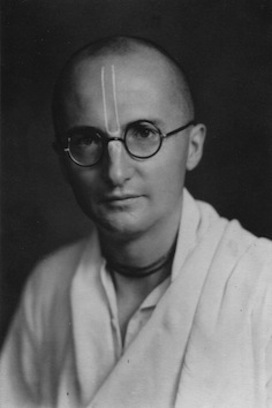
(Svami Sadananda Dasa to Vamandas, in the camp hospital 31 December 1943
© Kid Samuelsson 2011-Latest changed 01.03.2010)
Since the beginning of the kaliyuga no creative Divine Power has been at work to build up the human society on strict dharmic principles. Whereas, in the previous yugas, Vishnu manifested Himself repeatedly and Divine Shakti was infused into outstanding characters of political, social and economical importance, with the intention to establish in the samsara, at one or several places, a society based on theistic principles, giving the chance of partaking in the service of Krishna to every and each member of that society in the degrees of the willingness and capacity of the individual, so that all spheres of life were to a greater or lesser extent in direct contact with the service of Krishna, it is definitely not the will of Krishna to keep up anywhere in this world such a theistic society, in which the greatest intensity of direct service constitutes the only justification for having jurisdiction and authority in respect to others. It constitutes the greatness of the kaliyuga that those who are at all interested in the service of Krishna can devote themselves to that service without paying any attention whatsoever to the reaction of their actions on the society, to the apparently living, and they don’t have the least obligation to fulfil the so-called social duties which in the kaliyuga are considered the be- and end-all of life. Nevertheless, the society will indirectly benefit from the presence of such bhaktas, even if they would not display any external activity. It is the conscious or unconscious association with such people that gives the chance to other privileged souls to participate in the service, though the society does notdirectly or indirectly assist the practice of the serving attitude. It is perfectly useless to expect the establishment of a theistic society anywhere in the world in the kaliyuga because it is not the will of Krishna and not the programme put up for the kaliyuga. The experiments done in various countries in the kaliyuga to establish a society on ethical, moral or social principles of any sort are useless waste of energy, because all the ideals of the kaliyuga are secondary ideals, having no basis in the service of God but aim only at securing for everybody the greatest amount of material safety and continuance of the biological means to enjoy life. Once the fact is denied, that the real purpose of life in all spheres is to serve Krishna, the gradation of the members of the society according to their capacity and willingness to serve, becomes impossible, and instead of that society is classified according to the capacity and willingness of its members to work for supplying the means to enjoy life by all the members of the society to the greatest possible extent. All human ideals depend on the empiric character of man and not the real nature of man, and because the enjoying temper of one person or group is always in disharmony and conflict with the enjoying temper of another person or group, discord naturally constitutes the character of the history of the kaliyuga, a discord which is not the result of the conflict between the will to serve and the desire to enjoy as in previous yugas, where this conflict had the domination and intensification of the serving temper for its aim. It is completely wrong to impute to the war and strife in all spheres of life in the kaliyuga the motive of establishing final victory of the daivic and antiasuric force. In no age the shallow uselessness and worthlessness of human ideals become so distinctly manifest. Ethical and social values in the kaliyuga are apparent values only and the line of demarcation between the so-called good and bad is drawn according to the whims of those people who happen to dominate a certain part of society. All energy spent for the reconstruction of society on apparent religious principles, which are not really in accordance with the direct service of Krishna, is wasted. The certain proof of complete ignorance of the nature of God and the world is the attempt of a person to build
up a society on theistic principles in this kaliyuga, because it is not the will of Krishna. He who feels inclined to serve Krishna as He is, must serve Him without the least attention to the problems of humanity. It is not easy for a person in the kaliyuga to free himself from the erroneous opinion that human society itself has some value, and to overcome the enticing influence of the loftiest ideals of justice and humanity, so much propagated as the last hope of man in the present age. Many are allured by the charming picture of an utopian society, each member of which wants to serve the other – in reality to secure the proper means of the utmost degrees of aversion to the service of Krishna consisting in the desire to make this ephemeral world, at least temporarily, a place of enjoyment by the maximum elimination of the obstacles which stand in the way of such enjoyment. It is Maya in her most deluding form who comes to make men believe that it is worthwhile to fight for a homely samsara. The real bhakta is satisfied if he can find the way to induce worthy people to detach themselves completely from all social interests and to devotehimself to the exclusive, direct service of Krishna, though the society will not hesitate to decry such attitude as antisocial. The bhakta is not inclined to take serious the merely speculative values for which modern society quarrels. He minds very little the reaction of society, when he transgresses the ethical and social standards of that society, as he really does nothing but serve Krishna. He is at freedom to disregard the values, whenever he thinks it to be necessary in course of the fulfilment of the service of Krishna. His boldness and fearlessness increases in the degrees of the intensity of his service of Krishna and he is completely satisfied if his service pleases Krishna, even at the cost of the utter dissatisfaction of the wisest and most efficient non-bhaktas of humanity. It is the sweet will of the bhakta if he consents to abide by the standards of society, and he is under no obligation to serve its ends. And society cannot compel him to do so, if he does not like to keep up the show of doing so. It may be objected that very often in history in the name of service of God people tried to evade their social obligations. And where is the proof that a person transgressing the social values does it really for the service of Krishna. There can be no proof intelligible to the non-bhakta such as there can be no proof of the existence of the atma to the one who has not realised it, but everybody who likes to realise it is invited by the bhakta to take up the proper method to the realisation of the atma. But Truth cannot be realised by persons intent to contest the Truth or to know without unreserved service and dedication. The rationalist will object and say: You employ the same methods of all dogmatists, who fail to prove the truth of their statements, escaping to the fields of belief, where intellectual control and justification are impossible. But the bhakta will reply: Rational can only be that which is consisting with reality and human ratio belongs to the category of supposed but not actual reality. The only proof that the bhakta as atma-being is serving Krishna is the satisfaction of Krishna with that service, and society will be in the dark as to the nature of the person in question. Society will not be able to find out who is a bhakta or who is not with any criterion whatsoever and society is deceived and deluded in the degree of its unwillingness to serve Krishna. Not the false bhaktas of the past or present are guilty, what to say of the real bhaktas, if that society has been deceived. Society deserved to be decieved and therefore it was deceived. Besides what is the number of people deceived and put to difficulties by the false preachers of religion in comparison with the number of people put in difficulties and deceived by false moral and political propagandists? But certainly the worst criminal is a saint compared with the person who talks about God and preaches religion though he does not know himself what he is himself, what is God and the nature of the world, like Christian missionaries in India.