
(An article taken from the Sajjana Toshani (The Harmonist) VOL.XXIX, Februrary 1932, Chaitanya-Era , No. 8)
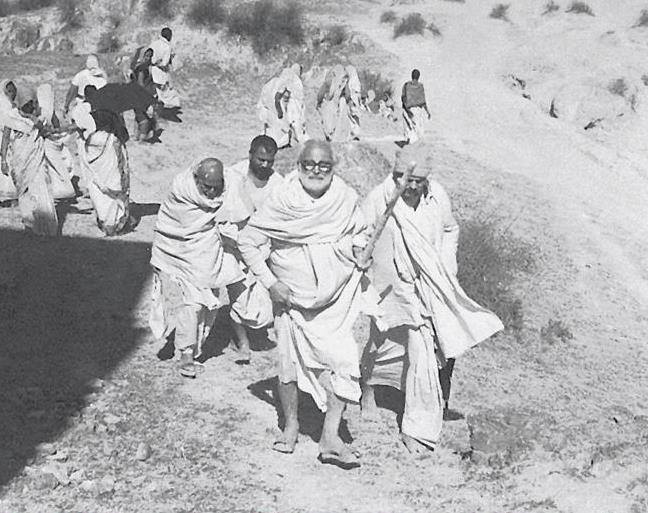
The Circumambulation of Sreedham Nabadwip will commence this year on the 12th March and will be completed on the 20th. The festival of the Anniversary of the Advent of the Supreme Lord Sree Krishna Chaitanya will be celebrated on the 22nd March. A certain amount of the details of the ceremony is to be found in the Nabadwip Almanac published by the Gaudiya Mission. The preliminary ( adhibas ) Kirtan will take place on the 11th evening, The ‘Nine Islands` will be circumambulated during the nine succeeding days in the following order!
March, 12th Antardwip (including Sreedham Mayapur )
,, 13th Simantadwip
„ 14th Godrumadwip
,, 15th Madhyadwip I6th Koladwip
,, 17 th Ritudwip
,, 18th Jahnudwip
,, 19th Modadrumdwip
„ 20th Rudradwip
The circumambulation of Sri Nabadwipdham is an ancient institution which can be traced in literature to almost the time of Sree Chaitanya. The well-known devotional work, Bhaktiratnakar, which is about two hundred years old, contains the ancient traditions connected with the different localities. They have been published in a handy form in Bengali with the title ‘Chitre-Nabadwip’. The reader is referred to that work for a detailed idea of the Subject in its different aspects.
There is an impression among a certain class of thoughtless people that the sanctity of a place or creed is somehow enhanced by its greater antiquity. Most of the places on this earth were in existence at the time of Sree Chaitanya and have been in existence from time immemorial. If the ancient history of a site is known the circumstance certainly adds to the human interest of the place. But it cannot sanctify i.e., confer any spiritual value on such locality.
Spiritual connection with Godhead or His devotee is the cause of the sanctity of a locality not because any mundane place is supposed to be able to recall the memory of the event which is transcendental, but for the entertainable reason that the locality itself is not mundane at all.
Sir P. 0. Roy in opening Sridham Mayapur Exhibition was led to declare that every particle of dust of Sridham Mayapur is sacred due to its association with Sree Chaitanya. If the localities surrounding Sridham Mayapur are annually visited for this antiquarian reason by pilgrims from all parts of the country such a custom would be of no help in preserving the real memory of Sree Chaitanya and His teachings.
The circumambulation of Sridham Nabadwip is not a national and antiquarian performance for showing respect to the memory of a great historical personality. Sree Chaitanya is Godhead Himself. Sreedham Nabadwip is the Eternal Transcendental Divine Realm. Sree Chaitanya, His Realm and His Activities are Eternal and are also capable of being realised as such by devout pilgrims in their performance of the circurnambulation of the spiritual sphere, by the Grace of those perfectly pure souls who serve Sree Chaitanya in the Spiritual Realm. The performance of circumambulation of Sridham Nabadwip under the guidance of the Sadhus is thus a purely spiritual function and the pilgrim in the course of his journey actually traverses not a number of mundane localities but the various constituent spheres of the Realm Absolute.
No particle of mundane dust can have any spiritual value whatever. Godhead and His saints never tread the mundane plane. They belong eternally to the spiritual Realm. The Appearance of Godhead to the view of mundane spectators is not a mundane event. A mundane spectator, till he is spiritually helped, can see nothing that is not mundane. The mundane entity which is observed by such a person is neither Godhead nor any of His saints but only a deluding mundane entity. Godhead certainly can and does manifest His Appearance in this world, without becoming thereby a mundane entity or getting alloyed by mundanity. He is declared by the Scriptures, to descend to the view of the spectators of this world with all His Divine Paraphernalia. But it does not, therefore, follow that the fleshy eye can have the actual sight of Godhead even on such occasion.
It may appear to be reasonable from the empiricist’s point of view to ask for the proof of the Divinity of Sree Krishna Chaitanya. The empiricist happens to think that it is his function to sit in judgment for allowing the claims of a person to the title of Divinity. Nothing can beat the impudence of such a ludicrous claim. Has the empiricist any faculty by which he can allow or disallow the claims of the Divinity?
The truth is that the empiricist is always denying the claims of the Divinity by requiring Godhead to produce such proofs of His claims to his allegiance as will be acceptable to his limited understanding. The attitude has produced the inevitable result in that the Divinity has never submitted any proofs for meeting such a laudable purpose. But on the contrary He has ever been supplying him with overwhelming proofs against all his claims. The empiricist has thus attained the state of utter ignorance of the Truth under the hypocritical conviction that what he is pleased to think as true for the time being, is, therefore, necessarily true. This may flatter his vanity at the expense of everything that really matters.
To this fool’s paradise the empiric pilgrim also is inclined to condemn himself by his so-called convictions and seeming critical caution. They only throw him more completely into the clutches of the deluding energy. By trying to avoid any concession to dogmatism he is made to grovel O in the fit of abject submission to the degrading dogmatic freaks of the Arch-Enchantress who is the mother of this material world.
It is necessary for the real seeker of Truth to approach Him by his genuine serving disposition. The wish to dominate Truth is the fruitful source of every form of ignorance. There is no other degradation for the soul than the hankering for such domination. There is no truer elevation than artless receptive serving humility in presence of the Absolute Indivisible Truth Who is all pervading. The Divinity is the Truth. He is a Person. His Personality is the reciprocal of our own transcendental nature. He is the only master. We are all His servants. Our pure animation is enabled to retain his spotless purity by His service.
But as Godhead is the Indivisible Truth His Realm and eternal servitors are part and parcel of Himself. It is no service of the Absolute which leaves out of account His eternal servitors and His eternal realm. Godhead manifests Himself through the functions of His constituents.
The ‘jeeva’ is a particle of the Divine Essence. But he is a detachable part of His Essence, He is privileged to serve Godhead by remaining eternally detached from Him. He is located in the superfluous or marginal zone of the Essence of the Divinity. There is also a negative zone. The ‘jeeva’ is a particle of the positive zone projected into the no-man’s land between the spiritual and mundane spheres of existence. He is liable to be drawn into the mundane sphere although he is by constitution a particle of the positive Essence of the Divinity.
The Realm of the Divinity is also of the Essence of the Divinity. The ‘jeeva’ is a detached particle of the Spiritual Potency of Godhead. The Realm of the Divinity is the Plenary Spiritual Power of the Divinity. The ‘jeeva’ can serve Godhead only in and through the aid of the Divine Realm. The Divine Realm is a spiritual Entity with freedom to allow or disallow the overtures for the service of the Divinity. But it is necessary for the ‘jeeva’ to seek her aid against every sort of apparent discouragement. The ‘sadhus’ who are the accepted proteges of the Divinity, teach us by their example and precept how to secure her favour.
The pilgrim who is, therefore, anxious to obtain the sight of Godhead, is under the absolute necessity of seeking the aid of the Divine Realm. The sight of the Divine Realm admits us automatically also to the Presence of the Divinity Who abides only there. But the Divine Realm tests our sincerity as seekers of the service of Godhead before she condescends to aid our endeavour. If she finds that we want to dominate and not to serve the Truth she presents her unapproachable face to our view. She appears as dumb as the sphinx to our hypocritical entreaties for her aid. This is the plight of the empiric pedant on the threshold of the Divine Realm. But the ‘sadhu’ is always at our elbow with his counsel of genuine submission to the Plenary Power of Godhead in recognition of Her, Divine Nature. The sadhu speaks to us in concrete and intelligible language. But the sadhu speaks with real knowledge of the requirements of the position. There is thus imperative necessity of making the pilgrimage under the guidance of the real sadhu. But the words of the sadhu also may appear to be irrational to one who is inclined to set up his experience of the world to be judge of the propriety of the sadhu’s counsel. Mundane experience can give no positive help in the quest of the spiritual. It is not necessary to turn to it for such help. The words of the sadhu can give every help that one requires for the spiritual purpose, provided only that one is not really willing to have anything mundane.
The spiritual realm is realisable in and through the words of the sadhu. The spiritual realm cannot be seen by the mortal eye, nor touched by the hand of flesh. Neither is it the closed ear that can hear the true voice of the sadhu. The ear of the soul is to be opened to the spiritual sound. In other words one is to listen to the words of the sadhu with the conviction that the words themselves are identical with the object which they signify, that if the words are only received by the fully receptive rational impulse the whole indivisible substantive reality will stand self-revealed. If the result is otherwise, it can only be due to the deliberate withholding of one’s full attention. It is in one’s power to correct this error of method when it is pointed out by the sadhu. In proportion as the receptive attitude of hearing is perfected the true import of the words of the sadhu manifests itself to the soul of the hearer. It is necessary to offer this form of service by way of the preliminary on the threshold of the Realm of the Divinity by all those who really want to enter there.
The pilgrim is required to give up his preference for pseudo-knowledge if he is to be benefited by his pilgrimage of the Divine Realm under the guidance of the sadhu who has a natural and exclusive attachment for the Real Truth. The guidance of the sadhu is necessary for enabling him to lend his full attention to his words by discarding all explicit or latent partiality for untruth. The function of the cognitive faculty is to be relieved from the consequences of its willful and perpetual attraction towards un-truth. Guidance for such an end is not any curtailment of one’s freedom of rational choice. The rational faculty is only then true itself when it submits to be guided by a competent person in the quest of the Truth Who is located beyond its reach. It is prepared to submit for its instinctive and causeless love for the Truth. It is enabled to attain its fully expanded natural state by such submission. Neither the end nor the method indicated above proposes any form of mechanical subordination to an external agency which is being always enforced without any protest on the part of the conditioned soul by his material environment. Unless we are prepared to adopt the only rational course that is open to us the attainment of the knowledge of the Absolute Truth in the form of willing submission for receiving Him from His agents we really abdicate our rational function by preferring to follow the irrational alternative. We are of course free to go astray. We are also free to maintain that such irrational course is rational. But such sophistry will not enable us to avoid the logical consequences of such a procedure in the shape of losing sight of the Truth altogether.
True, the description of Sree Nabadwipdham in the literary works penned by the devotees who speak of the Absolute Truth, is bound to appear to the uninitiated as being apparently opposed to the evidence of one’s senses. This is the standing grievance of the empiric historians and antiquarians in regard to the statements of the devotees. But the devotees always take good care to inform their readers that they are not describing anything that is limited by space and time. Empiric historians and antiquarians cannot be expected to understand on their own terms the nature of spiritual entities. Neither is that their function nor purpose. The erratic excursions of empiric historians and antiquarians into the domains of the spirit should be avoidable by the exercise of the ordinary honest common sense that is happily to be found also in this mundane world.
It is not proposed that the empiric historian and antiquarian should be debarred from approaching the subject of the Absolute. It is the duty of all persons including the atheists to seek the Absolute and to seek nothing but the Absolute. But the empiric method which is employed by the historians and antiquarians who are engaged in the so-called investigations of the phenomena of this world by the resources of their defective limited senses, cannot enable one to understand at all the subject-matter of the revealed Scriptures. It is, of course, open to the empiric historian and antiquarian to apply their own method to the investigation of a spiritual subject for deducing a purely mundane conclusion against the principle of rationality. This has actually been done by more than one famous writer. But such attempt constitutes only one of the numerous departments of changeable human knowledge which have nothing to do with the spiritual.
One who undertakes the pilgrimage of Sree Nabadwipdham with the conviction and in pursuance of the method of the empiric historian and antiquarian, will certainly enrich the range of his worldly experience which he values. But he will miss the spiritual end which is declared by the Scriptures to be attainable by the performance of the journey under the guidance of the sadhus.
We invite all persons to join the devotional function with the attitude that is necessary for ensuring the success of the spiritual quest which alone matters. It will not be irrelevent to consider at this place the nature of the objection that has actually been taken by certain persons to the practice of asking pilgrims to serve Sree Gaurkunda and Sree Radhakunda at Sridham Mayapur. Those objectors probably think that Sree Gaurkunda and Sree Radhakunda are merely tanks that have been made by recent excavation and cannot, therefore, have really anything to do with either Sree Radhika or Sree Gaursundar Who appeared on this earth long ago. But those who make the pilgrimage to Sridham Mayapur never suppose that either Gaurkunda or Radhakunda can be any pool of water of this or any other period, or that bathing in Sree Radhakunda is identical with a bath in some ancient tank of the British District of Mathura. Sree Radhakunda is always invisible to mortal eyes ; nor can any mortal ever bathe in the same. But Sree Gaursundar appeared in the Form of His Power in the home of Sree Chandra Sekhar Acharyya. Sree Chaitanya Math occupies the site of the residence of Sree Chandra Shekhar Acharyya. Sree Radhakunda is certainly to be found in the home of Sree Chandra Sekhar by one who seeks for a bath in the same. Sree Gaurkunda is to be eternally found only in the home of Sree Jagannath misra. Those who have no faith in Sree Gaursundar are not likely to understand the sayings and doings of His devotees, nor ever attain the sight of the Eternal Transcendental Realm of the Divinity. Faith in Sree Gaursundar cannot be obtained except by the grace of His bonafide devotees. It is not the so-called blind faith of the empiricists of this world to which the reader is asked to subscribe. Neither is it asserted that true faith is any product of the so-called empiric knowledge. Spiritual faith on the contrary, is that perfectly rational disposition of the pure soul which seeks patiently and unceasingly for the service of the Absolute Truth. The sincere seeker of the service of the Divinity is alone privileged to be favoured by the sight of the Truth for the purpose of rendering such service.