
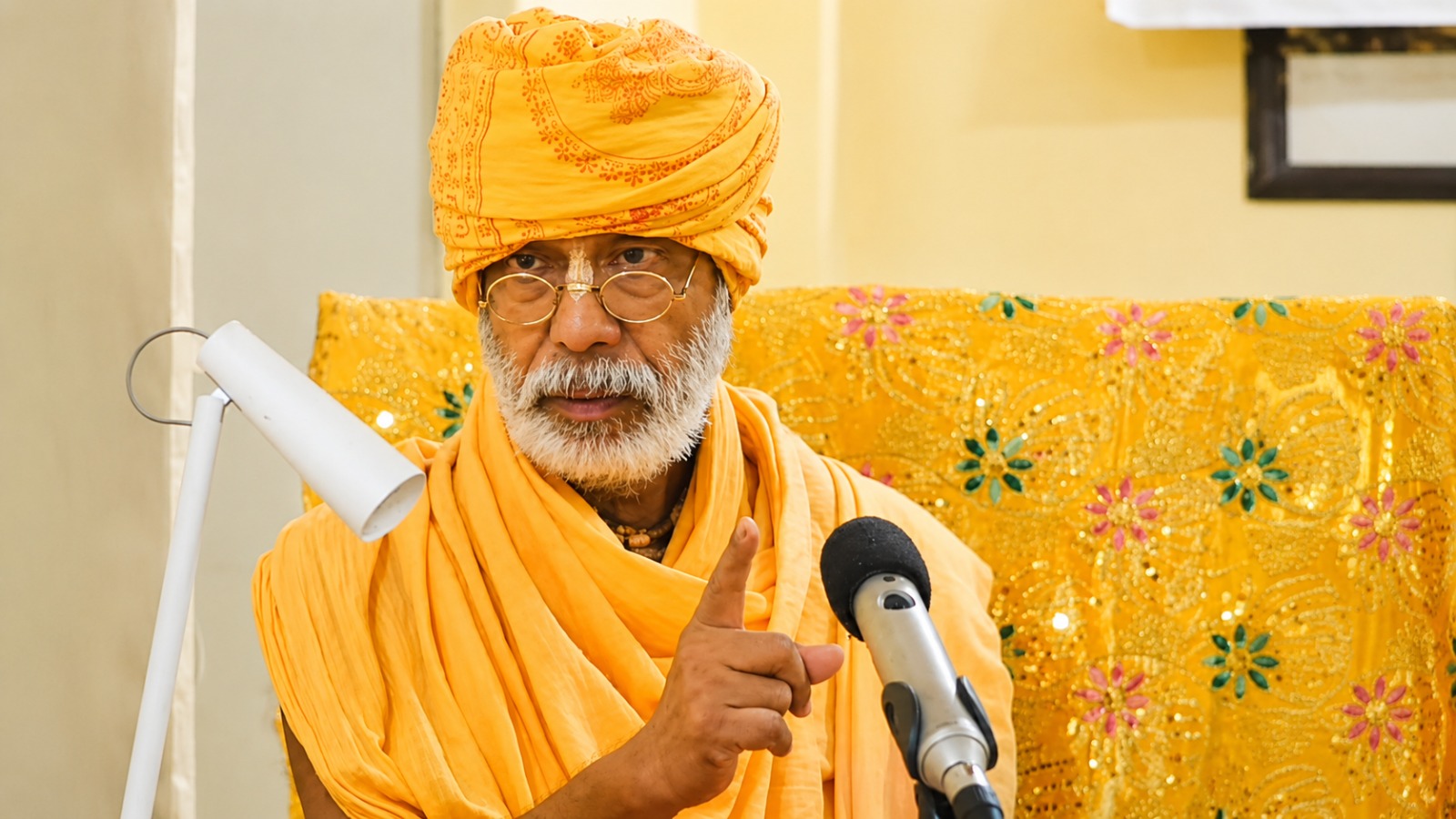
Śrī Śrīla Shyām Dās Bābā Mahārāja
(Date 10.08.2026)
Gauḍīya Goṣṭhī Pati Śrī Śrīla Bhaktisiddhānta Sarasvatī Gosvāmī Ṭhākura Prabhupāda once said–“Those who, after staying for a long time with pure Guru and Vaiṣṇavas, and still do not feel the necessity to take initiation (dīkṣā), are surely kapaṭa (not sincere).”
It is a fact that if someone hearing absolute Hari-kathā from an absolute source, but still not feeling any positive reaction inside heart to take shelter unto the Lotus feet of a sat-guru with the resolution to dedicate his/her life for the absolute sevā of Guru-Vaiṣṇava-Bhagavān then he/she must be a kapaṭa.
If one can truly realize ātmā-tattva through hearing absolute Hari-kathā with full attention to realize that everything is unstable in this world, always changeable and destructive by nature in course of time, then his/her heart naturally can feel the necessity for taking real eternal shelter (āśraya) unto the Lotus feet of śuddha Guru-Vaiṣṇava.
Even Mārkaṇḍeya Ṛṣi who was granted with the lifespan of seven kalpas, still he cannot give any guarantee about the stability of his life. After experiencing the first pralaya (devastation of the universe) he started thinking himself as a foolish for the benediction accepted by him from Shiv Ji, because he had to suffer so much. After long time drifting helplessly in the cosmic waters, he finally felt the soft touch of a cow. That cow was Surabhī Go-mātā, who resides eternally in Godrumadvīpa. Mārkaṇḍeya Ṛṣi immediately took shelter of her. Surabhī Go-mātā lifted him from the water of pralaya and brought him to the island of Godrumadvīpa, a place which is never touched by the annihilation of the material universe, where he finally got relief. The same way the jīvātmā is also floating since time immemorial in the ocean of material saṁsāra, suffering his or her own karmic reactions, but if somehow one jīva can come in touch with pure Guru-Vaiṣṇavas — who are staying on the safe ground beyond the influence of material influence — I mean in Vaikuṇṭha-jagat, and can take finally shelter, then can discover all problems are over. To illustrate this scenario of taking shelter further we would like to give another very nice example —
Once, in a village in North Bengal, a massive dam broke down during the night time, then all those flood waters started flowing in a very destructive crazy mood to inundate all the villages and towns all around. In this way everybody was helpless to protect themselves from flood water. Small babies were found detached from mothers or husbands were found detached from their wife’s etc. etc. How destructive the nature of the flood was visible, even we cannot imagine in dream.
Somehow a few of them had the good fortune to meet with a banyan tree to grasp the branches with all their strength to protect themselves from the strong current of the flood water. This is the example just fitting for those who are floating in the current of māyā. If we can feel from heart the danger of this material ocean where countless waves disturb us in the form of lust, pride, envy, deceit and to compel us to run through countless birth and death cycles, then in that case we can feel the absolute necessity to grasp the lotus feet of a powerful sat-guru to get absolute protection, because only such kind of shelter can deliver us from our helpless condition. But by taking shelter of a false guru or kapaṭa guru this kind of absolute protection can never be ensured.
A person or any so called devotee may perform many religious activities with material interest, but until and unless one not going to take shelter of śuddha guru-vaishnava with unconditional-mood, cannot save himself or herself. It is just like a foolish effort of watering the desert before planting the seed. Without the absolute connection with a very powerful Sat-Guru true bhakti is like a castle in the sky.
The Prabhupāda wanted to clarify us that — merely visiting maṭha-mandir is not sufficient. One may participate in kīrtana, or can offer daṇḍavats to the Deities in the temple or to Guru-Vaiṣṇavas, or can listen Hari-kathā from a genuine sādhu, or even can participate apparently in various sevās — but if not at all feeling the urgency to take dīkṣā from a sat-guru, then his sincere attitude to become a devotee can never be proved. Without saṁbandha jñāna even devotional life cannot start — that is the absolute siddhānta shown by the The Prabhupāda.
Dīkṣā certainly is not only a ritualistic function. Dīkṣā is the divine process through which someone can develop absolute sambandha-jñāna to get established in Bhāgavata-sevā.
In this way Śrīla Bhaktisiddhānta Sarasvatī Gosvami Ṭhākura Prabhupāda wanted to protect people from self-deception and also he wanted to cut off all anarthas in the form of so called religion which is called mano-dharma, deha-dharma or chala-dharma etc. to guide us towards śuddha-bhakti.
Sometimes we can hear people saying that only harināma is enough, no need of taking dīkṣā. This is not at all the vicāra of sāstra. That may be true but this is very rare and exceptional. For example, Śrīla Parīkṣit Mahārāja did not take formal dīkṣā from Śukadeva Gosvāmī. Śukadeva Gosvāmī himself also did not take dīkṣā from anyone. Also in the case of Prahlāda Mahārāja we can see the same thing. But surely these are not at all normal or usual cases.
For example in the case of Parīkṣit Mahārāja, Kṛṣṇa personally entered the womb of Uttarā mataji to protect him from the brahmāstra launched by Aśvatthāmā to destroy the seed of Pāṇḍava dynasty. So naturally there cannot be any doubt about him who got the darshan of Bhagavān while remaining inside the womb of mother. Also in Śrīmad-Bhāgavatam we can see that Śrīla Parīkṣit Mahārāja already described as a mahā-bhāgavata many times, and we also know that through the hearing of Śrīmad-Bhāgavatam from Śrīla Śukadeva Gosvāmī — the topmost Paramahaṁsa, sambandha-jñāna naturally arose within him. Śrīmad-Bhāgavatam can give us all like sambandha–abhideya-prayojan– everything. Therefore, there was no need of any formal initiation ceremony. The Prabhupada already confirm this point many times. Also we can find one very important sloka written by Śrīla Viśvanātha Cakravartī Ṭhākura which can clarify any doubt inside us –
ārādhyo bhagavān vrajeśa-tanayas
tad-dhāma vṛndāvanam
ramyā kācid upāsanā vraja-vadhū-
vargena yā kalpitā
śrīmad-bhāgavataṁ pramāṇam amalaṁ
premā pumartho mahān
śrī-caitanya-mahāprabhor matam idaṁ
tatrādaro naḥ paraḥ
(Caitanya-mañjuṣā —Śrīla Viśvanātha Cakravartī Ṭhākura)
Vrajendra-nandana Śrī Kṛṣṇa is our exclusive object of worship and love. In the same way that He is worshipful, so is His transcendental abode, Śrī Vṛndāvana Dhāma. The mood in which the young brides of Vraja [the gopīs, headed by Śrīmatī Rādhikā] worship Him is the highest and ultimate form of love of God. Śrīmad-Bhāgavatam alone is the immaculate scriptural evidence of this. Kṛṣṇa-prema is the supreme objective of life [beyond mundane religiosity, economic development, sense gratification and impersonal liberation]. This is the conception of Śrī Caitanya Mahāprabhu (gaura-vāṇī). We hold this conclusion (siddhānta) in supreme regard [and have no inclination or respect for any other conclusion or cheating opinions].
In the case of Śrīla Śukadeva Gosvāmī, we know it for sure that he was already ātmārāma by birth, fully established in brahma-jñāna. By hearing the glorification of the Supreme Lord Śrī Kṛṣṇa in the form of absolute description about the absolute beauty and mercy of Śrī Kṛṣṇa he was totally surprised to jump into the ocean of nectarine Bhagavat katha. In this way according to his own declaration he was absorbed in Kṛṣṇa prema.
pariniṣṭhito ’pi nairguṇya
uttamaśloka-līlayā
gṛhīta-cetā rājarṣe
ākhyānaṁ yad adhītavān (ŚB 2.1.9)
“Although I was fully situated in the transcendental position, I became attracted by the pastimes of the Supreme Personality of Godhead, who is celebrated by sublime poetry. Thus, O saintly King, my mind became captivated by the narration of His pastimes.”
Another very important point is that the Supreme Lord Himself came in the form of Śukadeva Gosvāmī to teach us the absolute Bhāgavata-dharma.
Similarly, in the case of sādhana-siddha Nārada we can see that by the help of sat-saṅga in the form of hearing Hari-kathā etc. during the period of Cāturmāsya-vrata he was successful to attain the highest goal in course of time. In this way he was given siddha deha by the Supreme Lord without any formal dīkṣā.
Again Hanumān ji Maharaj, or Ajāmila, or Yajñika-vipra-patnīs and others also did not go through formal initiation.
bahavo mat-padaṁ prāptās
tvāṣṭra-kāyādhavādayaḥ
vṛṣaparvā balir bāṇo
māyāś cātha vibhīṣaṇaḥ (ŚB 11.12.5)
In every yuga many living entities entangled in the modes of passion and ignorance gained the association of My devotees. Thus, such living entities as the Daityas, Rākṣasas, birds, beasts, Gandharvas, Apsarās, Nāgas, Siddhas, Cāraṇas, Guhyakas and Vidyādharas, as well as such lower-class human beings as the vaiśyas, śūdras, women and others, were able to achieve My supreme abode. Vṛtrāsura, Prahlāda Mahārāja and others like them also achieved My abode by association with My devotees, as did personalities such as Vṛṣaparvā, Bali Mahārāja, Bāṇāsura, Maya, Vibhīṣaṇa, Sugrīva, Hanumān, Jāmbavān, Gajendra, Jaṭāyu, Tulādhāra, Dharma-vyādha, Kubjā, the gopīs in Vṛndāvana and the wives of the brāhmaṇas who were performing sacrifice.
Either through the direct association of Bhagavān or through the association of His pure devotees, they naturally developed sambandha-jñāna without external dīkṣā. Śrīla Saccidananda Bhaktivinoda Ṭhākura also said that if someone already having absolute sukriti to develop one hundred percent faith in harināma mahā-mantra, then in that case the person concerned need not take any dīkṣā because his Harinam taken (form any Mahapurush) from any pure Vaiṣṇava can give the complete result in the form of Kṛṣṇa-prema-prāpti. However, in general case for us all dīkṣā is a must, because that will help us to cut the strong relationship with māyā.
Śrīla Raghunātha dāsa Gosvāmī has written:
gurau goṣṭhe goṣṭhālayiṣu sujane bhū-sura-gaṇe
sva-mantre śrī-nāmni vraja-nava-yuva-dvandva-śaraṇe
sadā dambhaṁ hitvā kuru ratim apūrvām atitarāṁ
aye svāntar-bhrātaś caṭubhir abhiyāce dhṛta-padaḥ
(Manaḥ–śikṣā 1)
“O my brother mind, with these gentle words I grasp your feet and beg you—always give up pride and develop deep, unparalleled attachment to the guru, to the holy land of Vraja, to the residents of Vraja, to the devotees, to the brāhmaṇas, to one’s mantra, to the Holy Name, and to the shelter of the ever-youthful Divine Couple of Vraja.”
Gaura Hari Hari Bol