
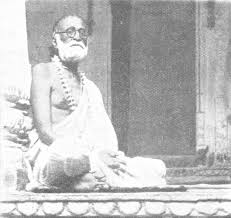
(Full article from The Harmonist, Vol. 4, April 1932, Pages 332 to 336, by His Divine Grace Srila Bhaktisiddhanta Saraswati Thakur Jagad Guru Prabhupada).
The appearance of the ideas of right and wrong, good and bad, has been supposed to be the decisive mark of, what is called in the English language, the civilized condition of human beings. This test is supposed to be equally applicable to individuals as well as communities.
Man is supposed to be alone endowed with the possession of the moral faculty. Its possession particularly distinguishes mankind from other animals and all lifeless objects. Moral activity is declared to be not merely purposive activity. The purpose must also be righteous. It is quite possible for a person to have a bad purpose. Badness is considered to be distinguishable from ignorance. It is possible for an ignorant person to be a good man.
But it is not so easy to say clearly what makes any act either good or bad. Adultery may be taken as an example. Is it bad or good ? It is generally supposed to be immoral. But has any perfectly satisfactory reason been given by any moral philosopher why it should be considered as a bad thing ? True, the practice of adultery involves certain consequences both to the individual practising it and to others. But these consequences are not necessarily peculiar to unmarried sexual intercourse or to sexual intercourse in contravention of the rules of marriage. The reasons, if there be any against adultery, would, most of them, if not all, apply also to sexual intercourse itself. It would, therefore, be difficult logically to regard the sentiment against adultery as anything more than the result of a longstanding, generally observed, social convention. The good points of the practice of chastity may be admitted without extreme or illogical advocacy of a physical relationship. The married state enjoined by the scriptures is not made to rest on the merely mundane basis.
All the so-called virtues could be proved in a similar way to be, at least in a very great measure, the offspring of habit. It is considered to be a good act to relieve physical suffering. It certainly is welcomed by the person who may be the recipient of the benefit of it. But how do we know that pleasure is morally better than pain ? If a drunkard suffers from the troubles of a bad liver how can we say that he does not deserve such suffering, or that such suffering may not do him real and lasting good, in the sense of making him willing to drink less in future ?
There is even more serious objection to admitting any real value of so-called morality, than the above. Morality may be after all only a convenient device for exploiting the ignorant and the weak by the intelligent and the strong for the furtherance of the immoral interests of the latter. For example it is almost generally admitted as the moral duty of every civilized country to make suitable provision for the education, health and feeding of the poor. In capitalistic countries this duty is so managed that the interests of the rich are thereby served at the expense of those of the poor.
The moral principle as conceived by the empiricists must always point to some form of mundane utility. It is the nature of such utility to be limited, defective, and to a certain extent positively harmful. The practice of such morality can never give all-round satisfaction even to a limited number of persons though only for a short time. For this reason it is quite possible for a number of persons to quarrel with one another by invoking the particular moral principle in defense of his conduct that is best calculated to serve his special purpose. So that ultimately professions of morality become utterly powerless and come to be discredited as of any help for the promotion of real well-being.
This is the reason why at the present moment almost all over the world there is observable almost a definitely general movement against the tenets of the fashionable moral code. The apologists find it impossible to secure the re-acceptance of a worn-out system that has been tried and found wanting. The world is drifting into a non-moral position which is bound to be destructive of regulated social life whose consequences it is not pleasant to contemplate.
If everybody does in society what he likes will it be possible to exercise sufficient check upon the rascals and fools ? The non-moral condition will quickly degenerate to all intents and purposes into the professedly immoral. This may be a triumph for the reason but at the expense of everything that makes human life at all interesting. But the ideas of right and wrong cannot be got rid of by simply ignoring them. They are bound to have their revenge if they are attempted to be hustled out so unceremoniously. Animalism is lower than moralism, than even empiric moralism with all its patent defects. If reason cannot discover a morality that is higher than that of the empiric brand it will not certainly be justified to commit suicide by falling back into animalism.
There is a third alternative. Morality may be supplied with real legs by giving up its alliance with the principle of worldly utility. In that case it may claim to be absolute by its own right. If it tries to do so the real difficulty will be in defining it, the existing conventional code being found ineffectual in practice. It will be neither safe nor practicable to overlook this material difficulty of the existing code. If an attempt be made to draw up a new code free from the worst defects of the present one such an attempt may have to advocate the legalising of certain forms of conduct that would go against the fundamental principles of the existing code. The democratic or legislative method is, therefore, likely to be unfavourable to the cause of morality as it has been ordinarily understood up till now.
The nearest equivalent of the term ‘a-sat ’ (Bengali) is non-permanent existence. It is possible to classify entities into really existent or ‘sat ’ and not really existent or a-sat. The soul belongs to the category of real existence or ‘sat ’. The mind and physical body are not real existence. In this world the deluded soul seeks all kinds of relationship with the body and not mind. But the soul can have no real relationship with either. This misguided affinity of the deluded soul towards non-substantive existence, is the cause of all suffering and evil that afflict everyone in this world. If it be our object to lessen physical and mental suffering it will be necessary to find a method for removing the delusion which is the cause of such suffering.
Pleasure and pain are non-absolute i.e. relative existence (a-sat). Neither of them can really satisfy the soul. The soul is everlasting. Neither pleasure nor pain can be everlasting. On the contrary they are the co-ordinate faces of the deluded experience. The same is true of all similar other couples which are the offspring of the activities of the material mind. Right and wrong, good and bad are not substantially different from one another. But all of them are substantially and eternally different from the absolute existence or the sat.
The moral codes that have been invented by the erring mind can only perpetuate the evil which it does not understand and cannot remove. But the relative existence, a-sat, also really exists. It is, therefore, a source of real trouble to all of us. The deluded soul may pretend not to be able to recognise this. He may also be disinclined to recognise that his abnormal alliance with the mind and body is the real and only cause of all his miseries.
But even the conventional moralists are never tired of declaring from the house top that they are also believers in the absolute purity, at any rate potentially, of the soul. If this is really admitted they should be able to recognise the distinction between the relative and absolute existence sat and a-sat, and also to recognise this distinction as alone affording the only basis for a true science of conduct that is proper for the soul. Instead of running after so-called bad and good, right and wrong, it is necessary to try to understand the real nature of absolute existence, the sat, in the first place.
The distinction between sat and a-sat is not merely subjective. One cannot become sat by simply wishing to be sat. The conditioned soul cannot get rid of his fetters of relative cognition by his own efforts. Mental speculation is bound to lead its victim into a blind lane. No amount of mental cogitation can produce real enlightenment or afford real relief from our blinding limitations. It will not do to call any condition good if it is to be found to be of no use to the soul. All impermanent relief is thus proved to be really illusory and, therefore, harmful in one way or another, in as much as it tends to perpetuate the delusion. This is the radical defect of so-called conventional morality. This defect cannot be removed by persisting in the old groove. It is necessary to find out a method of getting out of the vicious groove if any permanent and real relief is to be expected.
The quest of the Absolute thus becomes necessary also for the Utilitarian by the pressure of perpetual disappointment. As neither present, past nor prospective experience offer any escape from the tragedy of the vicious circle the irrational advice of the empiric ethical philosopher has not proved wholly acceptable to the present generation which is aggressively pragmatic and realistic.
The distinction between good and bad is real although it is unattainable by the light of empiric philosopher. It is necessary for us to know what it is. Our Scriptures tell us that the substantive entity, by whose unwholesome shadow we wrongly suppose ourselves destined to be perpetually deluded, is to be found only on the substantive or absolute plane. This, as will appear from the above, is fully in keeping with the requirements of the rational instinct. That which is absolute is natural, i.e. necessarily and fully good, for the soul. What we are required to find is our own selves. The soul is not in his natural condition at present. The soul is naturally good as he is free from all limitations. This perfect condition is also realisable, by the admitted and familiar process of honest apprenticeship, on his own terms, with a person who really knows. The Scriptures help us to find such a person. This help comes at first from within. But this light cannot grow beyond a certain point if it chooses to confine itself to this selfish, individualistic source. It has to expand into a congregational function by being lifted to the plane of the service of the One Person by many individual persons in concert. In this spiritual community every individual member is related to all the rest as disciple to teacher, to use a very unsatisfactory phrase to denote the mutual relationship subsisting between all perfectly pure souls.