
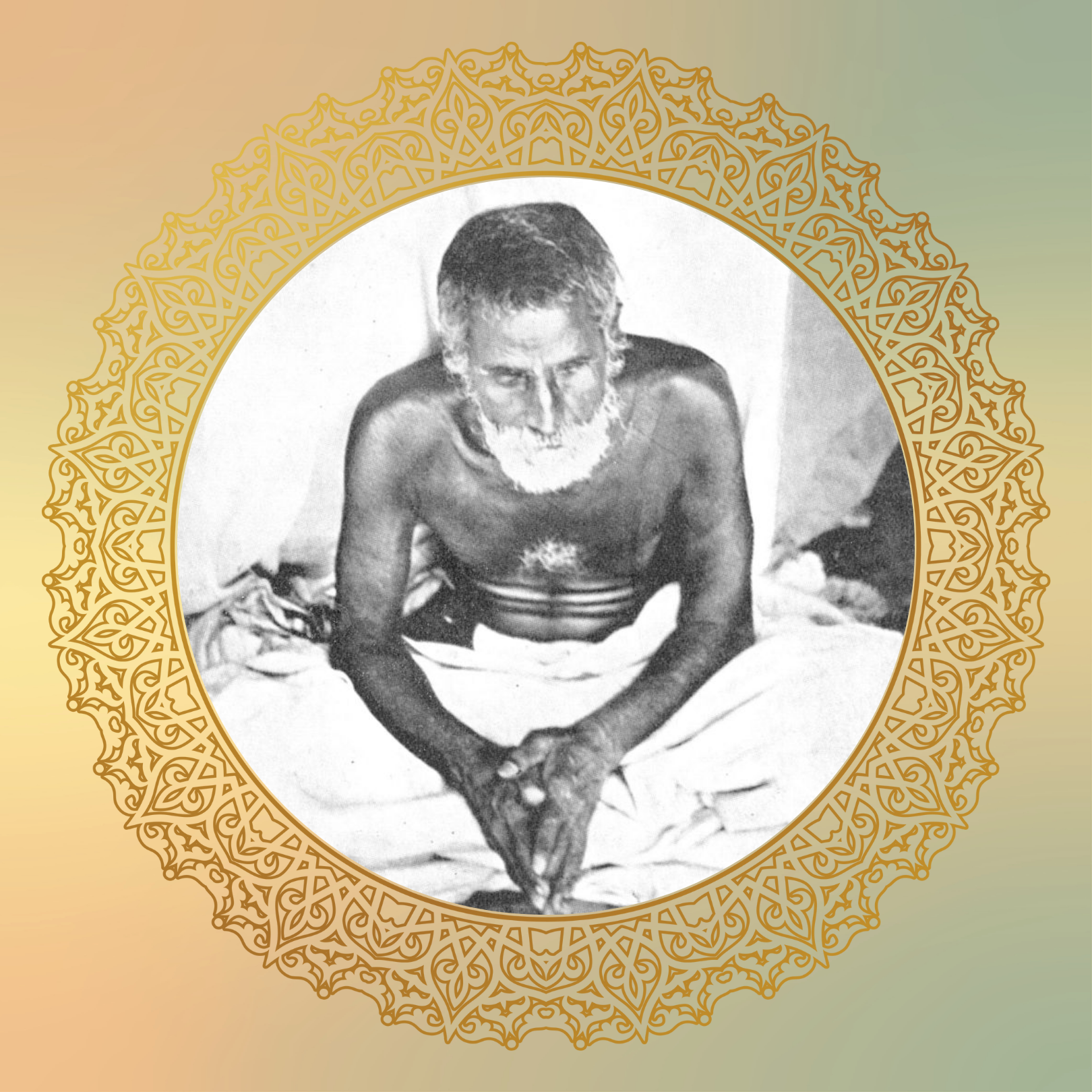
by Śrīla Bhaktisiddhānta Sarasvatī Ṭhākura Prabhupāda
namo gaura-kiśorāya sākṣād-vairāgya-mūrtaye
vipralambha-rasāmbodhe padāmbujāya te namaḥ
I offer my respectful obeisances unto Gaurakiśora dāsa Bābājī Mahārāja (the spiritual master of Bhaktisiddhānta Sarasvatī), who is renunciation personified. He is always merged in a feeling of separation and intense love of Kṛṣṇa.
“All glories to Guru and Gaurāṅga”
śrī śrī guru-gaurāṅga jayataḥ
Preface
The following descriptions of the most highly renounced ācārya (spiritual teacher), Oṁ Viṣṇupāda Śrīla Gaurakiśora dāsa Bābājī, document a significant part of the history of our Gauḍīya Vaiṣṇava disciplic succession. These wonderful, mind-attracting stories and instructions vividly illustrate that the problems we face in our march against māyā (illusion) are not new manifestations of her manifold trickery, but are eternal displays. Moreover, a deeper insight into the relationships among our previous ācāryas strengthens the faith of the inquisitive and intelligent disciple. And to those narrow-minded persons who entertain doubts about the teachings of the ācāryas in the last century, this work will present a challenge based on actual facts, quotes, and historical records now at our disposal.
The following articles appeared in the Sajjana Toṣaṇī monthly magazine in the year 1917. The articles, entitled Ānārāṅ Prabhura kathā or “The Instructions of My Spiritual Master,” appeared in the nineteenth volume, numbers five and six. The editors of the Caitanya Maṭha corrected these magazine articles by Śrīla Bhaktisiddhānta Sarasvatī Ṭhākura and compiled them into a small book. The headings of the stories were given by the editorial staff to depict their specific instructions. The original articles can be found in the Devananda Gauḍīya Maṭha in Navadvīpa, West Bengal, as well as in their branch in Mathurā, Uttar Pradesh.
The Real Spiritual Master and Disciple
The articles by Śrīla Bhaktisiddhānta Sarasvatī Ṭhākura describe the unearthly character of Śrīla Gaurakiśora dāsa Bābājī Mahārāja. The descriptions of spiritual leaders by historians and ordinary authors cannot compare to these unique presentations, which preserve the transcendental qualities of Śrīla Gaurakiśora and simultaneously reveal the path by which the rare character of such an immortal personality can be followed.
Śrīla Bhaktisiddhānta Sarasvatī Ṭhākura brings to light how we pretentiously approach the spiritual master, feigning advancement, pregnant with arrogance, and intoxicated by desires for sense gratification. The neophyte devotee is always in a precarious situation. Due to a poor fund of knowledge and lack of faith, he has the tendency to imitate. By studying the instructions of Śrīla Gaurakiśora one can learn how to escape the jaws of false renunciation and offensive mockery. In other words, the present level of our spiritual advancement is made obvious upon hearing the highly renounced example of Śrīla Gaurakiśora dāsa Bābājī.
Śrīla Bhaktisiddhānta Sarasvatī Ṭhākura describes himself before his meeting Śrīla Gaurakiśora dāsa Bābājī:
“I have been busy within this material world trying to bring sense gratification within the grasp of my hand. I have often thought that by obtaining the object of sense gratification, all my shortcomings will be fulfilled. I often attained different assets that were indeed very rare, but my own personal shortcomings were never mitigated. In this material world I have had the association of very high-class, aristocratic persons. However, seeing their various deficiencies, I could not offer them praise. The most merciful Supreme Lord, Śrī Gaurasundara, seeing me in such a lamentable condition at such a time of diversity, gave permission to His two dearmost devotees to grant their blessings to me. Because I was always intoxicated with a worldly false ego, wanting again and again self-aggrandizement, I deprived myself of my own real benefit. But because of the influence of my previous births’ activities in devotional service, I came into the association of Śrīla Bhaktivinoda Ṭhākura, who was the form of my spiritual well-wisher.
“My spiritual master would go and visit Śrīla Bhaktivinoda Ṭhākura and many times would reside with him. Śrīla Bhaktivinoda, out of his compassion for other living entities, pointed out my spiritual master, Śrīla Gaurakiśora dāsa Bābājī. Upon seeing my spiritual master, the extent of my worldly false ego diminished. I know that all the other living entities who have taken the human form of life were also fallen and low like myself. But by gradually observing the spiritual character of my master, I realized that only a Vaiṣṇava could reside in this material world and be of exemplary character.”
The External and Internal Identity of Śrīla Gaurakiśora
Śrīla Gaurakiśora dāsa Bābājī appeared almost one hundred years ago in the district of Phāridāpura next to the place called Tepākholā in the village of Bāgyānā. In that village, which is situated on the shore of the Padmā River, he was born as the son of a Vaiśya named Vaṁsī dāsa. During his boyhood, his mother and father arranged his marriage and he remained in household life for almost twenty-nine years, working as a grain broker.
After the death of his wife, he left his business and approached Śrīla Bhagavat dāsa Bābājī, requesting from him the traditional paramahaṁsa Vaiṣṇava Bābājī dress. After accepting Bābājī initiation from Śrīla Bhagavat dāsa Bābājī, who was a disciple of Śrīla Jagannātha dāsa Bābājī, Śrīla Gaurakiśora travelled from village to village in Vṛndāvana, continually performing his worship to Lord Kṛṣṇa for approximately thirty years. During this time he would sometimes travel to the holy places of pilgrimage in northern and western India. He associated with Śrī Svarūpa dāsa Bābājī in Jagannātha Purī, Śrīla Bhagavān dāsa Bābājī in Kālinā, and Śrī Caitanya dāsa Bābājī in Khuliā. Śrīla Gaurakiśora dāsa Bābājī became famous among the great devotees of Vṛndāvana and was given the appropriate name bhajananandī. Even though Śrīla Gaurakiśora received such exalted honor, he never secretly endeavored for even a drop of material sense gratification. He was totally indifferent to material enjoyment. Self-satisfied and alone, he performed his pure, unalloyed devotional pastimes in a deep devotional mood.
In the year 1897, during the month of Phālguna (March), when the Yoga Pīṭha (the exact birthplace of Śrī Caitanya Mahāprabhu) in Śrī Māyāpura Dhāma was revealed, Śrīla Gaurakiśora came to Śrī Navadvīpa Dhāma from Vṛndāvana. From this time until his disappearance, Śrīla Gaurakiśora lived in different villages in the area of Śrī Navadvīpa Dhāma, realizing them as nondifferent from Vṛndāvana. He begged dry foodstuffs from the householders of the holy dhāma, sometimes offering the food in his hand to the Supreme Personality of Godhead. To cook, he would often collect dry wood from the paths and he would wash used earthen pots that people had discarded along the roadside near the River Gaṅgā. To clothe himself, he would go to the shore of the Gaṅgā and collect and wash discarded cloth that had been used to cover corpses in the burning ghāṭas. In this way, always remaining independent from the support of others, he fulfilled his practical necessities by using items that had no value for anyone.
Śrīla Bhaktivinoda Ṭhākura would often cite the behavior of Śrīla Gaurakiśora dāsa Bābājī to explain the meaning of nirapekṣa, “indifference.” He often discussed the unequaled renunciation, pure devotion, and attachment to Kṛṣṇa that Bābājī Mahārāja displayed. Bābājī Mahārāja frequently visited Svananda Kuñja, a place within Godrumadvīpa (one of the nine islands of Navadvīpa), where Bhaktivinoda Ṭhākura spent his last days in retirement. Śrīla Gaurakiśora would come to hear Śrīla Bhaktivinoda Ṭhākura discourse on Śrīmad-Bhāgavatam and other topics concerning the intimate conclusions of devotional service. Bābājī Mahārāja would display fervent enthusiasm upon hearing these discourses.
His only possessions were the Tulasī-mālā he wore around his neck and the set of Tulasī-mālā he kept in his hand for counting. He also kept a few books, such as Narottama dāsa Ṭhākura’s works, Prārthanā and Prema-bhakti-candrikā. Sometimes Gaurakiśora dāsa Bābājī would wear no Tulasī-mālā around his neck and he would hold a torn knotted cloth in his hand for chanting his rounds. Sometimes, he would wear his kaupīna open and sometimes, he would wear no kaupīna at all. Sometimes Śrīla Gaurakiśora would utter harsh sounds of disgust for no apparent reason.
Even though Gaurakiśora dāsa Bābājī was not learned in Sanskrit grammatical rules, still the purport and conclusions of all scriptures were luminous in his heart and character. No one could ever find an opportunity to serve him because he refused to accept any kind of service from anyone. Whenever anyone saw his unearthly state of renunciation, they could only remember the topics of Śrīla Raghunātha dāsa Gosvāmī. Every kind of opulence, such as omniscience, was always waiting with folded hands to serve him. He was able to reveal the deceitful nature lying within the heart of any pretender. Even if someone was not residing in his vicinity, Bābājī Mahārāja could elaborately and scrutinizingly reveal that person’s cheating nature, because he was in contact with the Supersoul in the heart. This opulence was not, however, Śrīla Gaurakiśora dāsa Bābājī’s principal virtue. He exhibited the highest standard of devotion to the Supreme Lord, Śrī Kṛṣṇa, and because of his exemplary character, he was renowned as the embodiment of the deepest degree of separation from Lord Śrī Kṛṣṇa. His pure devotion distinguished him from all other Vaiṣṇavas and eternally spread the luster of his lotus feet.
The Vaiṣṇava Imposter
Many people—young, old, learned, foolish, proud, and reasonable—came into contact with Śrīla Gaurakiśora without realizing his real identity. The devotees of Lord Kṛṣṇa have this mystic opulence. Coming to consult with Śrīla Gaurakiśora about their insignificant desires, many persons would get suggestions that were usually a cause of disappointment. Innumerable persons accepted the bābājī dress, acting as devotees of the Lord. Far from being sādhus (saintly persons), they were actually imposters. Śrīla Gaurakiśora dāsa Bābājī never accepted such a way of life. The sincerity in his activities was self-evident. His loving attitude was such that even when he obtained an opulent offering, his renunciation predominated.
Śrīla Gaurakiśora dāsa Bābājī never displayed any distaste for persons opposed to him. Nor did he ever manifest special affection for those very dear to him. He would often say, “In this material world I am all alone in my service to Lord Kṛṣṇa. Everyone is worshipable by me.” Many materialistic, foolish persons masquerading as devotees would surround him. They would consider themselves as objects of his affection; meanwhile, their minds were engaged in so many worldly sense objects. Śrīla Gaurakiśora never showed any intention of driving them away or of compromising with them.
In Svananda Kuñja
In 1898, soon after Svananda-sukhada-kuñja was built in Godrumadvīpa, Navadvīpa-dhāma, Śrīla Bhaktisiddhānta Sarasvatī first met his spiritual master, Śrīla Gaurakiśora. On that day, the embodiment of the highest boon in the succession of the Rūpānuga-sampradāya, Oṁ Paramahaṁsa Śrīla Gaurakiśora dāsa Bābājī, in deep humility, following the direct instruction of Śrī Vārṣabhānavī-devī (Śrīmatī Rādhārāṇī) and singing in a plaintive voice, arrived in Svananda-kuñja.
The transcendental crest jewel of the highest renounced order, avadhūta, was wearing a cap made of tiger skin and carrying a basket of various items and materials for executing his service. He offered Śrīla Bhaktisiddhānta four or five pieces of rope for chanting rounds, a stamp for tilaka with the initials “Hare Kṛṣṇa,” the tiger skin cap, and paraphernalia for worship. Śrīla Gaurakiśora had received the basket and cap from his spiritual master, Śrīla Bhagavat dāsa Bābājī. In January 1900, Śrīla Gaurakiśora initiated Śrīla Bhaktisiddhānta Sarasvatī.
The great devotee, Śrīla Gaurakiśora dāsa Bābājī, frequently came to Svananda-kuñja to hear Śrīla Bhaktivinoda Ṭhākura’s explanations of the Śrīmad-Bhāgavatam. He would usually arrive at about three o’clock in the afternoon and leave around five o’clock. On several occasions, he would spend the night in a corner of Svananda-kuñja in a small hut. At times he would stay at a place called Amalajoda next to Svananda-kuñja in the district of Pārddhamāna. At other times he would stay at Pradyumna Kuñja at the residence of Śrī Kṣetranātha Bhaktinidhi and Śrī Vīpina Bihārī. He would collect dry wood and old, discarded clay containers and would place these on the verandas there. Another devotee, Cattopādhyāya Bhakti Bhṛṅga, would also regularly come to Navadvīpa-dhāma to hear Bhaktivinoda Ṭhākura’s lectures.
Occasionally Śrīla Gaurakiśora would accept prasāda from Svananda-kuñja and then again he would fast and under no circumstances accept prasāda. In this way he would either fast, accept prasādam, or cook for himself. At times Bābājī Mahārāja would act as if afflicted by a disease called śiroroga, or insanity and blindness. Śrīla Bhaktivinoda Ṭhākura arranged a proper diet for him, but to the Ṭhākura’s dismay Bābājī Mahārāja continued enacting his intense renunciation. He never paid any attention to the diet Śrīla Bhaktivinoda Ṭhākura arranged. He enacted this pastime to such a degree that eventually he almost lost sight in both eyes.
In 1908 Śrīla Gaurakiśora lost his external vision completely. The following year he stopped all traveling and began to reside in Navadvīpa. He built a kuṭīra for performing bhajana at Pradyumna Kuñja, which was previously owned by the deceased Saraccandra Vasu of South Calcutta. There he would chant japa and perform his worship of Lord Kṛṣṇa. Now and then, having lost external bodily consciousness, Śrīla Gaurakiśora would act as if he could not recognize whether he was dressed or not. In that condition he would often go to swim in the Sarasvatī River with all his cloth open. Afterwards, he would enter into his small bhajana-kuṭīra and in a deep voice he would begin calling the gopīs of Vṛndāvana.
The Material Universe
During the time Śrīla Gaurakiśora dāsa Bābājī was acting as if he were losing his eyesight, Śrīla Bhaktisiddhānta Sarasvatī requested him to go to Calcutta for proper treatment. Bhaktivinoda Ṭhākura also requested him many times to go there, but Śrīla Gaurakiśora would say, “I will never go to the material universe, Calcutta.” Śrīla Bhaktivinoda Ṭhākura told Bābājī Mahārāja that his servant, Śrīla Bhaktisiddhānta Sarasvatī, would be in Calcutta and so Śrīla Gaurakiśora would not have to undergo any inconvenience. “I will never accept his service,” replied Śrīla Gaurakiśora. “I will drown myself first in the Sarasvatī. If I drown myself in the Sarasvatī, then perhaps I can take birth as a ghost.” Then Śrīla Gaurakiśora left very quickly, proceeding toward the Sarasvatī River, which flowed in front of Svananda Kuñja. Śrīla Bhaktisiddhānta Sarasvatī, running behind him, humbly requested again and again that he come back. From that day, Bābājī Mahārāja was neither seen nor heard of for about forty-five days. Then, suddenly, after forty-five days, he arrived at Svananda Kuñja and declared, “By killing myself I will not obtain Śrī Kṛṣṇa. Nevertheless, I cannot tolerate anyone serving me directly.”
Although requested hundreds of times to take medicine, Śrīla Gaurakiśora never consented. He always followed ekādaśī without accepting water. On days other than ekādaśī he would eat dried, cracked rice and dried pepper that had been soaked in Ganges water. His renunciation was not false, but that which pleased the Supreme Personality of Godhead, Śrī Kṛṣṇa.
Śrī Māyāpur Dhāma
From 1907 to 1908, Śrīla Bhaktisiddhānta Sarasvatī Ṭhākur lived in Māyāpur at the Yoga Pīṭh. Here the Adhokṣaja Viṣṇu Deity, found during the digging of the Caitanya Maṭha, later manifested. Before the construction of the temple the place was called Kānatala. Śrīla Gaurakiśora spent much of his time there. At this time, Bābājī Mahārāja gave instructions to Śrīla Bhaktisiddhānta Prabhupāda about the mystery of the disciple’s service to his guru and the example of proper behavior for Vaiṣṇavas. Once, although completely blind, Bābājī Mahārāja arrived alone in Śrī Dhāma Māyāpur at the Yoga Pīṭh, at two o’clock in the morning. Later in the morning, Śrīla Bhaktisiddhānta Sarasvatī Ṭhākur, amazed to see Śrīla Gaurakiśora, inquired, “When did you arrive?” “I arrived at about two in the morning,” replied Bābājī Mahārāja. Completely astonished, Śrīla Bhaktisiddhānta Sarasvatī Ṭhākur then asked, “What is it that brought you here last night, and how was it possible to acquire light to see the path?”
“One person showed me the proper way,” answered Śrīla Gaurakiśora. Śrīla Bhaktisiddhānta Sarasvatī Ṭhākur replied, “We can see by our external vision, but you cannot see. Who would bring you such a long distance by hand? And then, upon arriving here, who would suddenly leave in the middle of the night? How is it that you were able to come? It must have been Śrī Kṛṣṇa who personally brought you here.” Hearing this supposition by Bhaktisiddhānta Sarasvatī Ṭhākur, Śrīla Bābājī Mahārāja began to laugh slightly. The fact was that in those days one could not walk from Kuliā to Māyāpur because there were no footpaths and no boat landings. Śrīla Bhaktisiddhānta Sarasvatī Ṭhākur again inquired, “Who brought you across the river?” Again Śrīla Gaurakiśora laughingly answered, “One person took me across the river.” His disciple could then understand that this person was none other then Vrajānandana, Śrī Kṛṣṇa.
The Real and Pretender Bhajananandi
Once, while Śrīla Gaurakiśora was residing in the dharmsala in Kuliā, Śrīla Bhaktisiddhānta Sarasvatī Gosvāmī Ṭhākur asked him many questions about the residents of Vṛndāvana and the various devotees who were performing solitary worship there. Śrīla Bhaktisiddhānta Sarasvatī Ṭhākur especially asked about the bhajananandis, who were reputed to be perfect, realized souls. Śrīla Gaurakiśora laughed again and again upon hearing this question, finally stating, “They are all imposters.”
One bābājī residing at Kusama Sarova was renowned as a great bhajananandi. He had a few disciples who were also reputed to be perfectly realized persons. But Śrīla Gaura Kiśora did not even slightly agree to the authenticity of their worship. After some time, these “great souls” were afflicted with leprosy of the throat and left their bodies after extreme suffering. They had resided in the Holy Dhāma with their intelligence bent on sense gratification and thus they would behave offensively toward Śrīla Gaura Kiśora.
Deception and Actual Residence in the Holy Dhama
Once, a young doctor, eager to serve and live in the Holy Dhāma of Navadvīpa, shared his plans with Śrīla Gaurakiśora. The doctor intended to treat the sick for free, while also selling medicine on the side to support himself. He thought this would allow him to perform his bhajan (devotional service) and also engage in a great welfare activity. To justify his plan, he quoted a verse from Caitanya Caritāmṛta (Ādi Līlā 10:50-51) about Śrīla Murāri Gupta:
pratigraha nahi kare, na laya kara dhana
atma-vrtti kari kare kutumbe bharana
cikitsa karena yare hoiya sadaya
deha-roga bhava-roga, dui tara ksaya
“Śrīla Murāri Gupta never accepted charity from his friends, nor did he accept money from anyone. He practiced being a physician and maintained his family with his earnings. As Murāri Gupta treated his patients, by his mercy, both their bodily and spiritual diseases ceased.”
Śrīla Gaurakiśora, seeing the doctor’s hidden motivations, explained that Murāri Gupta was an eternal associate of Lord Caitanya, not a person using devotional service as a pretext for sense gratification. He highlighted that Murāri Gupta’s treatment was a result of his pure love for God, not a means to earn a living or gain prestige. Unlike the doctor’s plan, Murāri Gupta never depended on a temple or used his practice to accumulate wealth. He was a pure devotee who, by his mere presence, would free people from both bodily and spiritual diseases.
Śrīla Gaurakiśora then directly addressed the doctor’s intentions, saying: “You are a patient yourself of this material world. How will you properly treat others? You must incessantly and seriously pray for the mercy of Śrīla Murāri Gupta. Then you will be able to understand what is actual benefit. Śrī Caitanya Mahāprabhu instructed that one must have no false pretentions in his intelligence when chanting Hare Kṛṣṇa. Those who have such intentions are considered less intelligent. You should give up your bad intelligence and begin the process of chanting the glories of the Supreme Lord. If anyone performs devotional service with your false intentions, then one’s devotion becomes a product of lust and everything is lost. The administering of free medical treatment for the purpose of self-prestige and the desire to reside in the Holy Dhāma have no point of unity. A person desirous of the fruits of his activities can never live in the Holy Dhāma.”
Hearing these instructions, the doctor asked, “Therefore, what should I do?” Śrīla Gaurakiśora replied, “If you actually want the result of residing in the Holy Dhāma, then you should first give up all relationships with the idea you are entertaining. Abandon this misconception of benefitting materialistic persons by distributing free medical treatment. Those who are resolute in performing worship unto the Supreme Lord, Hari, will never discharge any activities unfavorable to the Supreme Lord, and they will only perform favorable activities. Other then this, all activities performed will be the cause of deep conditioning. If you want to support yourself in the way you have planned, then you should return to your own residence outside the Holy Dhāma, but do not live within the Supreme Abode of the Absolute Truth, Śrī Kṛṣṇa, and deceptively maintain your livelihood.”
The New Babaji
A new practitioner who had taken the dress of bābājī would often come and converse with Śrīla Gaurakiśora. Once, he decided he would become a resident of the Holy Dhāma. In Kuliā he approached the estate of a landowner (who was at that time a queen) to purchase three-quarters of an acre of land. Upon hearing this, Śrīla Gaurakiśora commented, “The Supreme Abode of the Lord is transcendental. How is it that this queen has become a landowner of the Holy Dhāma? How is it that this person is entitled to sell that new Bābā a portion of the land of the Holy Dhāma? Even all the jewels found within the universe are not valuable enough to buy even one speck of dust of the Holy Dhāma. Therefore, how can any landowner amass enough wealth to become the owner of a plot of the transcendental abode of Śrī Navadvīpa Dhāma? Has this new Bābā, for the exchange of the practice of devotional service, become entitled to a portion of land in Navadvīpa Dhāma? Anyone who has such materially tinged intelligence is very offensive and far away from actually residing within the Holy Dhāma. Those persons whose attitude is tinged with such material intelligence, thinking the Holy Dhāma is of material nature, are considered by the devotees of the Supreme Lord to be sahajiyas or cheap imposters.”
Deception and Devotional Service
A very wealthy and famous landlord from Bangladesh, who was a scholar and a great devotee, came with a friend to visit Śrīla Gaurakiśora. The landlord was so absorbed in devotional ecstasies that he trembled, and his friend had to assist him. When they arrived, two other people who recognized the landlord treated him with great respect. Śrīla Gaurakiśora, feigning blindness, asked who had come. The friend introduced the landlord, praising his knowledge, devotion, and detachment, despite his great wealth. The friend mentioned that a thief had recently stolen forty-five thousand Rupees from the landlord’s house, but the landlord remained unbothered. The friend explained that they had come to seek Śrīla Gaurakiśora’s darśan (divine vision) to understand a confidential conversation between Śrī Caitanya Mahāprabhu and Śrī Rāmānanda Rāya from the Caitanya Caritāmṛta.
After the introduction, Śrīla Gaurakiśora replied, “To understand these confidential topics, you must first renounce the association of this imposter and take shelter of a pure devotee. You should hear the Caitanya Caritāmṛta one hundred times in the association of real devotees. In this way, you will be able to realize the purport of these conversations. At the present moment, all the devotees here want to perform congregational chanting of the Holy Name of the Lord. We don’t have time to discuss any other topics.” With that, Śrīla Gaurakiśora loudly requested everyone to perform Hari Nāma Saṅkīrtana (congregational chanting). The proud landlord and his friend immediately left.
Later, some people questioned Śrīla Gaurakiśora, noting that the landlord seemed genuinely absorbed in devotional ecstasies and appeared to have no material consciousness. Another person remarked, “That person was so immersed in various loving devotional ecstasies that he could not even walk by his own efforts. How is it that you can say he was not on the highest level of bhāva bhakti (ecstatic devotion)?”
Śrīla Gaurakiśora replied, “After speaking with him a few moments, I could understand that he had no good intentions in his performance of devotional service. One cannot measure the amount of devotion a person possesses by the approval of the general people. If a person is not serious in his devotional practice, then even if he has the symptoms of renunciation, detachment, and many ecstasies, still he should not be considered to have real renunciation or detachment. As soon as a difficult test comes, that false renunciation will cease. Detachment searches out the shelter of those who are actually fixed in their intentions for devotional service. In our practical devotional service, we should never show anyone our devotional ecstasies. One should perform devotional service in such a way that his deep attachment to the Lord will increase within his heart. Even if one displays hundreds and hundreds of exhibitions of external detachment, he will not be blessed by the Lord if he does not develop an internal loving attachment. If there is actually a deep loving attitude, then Kṛṣṇa Himself will approach and overtake the advanced devotee. Whoever is not enticed by the fragrance of unflinching devotional service and whose heart is filled with material desires will wear different types of external bodily dress. Kṛṣṇa is proportionately aloof or available to the degree of one’s surrender. If one is deeply immersed in devotional attachment to Lord Hari, then even while suffering distressing diseases or other material miseries, he will remain absorbed in transcendental loving service to the Lord. If you can fast and chant Hare Kṛṣṇa both day and night, and when you can always cry out in desire for the service of Vṛṣabhānu Rādhārāṇī, without displaying this to others, then Śrī Kṛṣṇa, who is very dear to Śrīmatī Rādhārāṇī, will call out for you to take his shelter.”
The Grains of the Materialist
A lawyer named Bhaṭṭācārya came to visit Śrīla Gaurakiśora, who was living nearby. The lawyer had arranged with a certain goswami to provide his meals on a monthly basis. When Śrīla Gaurakiśora asked the lawyer about his food arrangements, Bhaṭṭācārya replied, “I have arranged to receive my foodstuffs in the house of certain Vaiṣṇavas and brāhmaṇas.”
Śrīla Gaurakiśora responded, “Give up eating their cooked rice. You should cook yourself and accept that. Those persons from whom you are accepting food grains eat meat and maintain their service to Lord Caitanya by various deceptive ways. Their activity is most offensive because they are in knowledge of what they are doing. Those persons who have no fear of offenses they may perform to the Supreme Lord should never be spoken to. Otherwise, one’s devotional service will be destroyed.”
Later, the lawyer brought sweets and offered them to Śrīla Gaurakiśora, especially praying for him to accept them. Śrīla Gaurakiśora told him, “Never accept sweetmeats.” Bhaṭṭācārya replied, “There is nothing higher than accepting food that the Lord has directly accepted.”
Bābājī Mahārāja explained, “Whoever eats fish is like a prostitute. If someone has perverted desires and offers foodstuffs to Lord Caitanya, those preparations can never be accepted as the prasāda of the Supreme Lord because the Lord does not partake of them. Whoever is not actually a sincere devotee of the Lord cannot understand what a nondevotee is. Even if one offers foodstuffs to the Supreme Lord, if one has perverted intentions then the offering is never accepted. If one offers the covering of the banana flowers because he himself likes its taste, the offering is not accepted by the Supreme Lord. Offering foodstuffs to the Supreme Lord that have been contaminated by one’s lusty desires should be considered a great offense. If preparations favored by the great devotees of the Lord are offered, then the offering is considered proper. Kṛṣṇa tastes foodstuffs that have been tasted by the lips of His pure devotees. If one accepts the grains of a sinful person, then his mind becomes impure. One should think, ‘My worship to the Lord has not fructified yet—how can I obtain the service of a pure devotee of the Lord?’ In this way, with a heart full of grief, if one takes banana peels and the discarded skin of an eggplant and boils them without salt, this attitude of full surrender will cause those foodstuffs to become mahā-prasāda. One should think, ‘My worship to the Lord has not yet come about. The pure devotee of the Lord accepts nice foodstuffs, but my doing so would only impede my devotion. What will happen to me if I continue eating nicely and wearing nice clothes?'”
The Love of Srila Gaura Kisora for Sri Mayapura Dhama
Within the pure character of Śrīla one can see his unmatching incompatibility towards anything opposing the real conclusions of bhakti. If one does not follow the example of the followers of Śrīla Gaurakiśora, who are fully blessed by him and who always engage in glorifying the Lord, then one will not be able to understand Śrīla Gaurakiśora’s spiritual nature, which is above all mundane thought. Furthermore, to grasp his instructions and example will not be possible. To some persons who came to him hundreds of times he would give no blessing, whereas to others he would bestow his mercy at random.
One day a householder devotee went to obtain the association of Śrīla Gaurakiśora. Bābājī Mahārāja was seated in a chair made of grass just within the door of his kuṭhīr. When the gṛhastha devotee approached him, Śrīla Gaurakiśora very nonchalantly closed the door. From outside the kuṭhīr the devotee informed Śrīla Gaurakiśora that he wanted to see him. Śrīla Bābājī Mahārāja replied, “If you want to have my darśan then you must give me two rupees.” A servant who resided nearby collected the money from the gṛhastha and indicated to Śrīla Gaurakiśora that the visitor had given the two rupees. Bābājī Mahārāja then opened the door of the kuṭhīr and said, “Please have a look.” The gṛhastha remained some distance from the kuṭhīr and offered obeisances. But by his own sweet voice, Śrīla Gaurakiśora allured him closer, took his hands within his hands and said, “You have come upon the place where my Supreme Master, Śrī Kṛṣṇa Caitanya Mahāprabhu has appeared. Śrī Caitanya Mahāprabhu has sent you here so therefore I have a few topics to discuss. Śrī Caitanya will certainly listen to this. You should take shelter of Kṛṣṇa by always chanting the name of Kṛṣṇa, then in your life there will be no more obstructions.”
Whenever Śrīla Gaurakiśora would see the residents of the Holy Dhāma, he would always very affectionately say, “The residents of the Holy Dhāma.” Even if someone tried to offer great wealth, he would be indifferent. But then again it would be seen that he would request different persons to help him in his service to the Lord’s devotees. He never accepted anything for himself, but only received things for the devotees of the Lord.
Displaying Ecstatic Symptoms
Another day, Śrīla Gaurakiśora was sitting in his bhajana kuṭhīr in Śrī Navadvīpa Dhāma, chanting Hare Kṛṣṇa very loudly. Other persons who had assembled there were also chanting. At this time, one person came and began to display different emotional symptoms, such as crying. Some devotees began to think that that person had attained the highest stage of devotional ecstasy by chanting the glories of the Lord. Śrīla Gaurakiśora immediately requested that person to leave. Some of the persons assembled there became disturbed at seeing this and also left. Śrīla Gaurakiśora then said, “One who has actually attained love of Godhead will never display the symptoms, but will always keep them hidden from the general people, just as a chaste wife becomes very embarrassed when she has to show any part of her body and thus keeps her body very thoroughly covered. In the same way, when one has real devotion unto the Supreme Lord and becomes elevated to love of Godhead, he always feels embarrassed to exhibit the symptoms of ecstasy and thus always keeps such symptoms unmanifest.”
The Disturbing Explanation of the Devotee
Śrīla Gaurakiśora would always give beneficial instructions to all faithful living entities. One day, a person came to Śrīla Gaurakiśora to hear topics of the Supreme Lord but heard him speaking harshly. This person therefore decided never to come near Śrīla Gaurakiśora anymore. After some time, that same person suddenly went to see Śrīla Gaurakiśora again, this time with a distressed and troubled mind.
Bābājī Mahārāja, realizing this, told him, “Oh, you have left the association of the devotees, where topics of the Supreme Lord are discussed, and now you are living in a solitary place, carrying on your own worship. When one hears the topics of the Supreme Lord in the proper association of the devotees of the Lord, then one can become free from māyā’s net of illusion. But if one performs worship of the Lord in a solitary place, not in association with devotees, then one becomes caught by the illusory energy. Consequently, instead of topics about the Supreme Lord possessing the heart, materialistic subject matters will occupy it.”
The person explained to Śrīla Gaurakiśora, “I thought it better to reside in a solitary place and perform my own individual worship than to become disturbed at heart by hearing another holy person’s sharp words.”
Śrīla Gaurakiśora replied, “Please notice that those devotees who speak sharp words to drive away the witch of illusory energy are actually the only real devotees and the friends of the living entities. The conditioned living entity hears the distressful quarrels of his wife and close relations until death, yet he never desires to leave their association. To the contrary, he absorbs himself in ways to please them by his service. But when a devotee of the Lord who is always desirous of the living entity’s ultimate welfare speaks just one instruction to drive away Māyā, then the conditioned entity immediately makes plans to leave that person for his entire life. If you actually want to perform proper devotional service, then you must accept the harsh language as the medicine by which Māyā can be given up. Then one can obtain the necessary spiritual advancement and accept the chanting of the Holy Name.”
The Householder Vow
Once a newly married devotee and his wife came to Śrīla Gaurakiśora dāsa Bābājī to ask for his mercy. Śrīla Bābājī Mahārāja told the husband, “If you truly want to perform devotional service, you must live separately from your wife. In this way, not depending on each other, you can chant the glories of the Lord.” The newly-wed man did as he was told.
A few days later, the devotee returned. Śrīla Gaurakiśora asked him, “Are you and your wife taking your foodstuffs together or separately?” The husband replied, “We are living separately and carrying on our worship as you instructed, but we eat our meals together.”
Śrīla Gaurakiśora then asked, “What did you eat today?” The newlywed answered, “We had very nice vegetables, the best dahl, and fried eggplant.”
Bābājī Mahārāja explained, “If you only give up the external connection with your wife, that is not enough, because you are associating with her from within. You have not been able to give up the finest foodstuffs prepared by your wife, so how will you be able to perform worship of the Lord? Your wife is communicating with you through the medium of what she has prepared. Shame, shame. Even though you are acting as if you are chanting the Lord’s Holy Name, you are still desiring the stems of the finest vegetables. Do you think that after a person suffers a loss of one hundred thousand rupees, he will be satisfied accepting only a handful of rice? Although he may gradually become accustomed to accepting the rice as a daily practice, he will always think about the money he lost. And even if you give this person the nicest foodstuffs, because he is always in anxiety about what he has lost, he will not forget his desire. So you have lost that which is invaluable—your devotional service to the Supreme Lord. Thus, how can you become absorbed in eating such nice foodstuffs? As for your wife, externally you are disassociated from her, yet you are maintaining attachment from within.”
Renunciation for Krsna’s Pleasure and False Renunciation
A gṛhastha (householder) asked Śrīla Gaurakiśora, “We see many Vaiṣṇavas living with their wives who serve the Supreme Lord. Will these devotees receive any spiritual benefit?”
Śrīla Gaurakiśora replied that the living entity is the eternal servant of the Supreme Lord, but in the conditioned state, one only recognizes his wife and children. This realization is material. Without the eyes of devotional service, one can’t recognize their true identity as an eternal servant of Lord Kṛṣṇa. The inclination for material enjoyment is always present when one associates with family. Today, people often don’t hear topics of the Lord or associate with His devotees. If one doesn’t attain the spiritual energy from chanting the Holy Name, they will be attracted to their wife and children.
True Renunciation vs. Pretense
Śrīla Gaurakiśora continued, “Some people act like monkeys who have renounced family, but this is just a pretense. A true Vaiṣṇava will never engage in sense gratification with his wife. He will always follow the instructions of the Lord and a bona fide guru. Those who genuinely desire to perform devotional service but are too attached to family should associate with great devotees, chant Hare Kṛṣṇa, and perform congregational chanting. This will quickly help them become unattached to their families. They will gradually realize that complete surrender to the Supreme Lord brings all auspiciousness.”
He concluded, “As long as one is in bodily consciousness, they cannot attain Kṛṣṇa’s mercy. This consciousness extends to one’s affection for their wife and children. Someone who leaves his wife out of mental distress, seeking happiness for his own body and mind, is not a true renunciate. True renunciation is defined by one’s connection to the Lord’s service. A real renunciate accepts what is favorable for the Lord’s satisfaction and rejects what is unfavorable.”
That is the Highest Happiness
One day, a person saw one of Śrīla Gaurakiśora’s devotees begging at noon in the hot sun during the month of Caitra. Approaching Śrīla Gaurakiśora, the person asked him, “Why is your servant begging in the hot sun? Everyone begs in the morning and then returns to their residence.”
Śrīla Gaurakiśora responded by quoting Śrīla Bhaktivinoda, who instructed his followers with this verse:
tomāra sevāya duḥkha haya yato se o ta’ parama sukha
sevā-sukha-duḥkha parama sampada, nāśaye avidyā-duḥkha
This translates to: “Whatever amount of distress comes about in devotional service, that is all the reason for your happiness.”
Śrīla Gaurakiśora explained that this instruction is for those who seek true spiritual benefit by taking shelter of the Supreme Master, Śrī Kṛṣṇa, and His devotees. One must tolerate any hardship that arises during devotional service. This tolerance helps diminish the dualistic suffering of happiness and distress. He added that anyone who serves the Lord to achieve a comfortable life will never be free from ignorance; instead, they will face various obstacles in their service.
The Different Forms of Māyā
Once during the rainy season, Śrīla Gaurakiśora was sitting on a seat on the balcony of a dharmaśalla where he resided. Prasāda—rice with a dab of banana flower vegetable on top—was given to him. While he was honoring the prasāda, a poisonous snake came up on the veranda and nearing the plate, took note of its aroma and then slid back onto the ground. Seeing the snake, an old woman came running, yelling, “A snake has bitten Bābājī Mahārāja!” Śrīla Gaurakiśora, who was blind, beat his hand upon the ground, and the snake quickly left. He then asked, “Where is the snake? Where is the snake?” The woman exclaimed, “Bābājī Mahārāja, have you gone mad? That snake could have bitten you. He passed just next to your right hand. If your hand had been extended a little more to the side then you would have been bitten. We are not going to let you stay here anymore.” Bābājī Mahārāja responded, “Please don’t stand here any longer. You are inconveniencing yourself by standing so long.” But the woman refused to go, saying, “As long as you do not go into your room, I will remain here.” Śrīla Gaurakiśora said, “I am going to accept prasāda now. First, I will take prasāda, then I will go to my room.” Still the old woman continued to admonish him. “That prasāda you are going to take might have been touched by the lips of the snake.” she said. “You cannot accept it because if it is poisonous, you will die.” Then Śrīla Gaurakiśora remarked, “I only accept prasāda that has been offered to the Deity or prasāda that has been obtained by begging, and not otherwise.” Turning to a nearby servant, the old woman instructed, “Will you please go and arrange more rice for Bābājī Mahārāja.” But Śrīla Gaura Kiśora told her, “My dear mother, if you do not leave now, I will not listen to anything else that you say.” Feeling discarded, the woman left. After some time, Śrīla Bābājī Mahārāja asked a nearby person, “Has she left yet?” When he knew that she had left, he told the servant, “Did you see that, how Māyā is acting? Just see how Māyā, the illusory energy, tries to gradually enter, using her different deceptive ways. Māyā takes on different forms and she knows many different ways to trick the living entity. She never lets the living entity serve the Supreme Lord.” Then Śrīla Gaurakiśora began to sing the following song:
gorā pañhu nā bhajiya moinu
premaratana śana he laya harainu
adhane yatana kori’ dhana teyaginu
āpana karama doṣe āpani ḍubinu
sat saṅga chāḍi koinu asate vilāsa
te-kāraṇe lāgilo ye karmabandha-phāṅasa
viṣama viṣaya-viṣa satata khāinu
gourā kīrtanarase magana nā hainu
keno va achaye prāṇa ki sukha lāgiya
narottamera dāsa keno nā gelo mariyā
Translation
“Not having worshiped the lotus feet of Lord Gaurāṅga, I have met only death. I have lost the jewel of love of Godhead due to my own negligence. I have only given attention to that which is not real wealth and abandoned that which has actual value. I have stuck within the material world by the reactions of my own karma. Having left real association, I am performing materialistic activities. I have thus become conditioned by the grasp of past karma. I have eaten the poison of material sense gratification over and over again. For this reason I have not become absorbed in the nectar of the congregational chanting of Lord Hari. Why do I remain alive? What is my happiness? Why hasn’t Narottama dāsa given up his life?”
The stanzas above were composed by Śrīla Raghunātha dāsa Goswāmī. This song was sung by Śrīla Gaurakiśora dāsa Bābājī when he entered into Śrī Svānanda Kuñja in Godrumadvīp, where he met his only disciple, Śrīla Bhaktisiddhānta Sarasvatī Ṭhākura. It appears above as it was discovered later by his disciples in Bhaktisiddhānta Sarasvatī Ṭhākura’s own handwriting.
Śrīla Gaurakiśora and the Supersoul
One night at about ten o’clock, Śrīla Gaurakiśora suddenly woke up, shouting, “Did you see that? Did you see that? One person who delivers lectures has gone to the district of Pavana and had illicit sex with a widow there. Shame! Shame! These different kinds of low persons have brought about scandals in the name of religion.” Śrīla Bābājī Mahārāja spoke as if he were directly speaking to the person and witnessing his mischievous activities. Revealing more, Śrīla Gaurakiśora said, “Caitanya Mahāprabhu has made me realize the truth about this so-called scholar, who travels from place to place establishing himself as very learned. In the name of Śrīmad Bhāgavatam class he collects money to support himself. The ordinary people do not know his real nature. He always keeps one widow with him. When anyone asks him if she is his wife, he says yes. The money the scholar earns is used to purchase bracelets, oils, and so forth for her. Is there anyone more of an offender and a hypocrite than this person?”
General Instructions
One day, Śrīla Gaura Kiśora wrapped his body and two feet with a cloth. Sitting covered like this he said, “Many persons, after being informed by others, come here to collect the dust from my feet. I tell them I am not a Vaiṣṇava. If you go to the vicinity where there are Vaiṣṇavas with their feet pretentiously decorated and extended to be touched, then you can get unlimited dust.”
During this time, a person named Bhaṭṭācārya came from Vṛndāvana with his female companion to see Śrīla Gaurakiśora. Approaching Bābājī Mahārāja, he said, “You are my spiritual master. Please be merciful unto me.” Śrīla Gaurakiśora replied, “I have no rasagullās, sandesh, lūcī, pūrīs, money, sweet rice, or sweet words. How can I bless you? Those spiritual masters who can feed their disciples many sweets are praised as the most advanced. Nowadays these people are entitled to become spiritual masters. At present, learned persons define the word anukūla (favorable) as receiving wealth, a beautiful wife, and sweet words.” Bhaṭṭācārya then remarked, “Our minds are possessed with different kinds of misconceptions. So whatever you instruct, that we will do!” Śrīla Gaurakiśora replied, “I can see what is most favorable for you. You should eat rice that has been soaked in water and sit on a grass seat. You should eat food that not even a dog would accept. You should wear clothes that even a thief would hate to wear. You must remain in the association of devotees and always chant the Holy Name of the Lord. By imitating the activities of one who is very renounced, one resembles a monkey. Monkeys sit in one place and remain quiet. But when they get the opportunity, they take something. As long as one acts in this same way, as a monkey, then his devotional service will never become fixed.”
Aṣṭa-kāla Līlā
A person known as a goswami approached Śrīla Gaurakiśora to learn the most intimate pastimes of the Lord, called Aṣṭa-kāla Līlā, so that he could systematically worship the Lord at given periods during the day. The first time he came, Śrīla Gaurakiśora told him, “Right now I do not have any leisure time. When I find the opportunity I will explain it to you.” As many times as the so-called goswami would come, he would receive the same answer. Finally, the goswami became disturbed and stopped coming.
Śrīla Gaurakiśora said to himself, “Any person who becomes distressed about losing a useless coin cannot possibly learn the most intimate pastimes of the Lord. Just by reading a book, realization is not possible. One can theoretically understand, but where will one’s spiritual body come from? Revealing the Lord’s pastimes in ordinary books has caused turmoil in the material world. Everyone is building a high wooden platform, two stories high. Then, after climbing to the top of that platform, they simply pass stool. So many different persons come to see me, but they are all deceptive.
“Before one can learn about the most intimate pastimes of the Lord, one must give up all bad association and in the association of devotees continuously chant the Holy Name of the Lord. If one wants to worship the Lord according to his own whim in a solitary place, then one becomes caught by the illusory energy. The form, name, and pastimes of the Lord manifest within the association of devotees. Whoever does not have full faith in the chanting of the Holy Name creates an inauspicious situation for himself. Such persons worship the Lord without proper intelligence.”
Householder Life and Goloka Vrndavana
Srila Gaurakisora once said, “If one remains in contact with stool, then worship of the Supreme Lord will not be possible.” After making this remark, he saw that the persons with him could not understand exactly what he meant. So he explained, “Those persons who remain in household life are always instructing, ‘Eat, eat.’ Thus they make their residence the place of lust. This may be fit for the demigods but not for the devotees of the Lord. According to external materialistic vision, persons think that they are residing in the heavenly planets, but actually they are living in a deep pond of stool in the form of the sense objects in the material world. For whoever seriously worships the Supreme Lord, taking full shelter of Him, wherever he resides will be the same as Sri Radha Kunda.”
Several days later, the landowner of the dharmaśāla in Navadwip by the name Giriś Bābū, once came to Gaurakiśora dāsa Bābājī with his wife. The wife of Giriś Bābū very seriously asked Śrīla Gaurakiśora, “Please instruct us as to how we can construct a small kuṭhīr so you can worship. You are remaining throughout the rainy season and hot season with very little shelter, thus, you are suffering very greatly. We have felt this within our hearts.”
Gaurakiśora dāsa Bābājī Mahārāja then replied, “I am feeling no anxiety whatsoever residing in my small hut. I have one trouble, if the both of you could just tolerate hearing it. Many persons come to me and very deceptively ask again and again ‘kṛpā koro, kṛpā koro‘ (bestow your mercy upon me) and thus my worship is interrupted. They are not interested in their own real benefit, but as a result of coming, my worship is disturbed. If both of you could just give me some of your stool here in this place where I perform my worship unto the Lord, that would be very favorable. I would be able to chant Hare Kṛṣṇa day and night. By depositing this stool, people would not like to come here. If you can’t do this, then many people will come and waste my time and thus, this human form of life.”
Hearing this, the wife of Giriś Bābū said, “Oh Bābājī Mahārāja, that instruction which you gave to us is certainly to be taken to heart, but if we pass stool and offer it to you in the place where you perform worship, won’t that result in unlimited sinful reactions?”
Gaurakiśora dāsa Bābājī Mahārāja then said, “I am not a devotee. Those persons who are the owners of large temples, and who wear long matted hair, are actually devotees. I haven’t received any result in the performance of my devotion. so, therefore, the place where I reside is fit to receive your stool. If just the both of you could just offer me your stool, then please speak up because otherwise I have nothing to say to either of you.”
Giriś Bābū and his wife agreed to his proposal and said, “Even though you won’t stay in the hut, still, if there are two huts then your servants can stay in one of them.” Following this, Giriś Bābū and his wife cleaned out the small room of Gaurakiśora dāsa Bābājī and constructed another small room with the help of a carpenter. Śrīla Gaurakiśora, after he realized what they had done never would enter into the room which Giriś Bābū had built. Therefore, Gaurakiśora dāsa Bābājī, knowing the smell of stool in the form of false prestige and the desire for women and wealth was stronger and longer lasting than the smell of the stool where persons would go to use the bathroom at his residence in this dharmaśāla. He resided six months in the area where persons that lived in the dharmaśāla passed stool.
In that small hut where Gaurakiśora dāsa Bābājī lived there was a door which was very small so no one could very easily enter. Śrīla Gaurakiśora would enter into the hut and from the inside lock it with a latch. Just adjacent to the hut was another kuṭhīr which was somewhat in a decrepit condition. There was one person who came there to live in that hut. He brought with him pieces of metal tin from which he made a nice roof. In this way, he built a place of worship imitating the activities of Śrīla Gaurakiśora. One day Bābājī Mahārāja asked him, “What do you do all day when you sit alone in your solitary small hut? What do you think about? If you do not spend your time in a unoffensive way taking association of devotees and chanting the Holy Names of the Lord, then as you sit in your room you will only be able to see the fence outside. Is this what you see as you’re sitting inside the room, or what are you thinking of? Women? Self-prestige and accumulated wealth? If you stay in this place then many different types of havoc will come about.”
Śrīla Gaurakiśora who was in direct contact with Supersoul within his heart was able to very exactly show the deceptiveness in that person. Many people would often come and tell Bābājī Mahārāja that the person who was imitating him would collect different articles in the name of his service unto the Lord, and that sometimes in Navadwip he would have illicit sex with different persons.
Finally, Śrīla Gaurakiśora became very upset with him and told one person who was related to him who had come there, that this person had become situated in the kingdom of Māyā. Śrīla Gaurakiśora dāsa Bābājī Mahārāja then showed him that a person who imitates the guru, the spiritual master, and the great devotees of the Lord will, as a result of his offensive activities, sink into the mud of Māyā.
Śrīla Gaurakiśora points out how it is that those persons who are opposed to proper religious activities live within stool within the deep hole of material existence. He gave these instructions to show that wherever a person is who is very dear to Rādhārāṇī lives, that place is the same as Rādhā Kuṇḍa.
In Touch With a Paid Scholar
There was one brahmacārī by the name of Ayatra who came to Śrīla Gaurakiśora to perform devotional service. Śrīla Gaurakiśora told him, “You should take proper association and you should give up offenses unto the lotus feet of the Vaiṣṇavas of the Lord.”
That brahmacārī, upon hearing this, did not take it with the proper taste. That particular brahmacārī did not tell Bābājī Mahārāja that he was going to Rādhādeśa. When he left and was residing there by collecting wealth by giving discourses on the Śrīmad Bhāgavatam, he would identify himself as being a disciple of Śrīla Bhaktisiddhānta Sarasvatī Gosvami Mahārāja.
After returning from Rādhādeśa, he came to learn Sanskrit grammar from one particular scholar who lived in Navadvīpa. The brahmacārī thought that if he learned Sanskrit grammar then he would become respected by all persons. He also began to think that since Bābājī Mahārāja did not know how to read or write that he would be situated above him.
One day the brahmacārī came to Śrīla Gaurakiśora, whereupon Śrīla Bābājī Mahārāja said to him, “Are you reading Sanskrit grammar to obtain wealth, women, and prestige?”
The brahmacārī then answered, “I don’t have any type of bad intention such as that. I’m simply reading it so that I may understand Śrīmad Bhāgavatam.”
Śrīla Gaurakiśora then answered him, “You have seen how the persons in the place of Rādhādeśa earn their living by professionally reciting Śrīmad Bhāgavatam and thus you have become greedy for this. You should give up the association of those who are not favorable and simply take to the chanting of Hare Kṛṣṇa with devotees of the Lord.”
The brahmacārī did not listen to the instructions of Gaurakiśora dāsa Bābājī. Some days following this the brahmacārī came to Śrīla Gaurakiśora and asked him, “Please be merciful unto me.”
Śrīla Gaurakiśora dāsa Bābājī, remaining quiet for some time, then said, “You mean you still haven’t given up that desire which you had before?”
Hearing this, the brahmacārī could not exactly understand what he meant. The brahmacārī then left and after this many people approached Śrīla Gaurakiśora and informed him that that brahmacārī had had illicit connection with one widow. Śrīla Bābājī Mahārāja then told the persons who had come to him to tell the brahmacārī the following instructions: “One should never bring others into the field of his sinful activities.”
Śrīla Gaurakiśora then made them understand that a person who approaches another person’s wife is very sinful and that improper activity and deceitfulness in the outward dress of a devotee can not be compared to be less serious than any sin. Śrīla Bhaktivinoda Ṭhākura, Śrīla Bhaktisiddhānta Sarasvatī and Śrīla Gaurakiśora dāsa Bābājī show in their character that their specialty was that they in no way whatsoever performed any type of deceitful activity.
The Devotee and the Hypocrite
There was one person who lived near Bābājī Mahārāja for some time. For this reason, many people also had a devotional relationship with him. This person had previously resided in Orissa. Once the father of that particular person came to Navadvīpa. In the hand of the father there was the book Śrīmad Bhāgavatam which he would carry with him from one place to another. He would show that to different learned persons, and in this way, try to understand its meaning.
Many persons would give this person who lived near Śrīla Gaurakiśora money for Bābājī Mahārāja’s service. Now and then this person would take this money and, hiding it, would give it to his father to help him because he was so poor. Śrīla Gaurakiśora who was in contact with Supersoul knew that this activity was going on. Eventually, he told that person to no longer carry on those activities.
Previously, that person would cook the rice of Śrīla Gaurakiśora. From that time on, Śrīla Gaurakiśora would never accept anything whatsoever from the hands of that person. Again, Gaurakiśora dāsa Bābājī would just take cracked rice and place it in the water of the Gaṅgā, would let it become soft and would thus accept it. Many persons including the aforementioned servant, seeing this, became very disturbed and afraid.
When Śrīla Gaurakiśora heard that others were becoming disturbed, he said, “If that person who has been living in my vicinity does not leave immediately from this place, then I will give my life up in the Ganges River.”
Shortly thereafter, Śrīla Gaurakiśora was going next to the bank of the Ganges River and he threw himself in. At that time, many persons came to rescue him from the water. Śrīla Bābājī Mahārāja began to yell very loudly, “Leave me alone! Leave me alone! Because I have not been able to perform worship unto the Supreme Lord properly, I’m not going to keep this body any longer.”
Many persons immediately grouped together and were able to fetch Gaurakiśora dāsa Bābājī from the river and bring him up onto the bank. After Bābājī Mahārāja had come to his normal senses, he said, “Why did all of you bring me up from the waters of the Gaṅgā? That person who is living with me has given everything which I have to his father.”
Then everyone said, “As much money as is necessary for you, we will bring that.”
Then that person who lived next to him said, “As much money as was wasted by me, I will bring four times that amount to you right now.”
Śrīla Bābājī Mahārāja then said, “Wealth is not important to me. It is just that I do not want any person such as the one before to live in my association because by the association of those who are deceitful one’s worship unto the Supreme Lord is not possible.”
Many persons began to understand that Gaurakiśora dāsa Bābājī Mahārāja had thrown himself into the Gaṅgā because of his attachment to his money. But now, they could understand that Śrīla Gaurakiśora was not simply a beggar of wealth. He would never in any way whatsoever tolerate a person who was deceitful in devotional service. One cannot become a Vaiṣṇava by becoming very deceitful. One has to remain very simple in his activities.
The Enjoyment of Wealth by the Materialist
Once, Śrīla Gaurakiśora gave Śrīla Bhaktisiddhānta Sarasvatī Thakur one hundred rupees. To keep the money safe, Śrīla Prabhupāda (a title for Śrīla Bhaktisiddhānta Sarasvatī) put it in the bank and went traveling.
One day, Śrīla Bābājī Mahārāja asked Bhaktivinoda Ṭhākura for the hundred rupees. Bhaktivinoda Ṭhākura explained that the money was in the bank and could not be withdrawn until Śrīla Prabhupāda returned. However, understanding that Śrīla Gaurakiśora needed the money, Bhaktivinoda Ṭhākura gave him one hundred rupees from his own funds.
Śrīla Bābājī Mahārāja immediately gave the money to a person he knew well and sent him to Vṛndāvana. He explained, “Many people have come thinking I am a Vaiṣṇava and therefore given me large amounts of wealth. But actually, I am not a Vaiṣṇava. I have heard that there are actually real Vaiṣṇavas in Vṛndāvana. So, therefore, I am sending the money for their service.”
Śrīla Bābājī Mahārāja never used donations for his own sense gratification. He always gave them for the service of other Vaiṣṇavas. He often said, “One who maintains himself by begging becomes pure. One should only take that which is necessary to maintain his personal worship, and everything else which is accepted other than that will cause the mind to become infected and cause different impediments on the path of devotional service.”
The Desire of Attaining Wealth
One day, in the place of Kuliyā in Navadvīpa-dhāma, one particular gosvāmī came with several other persons who were dressed as Vaiṣṇavas. Coming to Gaura-kiśora dāsa Bābājī, they said, “O Bābā, for many days we have not been able to have your association.”
Then he said to Bābājī Mahārāja, “It is a long time since I have had your association, but I have gone to a foreign country.”
Bābājī Mahārāja then said, “Why have you gone to a foreign country? If you stay here, there will be no impediments, so why is it that you have gone to a foreign country to take that type of association?”
Then one associate of the gosvāmī added, “He has gone to other foreign countries in order to deliver the people. If he doesn’t go to other places, then how is it that they will be able to understand the supreme goal of life?”
Hearing this, Bābājī Mahārāja became very disturbed and said, “If you want to actually uplift other countries, then why do you accept the money from foreigners? I have understood your intention. You are simply wanting a very nice brick house to live in. But if you actually want to perform simple service unto the Supreme Lord, then you should replace the understanding that you are the master, and thus Nityānanda Prabhu will certainly bless you. I will tell Him myself that you want fifty brick houses. But if you simply want a nice brick house as a place in which to enjoy your wife and son, then Nityānanda Prabhu, fulfilling all those different materialistic desires, will cancel the possibility of your obtaining love of Godhead. If you simply act as if you want to deliver other persons but are afflicted with prestige and self-aggrandizement, you will become fallen in this material world.”
Saying this, Śrīla Gaura-kiśora dāsa Bābājī Mahārāja began to perform kīrtana very loudly. In this way, he performed kīrtana until night. Śrīla Bābājī Mahārāja then made it very, very evident that if one becomes offensive unto the name of Lord Kṛṣṇa, or becomes offensive in one’s service, then one simply gets the result of religious activities, accumulation of wealth, and fulfillment of lusty desires. This is the most severe form of degraded misfortune.
Śrī Nityānanda Prabhu, in the form of our guru, fulfills the desires of those who are deceitful.
Gouranga! Gouranga! or Money! Money!
At one time, one particular gosvāmī, who was expert in explaining the Śrīmad-Bhāgavatam, began to explain to Śrīla Gaura-kiśora the glories of his offspring. He told him that they always chanted “Gaura, Gaura,” and that, being immersed in devotional service, they attracted many disciples.
Then Gaura-kiśora mentioned to some persons who were gathered there after the gosvāmī left as follows: “That so-called gosvāmī who just came does not chant ‘Gaura, Gaura,’ but ‘Ṭākā, Ṭākā’ (money, money). If one in this way performs devotional service, only yelling very loudly for wealth, then it is not possible for his devotional service to take place. This is the actual reason Vaiṣṇava practice has been covered. This will only cause harm in this material world, and thus no one will ever be benefited.”
Enjoying the Results of One’s Sinful Activities
Once there was a very young person who came up to Śrīla Gaura-kiśora and revealed to him that he wanted to perform worship unto the Supreme Lord. Hearing this, Śrīla Gaura-kiśora said, “If you want to perform real devotional service, then you should give up the association of ordinary people in general and non-Vaiṣṇavas, and live in the association of devotees.
We maintain ourselves by the discarded cloth and by the discarded articles which have been used by the residents of the holy dhāma. If you mix with other so-called Vaiṣṇavas, then maybe your intelligence will be contaminated.”
Following this, the young man replied, “I will follow these instructions which you have given me.”
But after some time, this person began to become enamored by his own voice when he was singing with Śrīla Gaura-kiśora. After singing in kīrtana with Śrīla Gaura-kiśora dāsa Bābājī, he was taking prasāda with the devotees there. In this way, he took with the devotees. The following afternoon, he took a pair of karatālas and went to take bath in the Gaṅgā. Going to the Gaṅgā, he began to sing kīrtana very loudly so that Bābājī Mahārāja could hear him, and he also began to recite different Vaiṣṇava prayers.
One day after that particular devotee had gone out to beg alms for the day, Śrīla Bābājī Mahārāja called one resident devotee over and said, “This person who is staying here is hiding and going to his own house, and from there he is picking up many misconceptions about devotional service. Then, coming back here, he tries to implement them here. Actually, instead of performing devotional service, he is simply performing offenses.”
Hearing this, one person said to Śrīla Gaura-kiśora, “Who told you that he has been doing this?”
Śrīla Bābājī Mahārāja then said, “I heard the way in which he was singing kīrtana and the way in which he pronounced it. In this way, I could understand that we cannot let him stay here, because a person who has come in contact with bad association and who has chanted in this association will only be able to remember that and not the proper way. He will only be able to learn that which is deceptive.”
Shortly following this, that person very suddenly left to go to Jagannātha Purī without telling Bābājī Mahārāja. Śrīla Gaura-kiśora showed that he was unhappy because of this: “That person has run away because he has become very lusty for the desire to eat nice foodstuffs. I could not save him. The living entity is independent and must suffer according to the past results of his activities. He came to me with the intention of pleasing Kṛṣṇa, but hiding, he would take the association of others and thus he became situated in this most dangerous condition. Now he is accepting the traditional Vaiṣṇava dress and decorating himself with the name Vaiṣṇava.
In this way, different types of persons in the material world have begun to take the word and turn it into the word byen, which means ‘from.’ Offering obeisances to different persons, becoming lusty for different types of nice foodstuffs—in this way, people are being known as Vaiṣṇavas. Those people who carry out their worship and kīrtana in such a deceitful way are causing havoc in Vaiṣṇava society. To the degree to which this havoc spreads, to that degree the snake of time will grasp such frogs.”
After about one month, that person came back from Jagannātha Purī again and began to live in a nearby place. Then the owner of the place where he lived came to Śrīla Gaura-kiśora, paid obeisances, and said, “Your dearest disciple who has just come from Jagannātha Purī is very, very fortunate indeed. He is serving Haridāsa Ṭhākura. He has just been serving Haridāsa Ṭhākura and is now performing his devotional service with very deep attachment.”
Śrīla Bābājī Mahārāja then said, “How is it possible for him to be my disciple? I have not accepted anyone as my disciple in this world. I could not even become my own disciple. How is it possible for me to become the spiritual master of another? If one is able to maintain frogs, is it possible to become a Vaiṣṇava? The attachment which a frog has is only for the purpose of his own sense gratification. This person has become a victim of the snake of time. Is it just from him that you have heard that he is serving Haridāsa Ṭhākura? You are in the position of a great estate holder and yet you are wasting your entire life.
You should give up these activities which you are performing and simply carry out pure devotional service.”
The estate holder then said, “It is not my desire to become a great estate holder. I simply want to see that the devotees are very nicely served and that all of the bhajana-kuṭīras are very nicely kept. The different places of solitary worship have all now become places of jungles. I have gone to those places and cleaned the area.”
Hearing this, Śrīla Gaura-kiśora became very disturbed and would no longer carry on a conversation with him. After the estate holder left, Gaura-kiśora dāsa Bābājī said, “The trees in Navadvīpa-dhāma are all kalpa-vṛkṣa trees, and this hypocrite rascal has very cruelly cut them. Now he has come and told me this. Shame! Shame! Just see, just see! If one just cuts one limb from the trees in Navadvīpa-dhāma I feel great distress. These different trees and vines in Śrī Navadvīpa-dhāma are my eternal friends and associates. They are part of the pastimes of Lord Gaurāṅga. After one’s friends and associates have been killed, is it possible for someone to come and cut their dead bodies to pieces?
This very cruel person will never be able to perform devotional service. He will simply enact the role of a Vaiṣṇava, which will result in only his own inauspiciousness and the inauspiciousness of others.”
The Atonement for Having Illicit Sex
Once, one person came to Śrīla Gaura-kiśora and expressed the desire to live in the same area in which he lived. At that time, the persons in the dharmaśālā had given Bābājī Mahārāja the right to give permission to persons to live in the adjacent small huts. No one could live in those without his permission.
Once, after receiving permission from Gaura-kiśora dāsa Bābājī Mahārāja, that person began to live in the nearby kuṭīra. Śrīla Gaura-kiśora would many times give him instruction that whoever wants to perform worship unto the Supreme Lord should never associate with undesirable persons. A person who thinks, “I will associate with improper persons and at the same time with proper association. In other words, those who hide to take the association of those who are unfavorable, they will become the victims of more and more impediments in devotional service. Many, many people have come before me and I have seen all of their deceptiveness. With great trouble I am tolerating this.
If I can just always remain in proper association, in the performance of śravaṇa-kīrtana, then I will be able to protect myself and the Holy Name of the Lord.”
After hearing all of this, that person would go hide and associate with persons who were unfavorable. Knowing this, gradually Gaura-kiśora dāsa Bābājī Mahārāja became disturbed.
After some time, that person became very ill. Seeing that the person was in a very distressed condition, Śrīla Gaura-kiśora, out of his mercy, sent one person to attend him.
After two or three days, one very young woman came there and began to ask where he was. Śrīla Gaura-kiśora, who was in direct contact with the Supersoul, could understand the situation and thus asked the person whom he had sent to serve the newcomer, “Are you serving that person whom I asked you to?”
His friend then said, “Oh yes, I am serving him alone and no one else.” Śrīla Gaura-kiśora, in a low voice like that of thunder, said, “There’s no one else who is serving him except you?”
Then the servant answered, “Actually, one woman comes.”
Then Śrīla Bābājī Mahārāja said to him, “The next time that woman comes to see him, then from that time you should never associate with him again.”
Śrīla Bābājī Mahārāja then called for the person to come to him and said to him, “If you want to stay here, then you have to give me fifteen rupees. If you cannot give me fifteen rupees, then there is no possibility for you to remain, because if you die while you are here, the arrangement to discard your body will cost fifteen rupees.”
After this, Śrīla Bābājī Mahārāja began to speak to himself: “If I don’t give him a place to stay, then that woman will gradually take him away to her own house. That is what he is desiring. And in this way, he can very whimsically perform his service.”
Not long after this, the newcomer became even more ill and as a result left to go to Vṛndāvana. Śrīla Gaura-kiśora showed no opposition whatsoever to that person going to Vṛndāvana. At the place of Kusuma-sarovara in Vṛndāvana, the so-called bābājī began to live next to another person who also knew Śrīla Gaura-kiśora. One day he approached his new companion and said, “I have accepted the most highly renounced order of Vaiṣṇavism and yet, I have had illicit sex with another woman. What is the proper atonement I must undergo?”
The other person said, “The best thing for you to do is to give up your body. Otherwise, you will not be following that which Mahāprabhu has arranged for such an offense.”
He then agreed, and from Govardhana he took a certain amount of opium and, bringing it back to his hut, he ate it. After eating the opium, he went to the person whom he had previously asked and told him he had taken the opium to kill himself. After some time, his body began to shake and he gave up his life.
Shortly following this, that person also became very ill. There was one so-called Gosvāmī who arrived in Vṛndāvana and treated him until he became better. After he became better, then he returned to Navadvīpa where he met with Bābājī Mahārāja. When Bābājī Mahārāja saw him, he said, “You cannot stay here. You must find another place of residence because there are already two persons who are very much opposed to me by their deceitful activities. Living here, they render service unto me and then outside, when mixing with the people in general, they preach that they are very dear to me. I am not sure where they stay at night. Once I called them in the dark of night. Again and again, very, very loudly I tried, yet I received no answer whatsoever.
The following day I called for them and I asked them why that was. Their only excuse was that they had heard nothing.” Not being favored by Śrīla Gaura-kiśora, this bābājī then left and went and took shelter at the house of one woman nearby. Later, one person came and told Gaura-kiśora about the situation in which this person was living—that he lived in the house of a young woman and accepted her service.
Becoming very angry, Śrīla Gaura-kiśora said, “Please don’t mention these things to me. There was also another person who lived in Kusuma-sarovara with this person, and he had previously been rejected by me in Navadvīpa. It has come to be known that recently the friend of the deceased had returned back to Vṛndāvana during the night and killed him. The rogues have cut his body into many pieces. There were many things which he had in his possession which he had himself stolen and hidden from the person I rejected. Therefore, for this reason the thieves have come there and killed him.”
The Offense of Imitating
We can understand from the different examples given, which describe the immortal character of Śrīla Gaura-kiśora dāsa Bābājī Mahārāja, that those persons who came to him with a deceiving attitude to serve received very terrible reactions. A person who does not follow the instructions of a real pure devotee of the Lord, but takes the association of those who oppose or are misdirected in devotional service, or accepts the association of those who are merely decorated as Vaiṣṇavas or false renunciates, can never obtain anything auspicious. On the contrary, they will obtain very terrible and inauspicious results.
Those persons who performed any type of deceptive activity in the presence of Śrīla Gaura-kiśora, or who were attached to the objects of sense gratification, or who engaged in illicit sex, went to the lower regions. By the offenses unto the Holy Name and unto the Vaiṣṇavas, everything becomes lost.
Srila Gaurakisora and Manindracandra Maharaja
Once the very aristocratic Śrī Manindracandra Nandi, who was a great landowner who lived in the place of Kaṣma Bāzār, invited Śrīla Gaurakiśora and Śrīla Bhaktisiddhānta Sarasvat Ṭhākura to come and join in an assembly of Vaiṣṇavas at his palace in Kaṣma Bāzār. Hearing his request of a Vaiṣṇava who knew Gaurakiśora and Bhaktisiddhānta were very elevated, he said, “If you want me to come there and associate with you, then you must offer all of your wealth unto the hands of the rent-collector and come here and live with me. You should build a bhajana-kuṭīr here and we will live together.”
“You do not have to worry about what foodstuffs you will eat because I will collect that when I beg daily and feed you myself. Then I will always be impelled to visit your bhajana-kuṭīr. But if I now leave the transcendental abode of the Supreme Lord, Śrī Caitanya Mahāprabhu, and come to your castle which is the same as Lord Indra, then after some time, I will also begin to think that I would like to amass a great amount of land. The result of all of this will be that the desire for sense-gratification will enter my heart.”
“As a result of amassing large amounts of land, I will become an object of your envy. If you want to become very dear to me, then as a friend you should bestow your mercy by coming here to the spiritual world of Viśambhara and by the activity of begging, maintain your life.”
Enjoying While Hiding
Once, an expert and well-respected scholar who lived in Navadvīpa came to see Śrīla Gaura-kiśora. Being very distressed at heart, one day Gaura-kiśora dāsa Bābājī Mahārāja took off his brāhmaṇa undergarment and put on the nicest and finest dhotī and chādar he could find. Folding the chādar nicely and dressing himself, he then went to the place where Bhaktivinoda Ṭhākura resided at Svananda-kuñja.
When he arrived before Bhaktivinoda Ṭhākura, the Ṭhākura, seeing him in such an incomprehensible dress, immediately asked him the reason for this.
In answer, Bābājī Mahārāja said:
“We have accepted the dress of Lord Caitanya Mahāprabhu, yet we only enjoy the association of women in hiding. This is for our own benefit—because by accepting the vaiṣṇava dress while at the same time indulging in illicit sex with prostitutes and women of very low character, we can, after having enjoyed them, again accept the dress of bābājī and remain free.”
In this way, Śrīla Gaura-kiśora, by his own example, sought to strike at the hypocrisy of such persons within other sampradāyas.
The Result of Performing Offenses At the Lotus Feet of the Acaryas
There was once a person who spent some time in Navadvīpa. He would often come from Śrī Māyāpura to visit with Śrīla Gaura-kiśora. Once, while begging, he came to Śrīla Gaura-kiśora. Bābājī Mahārāja asked him about the news of Śrī Māyāpura-dhāma. The person then said:
“I will never return to Māyāpura, because Bhaktisiddhānta Sarasvatī and his associates are all residents of Vaikuṇṭha. They are covered with the attitude of worship in opulence. I am a strict performer of worship of Lord Kṛṣṇa in the mood of Vṛndāvana. It is not important for me to associate with them.”
Hearing this, Śrīla Gaura-kiśora became very disturbed and said:
“If a parrot tries to cross over the ocean, he only becomes an object of laughter. If you actually want to live, then in an inoffensive and humble way, being very tolerant, you should always chant day and night the holy name of Kṛṣṇa.
First of all, give up all of your offenses unto the vaiṣṇavas of the Lord. Living in hell, is it possible for you to understand the message of Vraja-dhāma? Śrīla Bhaktisiddhānta Sarasvatī Ṭhākura is in Vaikuṇṭha, and he is also in Vṛndāvana. The witch of Māyā is riding upon your shoulder. How then can you understand the topics of Bhaktisiddhānta and his residence in Vṛndāvana-dhāma?”
Then the person who had come from Māyāpura said: “I would like to stay with you here in Navadvīpa-dhāma.”
Śrīla Bābājī Mahārāja replied:
“You cannot remain here in Navadvīpa-dhāma, because as a result of offending the lotus feet of the vaiṣṇavas, it is not possible for anyone to stay in Navadvīpa. Your aparādha was committed in the yoga-pīṭha of Śrī Māyāpura-dhāma. There is no doubt that you will take a very low birth.
I am also in Māyāpura and simultaneously in Navadvīpa. Whoever shows even the slightest reluctance toward Śrī Māyāpura-dhāma will never be able to reside in Navadvīpa. Śrī Māyāpura is the place where the son of Śacī took birth. It is completely transcendental in nature. Have you been shown how Śrīla Bhaktivinoda Ṭhākura and Śrīla Bhaktisiddhānta Sarasvatī Ṭhākura purely perform their devotion unto the Supreme Lord there? As of yet, you have not obtained the spiritual eyes to see that.
You have offended one vaiṣṇava of the Lord, and yet you come to another vaiṣṇava asking for blessings. This is your deceitfulness.”
Sure enough, that person who had come to Śrīla Gaura-kiśora later fell into the association of women and irreligious persons, maintaining his life by begging and engaging in illicit activities, including relations with others’ wives. This was the evident result of the offense he committed at the lotus feet of a pure devotee.
The Way a Lusty Person Sees
Once, one person came to Śrīla Gaura-kiśora dāsa Bābājī and began to complain to him about another person who was very dear to Mahārāja. Hearing this, Śrīla Bābājī Mahārāja said:
“That person whom you have called your master, and whom you say is very devotional, is in fact very much attached to sense gratification. It is quite possible that he will become deeply attracted to it.”
Śrīla Gaura-kiśora then became so discouraged and disgusted with this that he displayed deep gravity. The persons who were sitting there with him, seeing him in such a condition, became very afraid and immediately drove that man away from the place.
On that day Śrīla Bābājī Mahārāja demonstrated by his example the instruction of Bhaktivinoda Ṭhākura, who has sung:
vaiṣṇava-caritra, sarvadā pavitra
yei ninde hiṁsā kari’
bhaktivinoda na sambhāṣe tāre
thāke sadā mauna dhari
After that person had left, Śrīla Gaura-kiśora, still trembling with anger, said:
“That person is only interested in his own sense gratification. Therefore, he has projected his own faults and impediments onto the shoulders of another vaiṣṇava. The devotees of the Lord are never attached to anything that is disconnected from Śrī Kṛṣṇa. Even if a person is slightly attached to material sense gratification, it is not possible for him to attain pure love of God.
When a person becomes deeply attached to the topics of the Supreme Lord, then he can understand and realize the true symptoms of devotional service. One who is deeply attached to Śrīmatī Rādhārāṇī and Śrī Kṛṣṇa can then develop pure love of Godhead. In this way, everything becomes favorable for that devotee in his service to the Lord. Real devotees of the Lord never perform service out of selfish motives, nor are they driven by attachment to their own sense gratification or to that of their relatives.
Those who are sense gratifiers or falsely renounced often say that devotees, being desirous of what is favorable to devotional service, are also attached to material sense objects. But this is false. Those who have no true attachment to anything connected with Śrī Kṛṣṇa are nothing more than imposters and cheaters.
Anyone who offends a devotee of the Lord, or one who is very dear to a devotee, must be avoided. Therefore, I will never again see the face of that person.”
The Attachment of the Pure Devotee
Once one householder came to Gaurakiśora dāsa Bābājī and offered him a very expensive shawl. Śrīla Bābājī Mahārāja accepted the shawl and very carefully put it next to his side. After he received it, he began to praise the person who had given it.
Following this, another person came who was a householder and devotee and offered Śrīla Gaurakiśora some money. Bābājī Mahārāja very carefully opened his hand and accepted that money and placed it next to the place where he was seated. Several times Śrīla Gaurakiśora would place his hand to the side to see if the money had been properly placed there.
At this time, there was one very wealthy materialistic person from Calcutta who saw this. By seeing this, whatever faith he had in Bābājī Mahārāja became lost.
Śrīla Bābājī Mahārāja, after some time, gave that shawl and that money to some other vaiṣṇavas for their service. Later, when that materialistic person saw Bhaktisiddhānta Sarasvatī Ṭhākura in Calcutta, he said, “I went to see Śrīla Bābājī Mahārāja, but I saw that he was very much attached when a person gave him a shawl and money, and he also very carefully gave special notice to the persons who gave those. How is it possible that he is a devotee? That I cannot understand.”
Hearing this from such a materialistic person, Śrīla Bhaktisiddhānta Sarasvatī said, “What you have seen is only a play. Actually, the devotees are never in any way whatsoever attached to anything which cannot be used in the service of the Lord. We may show that we are very much attached to different things, but that is in our service to the Lord. Whoever is very much attached to amassing wealth and who is very foolish, they will think that Śrīla Bābājī Mahārāja is attached to wealth, etc. Śrīla Gaurakiśora shows his favor toward those persons who made it possible for the service of the devotees to be better carried out. Those who are very lusty in nature always see the material world through that vision.”
“Those persons who enjoy sense gratification or who are falsely renounced see that those who are non-devotees see that attachment which the great devotees of the Lord have in their service to Kṛṣṇa is an endeavor for sense gratification.”
Bhaktisiddhanta Sarasvati Maharaja’s Prayer for Initiation
Śrīla Gaura-kiśora dāsa Bābājī Mahārāja and Śrīla Bhaktisiddhānta Sarasvatī Ṭhākura manifested one pastime which shows how unflinching devotional service is situated much higher than morality and scholarship.
Śrīla Bhaktisiddhānta Sarasvatī, who was very pure in nature and a very strict follower of vaiṣṇava principles and, being very learned in the scriptures, was given instruction by Śrīla Bhaktivinoda Ṭhākura to take initiation from Śrīla Gaura-kiśora dāsa Bābājī. He went to Śrīla Gaura-kiśora and prayed to him.
Śrīla Gaura-kiśora, hearing his prayer, on the first day said to him, “Whether I can be merciful unto you or not, that I must ask Śrī Caitanya Mahāprabhu. Then I will be able to tell you.”
On the second day, Śrīla Bhaktisiddhānta Sarasvatī Mahārāja again approached Śrīla Gaura-kiśora. Śrīla Bābājī Mahārāja answered him, “I have forgotten to ask my prabhu.”
In a very distressed way, Śrīla Bhaktisiddhānta Sarasvatī Ṭhākura said, “If you do not bestow your mercy upon me, then I cannot live any longer.”
On this very day, when Śrīla Bhaktisiddhānta Sarasvatī approached Śrīla Gaura-kiśora, he replied to him, “I asked Śrī Caitanya Mahāprabhu if I could bestow my mercy unto you, but He said that a person who is very, very morally expert and who is endowed with great learning is considered very insignificant in the association of My devotees.”
Hearing this, Śrīla Bhaktisiddhānta, expressing a small amount of pride, said, “So, should I think that you are the crown jewel of those who worship Lord Kṛṣṇa and that you are also trying to deceive me? If I do not receive the mercy of your lotus feet, then I will certainly not remain alive. In the same way in which Śrī Rāmānujācārya approached Ghoṣṭī Pūrṇa eighteen times for initiation and later received his mercy, I will certainly receive your mercy. This is my most serious promise.”
Following this, Śrīla Gaura-kiśora became very pleased seeing the determination of Śrīla Bhaktisiddhānta and washed him with the dust of his lotus feet. On that day, within the island of Godruma at Svananda-kuñja, Śrīla Gaura-kiśora dāsa Bābājī Mahārāja gave Bhaktisiddhānta Sarasvatī Ṭhākura initiation.
The Pride of the False Renunciate
In the holy dhāma, Śrī Māyāpura, once at the birthplace of Śrī Caitanya Mahāprabhu, a disciple of Śrīla Bhaktivinoda named Gopāla dāsa, who was very proud, began to imitate the renunciation which Śrīla Gaura-kiśora manifested.
Gopāla dāsa was always very absorbed in doing his bhajana. He neglected his service, which was washing the garden, and thus the horses, the cows, and the goats would come there and destroy the garden. Gopāla dāsa always had a very indifferent attitude toward this.
He would always chant the holy name of the Lord; therefore, all of those external activities did not seem very important to him, and thus, he was not very attached to them.
Once, in a very proud attitude, he approached Śrīla Bhaktisiddhānta Sarasvatī and said to him that Śrīla Gaura-kiśora is more renounced than himself.
Śrīla Bhaktisiddhānta, for the purpose of instructing him, gave him the following beneficial instructions. He began to describe Śrīla Gaura-kiśora dāsa Bābājī Mahārāja’s unearthly character and the way in which Śrīla Bābājī Mahārāja was so absorbed in Kṛṣṇa that his renunciation was so magnanimous. After some time, Gopāla dāsa approached Śrīla Bhaktivinoda Ṭhākura and complained about Bhaktisiddhānta Sarasvatī Mahārāja’s answer.
Śrīla Bhaktivinoda Ṭhākura answered and made Gopāla dāsa understand, “That which Bhaktisiddhānta Sarasvatī Mahārāja said to you is for the purpose of controlling you, and if you follow Bhaktisiddhānta Mahārāja’s example everything will become very auspicious.”
It is said that in Māyāpura even the Muslims knew that Śrīla Gaura-kiśora’s renunciation was genuine, whereas Gopāla dāsa’s was simply imitation. A person who imitates more advanced devotees of the Lord by acting very renounced can never actually become real renunciates and worshipers of the Lord.
Longing for Deceit
For the purpose of carrying out worship unto the Supreme Lord in a deceitful way, one person once came to Śrī-dhāma Māyāpura to Śrīla Bhaktisiddhānta Sarasvatī Mahārāja. This person would at different times go and have conversations with Śrīla Gaura-kiśora, but Śrīla Bābājī Mahārāja would never pay any special heed to him. He had heard that Śrīla Bhaktisiddhānta Sarasvatī Mahārāja was very, very dear to Śrīla Gaura-kiśora, so therefore, he came with the request, “If you could just please ask Śrīla Gaura-kiśora to be merciful unto me, then I could become very, very fortunate.”
Many times he would come and ask Bhaktisiddhānta Sarasvatī this, so once, Bhaktisiddhānta Sarasvatī Mahārāja went to see Śrīla Gaura-kiśora and asked him if he could please offer his special mercy to this person. Śrīla Gaura-kiśora, in his expert way, began to show how that person was not actually serious about devotional service. He said, “There is no one like Śrīla Bhaktisiddhānta Sarasvatī Ṭhākura who is as free from deceit, so therefore, if you can get his permission for me to bless you, then I will do so. Since he has come here with you, then I will certainly bless you.”
In this connection, Śrīla Gaura-kiśora said many things. After some time, Śrīla Bābājī Mahārāja from his own feet took some dust and rubbed it on the head of Śrīla Bhaktisiddhānta Sarasvatī, blessing him, saying, “You are non-different from the form of Nityānanda Prabhu, so it is by your heart that all of the distress of the living entities is mitigated. However, this person who has come with you—he is actually very, very deceitful and hypocritical. He does not truly want that which is his real benefit. He is simply, for the purpose of wanting to deceive me, playing like he is asking for my mercy.”
After some time, that person displayed his hypocritical nature. Once he went to Śrīla Bhaktisiddhānta holding the skull of a human being, and holding it up he began to drink water out of it. Then he said to Śrīla Bhaktisiddhānta, “Look! I am even more renounced than Śrīla Gaura-kiśora dāsa Bābājī. Can he drink water from a skull of a human being?”
Hearing this, Śrīla Bhaktisiddhānta Ṭhākura said, “You rascal. You immediately leave this place. Why is it that you are speaking such hateful words to my master as this? You are a witchly person. You are an atheist. Therefore you have no taste for the activities of devotional service. You will definitely descend to the lower planetary systems.”
After some time, because that person had performed a very bad offense unto Śrīla Gaura-kiśora, he became a victim of performing illicit sex with other persons’ wives and would spend his life selling coconut oil, which was used by the women he had been influenced by.
Undeterred Devotional Service
Once a devotee, who was close to Śrīla Gaura-kiśora, came and displayed his expertise in performing different types of arcana (worship) and was less inclined toward the chanting of the Holy Name. After some time in Kuliyā, when Śrīla Gaura-kiśora dāsa Bābājī saw Śrīla Bhaktisiddhānta, he mentioned to him: “Will this person always perform arcana or deity-worship until he dies?”
Bhaktisiddhānta Sarasvatī Mahārāja said: “What is wrong? Are you opposing something which I am doing? That person who came, being in the disciplic line of your guru, is performing different rules and regulations which are not proper?”
Śrīla Bābājī Mahārāja said: “I will not speak anything else about this.”
Śrīla Gaura-kiśora was only interested in the chanting of the Holy Name of the Lord and in taking full shelter of that Name. He was never engaged in the activity of following rules and regulations of arcana unto the Lord. For this reason, this instruction was given to show his high quality and indifference.
Love of God and Lust
A person, who was the offspring of some very famous Gosvāmīs, came to the place of Kuliyā in Navadvīpa and would give class from the Bhagavad-gītā. After two or three days of giving class, news reached Śrīla Gaura-kiśora that in the classes which he was giving, such things had never previously been heard within Navadvīpa.
“That person who has told you this,” said Śrīla Gaura-kiśora, “you tell him that he should never go back and hear those classes again. Look, whenever it rains, then those unfructified seeds which were in the ground very carefully begin to sprout. Those seeds which have been planted carefully begin to sprout, and some seeds which sprout at an undue time die. Whoever’s heart is free from the modes of material nature, in such a way that no type of material lust can come, he is the only person who is always engaged in determined devotional service unto the Vaiṣṇavas.
“These types of persons, who are free from all impediments in devotional service, in their hearts the sprout of love of Godhead can actually take place by hearing about the pastimes of the Lord. But those who have materialistic desires within their hearts—if they hear pastimes of Rādhā and Kṛṣṇa—then as a result, within their hearts the seed of material lust will manifest. Acting as if they are hearing the pastimes of Rādhā and Kṛṣṇa, their material lust simply grows and grows. Those persons who are opposed to the Supreme Lord—it is only natural that their hearts are covered with lust and that they will consider the pastimes of Śrī Śrī Rādhā and Govinda as being materially based on lust. Whoever thinks that such persons as these are actually faithful in hearing the pastimes of the Lord, and who think that they do not consider the activities of the Lord as materialistic, and who think that they understand what is spiritual—such people are also very much attached to lustful desires by the influence of Māyā.
“Just because one can say ‘spiritual,’ or can show another that he is faithful—that is not actually transcendental faithfulness.”
After saying this, one person spoke to Śrīla Gaura-kiśora as follows: “I have seen with my own eyes that some of those persons who are present during the discourses of the Bhagavad-gītā given there begin to cry very loudly, shouting, ‘Āh, Rādhā! Āh, Kṛṣṇa!’ And in this way they discuss different pastimes of the Lord.”
Śrīla Bābājī Mahārāja then said: “All of that which you have seen is not actually spiritual emotion. That is all coming from the intoxicating effect of lust. That is the reason why this material world has become condemned. Just by looking at their eyes you have been able to tell that they are immersed in love of God? Those persons who are not immersed in love of God themselves—how is it possible for them, by seeing through the medium of illusory energy, to understand what is actual love of God?
“All of those persons who have become immersed in so-called crying—tell all of them to give up their places of residence and their meeting places and go live on the shore of the Gaṅgā. In this way, performing worship unto the Supreme Lord, giving up all of their attachment to material sense gratification, they should worship the Supreme Lord very seriously.
“If they are able to do this for a year or so, then we will be able to see that all of them will become opposed to hearing the explanations given in this Gītā class.”
The Real Begger
One person, by the last name of Sāhā, once sent Śrīla Gaura-kiśora, by his own desire, some rice. In this way, other persons would also come and sometimes give small amounts of rice to Gaura-kiśora dāsa Bābājī. All of the rice which was kept in Navadvīpa at that time was stored in the dharmaśālā of the person who was the owner of the land there. This person, by the last name of Sāhā, would very regularly send rice every day to Śrīla Gaura-kiśora for a period of two months.
This person began to tell others about it. Śrīla Gaura-kiśora then sent persons to go and tell the sender of this rice that he should no longer send any more. When that person found out that Śrīla Bābājī Mahārāja no longer wanted to accept the rice he was sending, he immediately came there and said: “What offense have I committed against you? Please accept that which I send. Why have you discontinued taking what I have offered unto you?”
Bābājī Mahārāja then said: “My guru gave me the instruction never to become a pāla-guru or never to become what is called brahma-śara.”
Hearing Śrīla Bābājī Mahārāja speaking in this way, one person did not understand the meaning of pāla-guru and asked about it. Bābājī Mahārāja then explained:
“That person who is nourished and maintained by a gṛhastha devotee who is his disciple, and who also tends to his other needs, is called a pāla-guru (a ‘pet guru’). Or, that person who accepts what is necessary to fill his stomach from only one person is also on the same level as a pāla-guru. When the person who has been taking care of such a guru falls into debt, then for the purpose of obtaining the money which he lacks, he may even sell what he had previously given to his guru. Another type is called the dharma-śara—one who becomes dependent upon a single person. He who takes as much prasāda as he can hold in his hand, going from one place to another, does not become a pāla-guru. Those persons who nourish fallen spiritual masters have even been known to fine their gurus to recover what they originally gave.”
“At the present day we see many persons who call themselves mādhukarīs. Those who call themselves mādhukarīs think that by this alone they automatically become bābājīs. But the real mādhukarī or Vaiṣṇava beggar is free from the modes of material nature.
“That person who actually begs properly is perfectly surrendered unto the Supreme Lord, Śrī Kṛṣṇa. He has no external consciousness or perception of his gross material body. Those who are like conditioned living entities, eager for sense gratification, are always disturbed by the urges of the tongue and the belly, and thus, for the satisfaction of these, remain bound in the material world.
“Those persons who live in Vṛndāvana or Navadvīpa for the purpose of obtaining some sense object are actually apāla-gurus. And those who travel from one place to another in the holy dhāma, trying to collect very nice foodstuffs, are called dharma-śaras.”
The Duty of Those Who Are Worried
There were some persons who were disciples of Bhaktivinoda Ṭhākura, newly married and very wealthy, who came before Śrīla Bhaktisiddhānta Sarasvatī Mahārāja to understand how those who are married should follow the process of devotional service. They wanted to know what the proper instructions were, so they came and inquired from Śrīla Bhaktisiddhānta Sarasvatī Ṭhākura.
Śrīla Bhaktisiddhānta Sarasvatī Ṭhākura made it very evident to them that those persons who are married encounter many difficulties in the execution of devotional service. After hearing the explanation given by him, these persons became somewhat unhappy.
Sometime later, the same person who had come with his wife accompanied Śrīla Bhaktisiddhānta Sarasvatī Ṭhākura to Kuliyā in Navadvīpa, where Śrīla Gaura-kiśora resided. When Śrīla Gaura-kiśora heard that this person was married, he said:
“Oh, very good, very good. Now every morning you will prepare with your own hands that which will be offered to Lord Viṣṇu. And after preparing something for Lord Viṣṇu’s satisfaction, you will accept it as mahā-prasāda, and with your wife—whom you will always consider a devotee of Lord Kṛṣṇa—you will take that prasāda.
“You will never in any way whatsoever think of enjoying her materially, but you will always consider her a servant of Lord Kṛṣṇa and thus act as her guru. If this is done, then everything will become very auspicious for you. In this material world, everything is useful for the Lord’s service—wealth, jewels, wife, and husband. You should always know that your wife is not your servant, but she is the servant of Lord Kṛṣṇa. In this way, she should be respected.”
Return Ticket
Once a person by the name of Śrī Gupta Bundhilpadai, who was a B.A. and an M.A., came from Calcutta to see Śrīla Gaura-kiśora dāsa Bābājī in Navadvīpa. When he arrived there, one of his associates introduced him. Śrīla Gaura-kiśora then said:
“Oh, very nice. You have come here. Now you should stay and do worship of the Supreme Lord.”
Then the person said: “I came here, but before I left, I kept a return ticket.”
When Bābājī Mahārāja heard this, he became very astonished and said: “You have made arrangements for a return ticket even before coming here? Then why have you come to see me? Just to come and go back and forth to see me is not important. That person who wants to carry out devotional service in a regulated way—such a person should come to see me.”
By this example, Śrīla Gaura-kiśora dāsa Bābājī taught that simply going to see holy persons to satisfy one’s inquisitiveness, or visiting devotees of the Lord with some ulterior motive, or traveling to holy places of pilgrimage merely for sightseeing—this is not the real way to take association of the devotees, nor is it the proper way to visit the holy dhāmas. The real result of going to a place of pilgrimage is to receive the association of the pure devotees of the Lord.
One does not become an actual devotee of the Lord until he surrenders unflinchingly unto a pure devotee. A real devotee always surrenders by offering obeisances, inquiring submissively, and serving him. The meaning of saṅga is complete approach and submission.
If one comes to visit a pure devotee while still holding a “return ticket”—that is, while intending to return to material sense enjoyment after a brief show of renunciation—then he will not attain the fruit of that association. On the contrary, he will not be able to surrender unto that devotee. In such a case, unalloyed devotional service will never be able to enter his ears.
External Purity and Material Desires
Once in Navadvīpa, a very famous businessman of the Gosvāmī family, dressed in woolen cloth, went to see Śrīla Gaura-kiśora. In the course of their conversation, the topic arose of how one becomes pure in the practice of devotional service. After Śrīla Gaura-kiśora was asked about this, he replied:
“If a person has materialistic intentions—if he desires women, wealth, or position—even if he follows different rules for becoming pure, still he will never become pure.
“If one is afflicted with leprosy, then that leprosy gradually spreads all over the body. In the same way, if one wears wool cloth, or goes to the Gaṅgā for the purpose of purification, yet still harbors material desires within his mind and heart, then he is extremely impure. He is so impure that even if you explain to him why he is contaminated, he will still not understand.
“That person who wears wool cloth, silk cloth, who takes rice that has only been dried in the sun, or who bathes in the Gaṅgā, or who accepts any external means of purification—if at the same time he is only thinking of different ways to obtain wealth, and is absorbed in thoughts of wife, sons, money, and self-esteem—then it is all useless. Such a person will never be able to become pure in his activities. Kṛṣṇa will never be pleased with such a person.”
At the Birthplace of Lord Caitanya
Once, on the southwest side of a temple in Navadvīpa, one person came and built a small house. He began to worship a Deity of Lord Caitanya within that house. During a festival, he started preaching to everyone that this was the actual place where Lord Caitanya had appeared.
He requested everyone to give donations, claiming that the money would be used to discover other “lost” holy places of pilgrimage. Many pilgrims who came there gave him money.
In that area there lived Vāṁśī dāsa Bābājī, who was known as a perfected Vaiṣṇava in the practice of devotional service. Hearing of this, he once went to see that place. The person who was claiming the site to be the true birthplace of Lord Caitanya said that it had been revealed to him in a dream by Lord Caitanya Himself.
But in reality, the birthplace accepted by Śrīla Gaura-kiśora dāsa Bābājī, supported with extensive historical and scriptural proof, was already established. Śrīla Gaura-kiśora said:
“Those great personalities who have discovered the birthplace of Lord Caitanya Mahāprabhu are to be followed. Simply because someone has had a dream that this is the birthplace of Lord Caitanya is not proof. Those persons through whom holy places of pilgrimage are revealed never collect money with the intention of ‘finding’ such places. Only the true followers of Lord Caitanya are actually able to uncover the site of His appearance. Therefore, the way in which Śrīla Bhaktivinoda Ṭhākura and Śrīla Jagannātha dāsa Bābājī Mahārāja discovered this holy place must be accepted as factual.”
On the following day, after Śrīla Gaura-kiśora had spoken this, Śrīla Vāṁśī dāsa Bābājī took a small shovel in his hand and went to the spot where the man was preaching about his supposed discovery. There, he began cutting down the fence in front of that place and publicly showed the people how it was improper for someone to imitate what had already been established by the previous ācāryas.
The Feast of the Renunciate
Once, on the day before the disappearance of Śrīla Sanātana Gosvāmī, Śrīla Bābājī Mahārāja called one devotee and said to him:
“Tomorrow is the disappearance day of Śrīla Sanātana Gosvāmī. Therefore, we will have a great festival. In Navadvīpa, none of the Gosvāmīs arrange a festival.”
The devotee then said: “But how will we be able to bring here all of the things necessary for the feast?”
Śrīla Bābājī Mahārāja replied: “You don’t have to go anywhere or say anything. We will simply not eat even once tomorrow and only chant Hare Kṛṣṇa. That will be our festival.”
How Can I Know a Vaisnava?
Once, one person approached Śrīla Gaura-kiśora dāsa Bābājī and asked:
“We see many descriptions of the devotees of the Lord in the Bhagavad-gītā, Śrīmad-Bhāgavatam and other scriptures, which are of the highest order. But these narrations do not seem to have any real counterpart in the persons we see today who are called Vaiṣṇavas. Sometimes we even see that these persons are the opposite of those described. Therefore, kindly instruct us mercifully as to how we can, without doubt, identify the real devotees of the Lord.”
Gaura-kiśora dāsa Bābājī Mahārāja replied:
“When the desire of the devotee of the Lord is in direct conjunction with the desire of Kṛṣṇa, then such a compassionate pure devotee of the Lord—regardless of birth, time, or place—liberates the conditioned souls. When the pure devotee of the Lord attracts the living entities by exhibiting pure love of Kṛṣṇa, then the Supreme Lord Kṛṣṇa begins to reflect: ‘Those living entities who surrender unto My devotees are as dear to Me as Myself. If I clear away all their debts to this material world, then I Myself will be bound in obligation. My pure devotees who have surrendered unto Me are completely dependent, and thus, simply by their desire, I am within their grasp.’
For this reason, Kṛṣṇa covers the eyes of ordinary people so they cannot recognize the qualities of His pure devotee. Kṛṣṇa also tests other living entities in this way, to see how attached they are to Him. The symptoms which arise from Kṛṣṇa’s external energy are not the same as those which manifest in the pure devotees of the Lord. Therefore, only by the independent desire of the pure devotees of the Lord can those genuine symptoms be seen—even when described in the scriptures.”
“Sometimes it is seen that pure devotees will outwardly offer a high position of prestige to a conditioned soul. In this way, such a person is kept at a distance from the Supreme Lord. At other times, the pure devotee of the Lord may become alarmed at attracting too many followers and thus keep his natural qualities hidden. Even while concealing their spiritual identity, pure devotees may act as if they are going to accept disciples, so that people will remain near them and thereby receive their association. They may also assume the role of giving instruction and accepting various forms of service.”
Śrīla Gaura-kiśora then continued:
“I have seen with my own eyes a devotee in Vṛndāvana who performed his devotional service in a solitary place. He lived in a village just north of Rādhā-kuṇḍa. Many people would approach him, asking for blessings and relief from material distress. He would fulfill their desires, and thus he became famous as a perfected practitioner of devotional service. He was very renounced, free from desires for wealth, women, or prestige. He was always compassionate to the living beings and without fault in his conduct.
As word spread about his character, many people began to disturb him. To protect his solitude, that great devotee arranged that a wealthy man in Calcutta would pay the young, beautiful wife of a sweeper to sit in front of his place of worship. In this way, passersby would assume he was engaged in illicit connection with that woman and was collecting money out of greed. Others, frustrated that their material desires were not fulfilled, would reject him altogether. Yet that person was truly a Vaiṣṇava. When devotees of the Lord manifest their mercy, faithful souls become attracted to them.”
“Those who surrender to the pure devotee eventually attain pure devotional service. Extremely fortunate souls approach Kṛṣṇa only by the mercy of His devotee. Otherwise, being unfortunate, one may be rejected—sometimes by the devotee’s deliberate concealment. Therefore, sober devotees always pray to the lotus feet of Śrī Nityānanda Prabhu and Śrī Caitanya Mahāprabhu to become steady and non-deviant. By Their mercy alone does one gain the qualification to perceive the character of the pure devotee. When, by Their favor, the heart becomes free from pride and filled with humility, Śrī Caitanya Mahāprabhu and Śrī Nityānanda Prabhu reveal the identity of the pure devotee. It is They who manifest the pure devotee and make him known to all. Thus it has been declared in the Caitanya-caritāmṛta.”
Imitating the Pure Devotee
One brahmacārī, who was born in the family of a brāhmaṇa, pretended to be interested in devotional service. He came to Śrīla Gaura-kiśora. As a result, many people began to respect that brahmacārī. After some time, he decided he would also sit in the same manner as Śrīla Gaura-kiśora. He collected money and built a small bhajana-kuṭīr like that of Śrīla Bābājī Mahārāja, on the bank of the Gaṅgā.
The brahmacārī considered that he would like to approach Śrīla Gaura-kiśora, and getting permission from him, entered his small hut to begin solitary bhajana. But when he approached, Śrīla Gaura-kiśora—being in direct contact with the Supersoul—stood and said:
“If you want to perform devotional service, that is very good. But if you enter into the house of Māyā, you will be grasped by many impediments. Better to give up living in that hut and instead live under the nearby trees.”
Shortly after this, one person with a strong false ego, living nearby, asked Gaura-kiśora dāsa Bābājī:
“You first told us to lock ourselves up in our small huts and perform our worship unto the Supreme Lord. Now you are instructing that one must live under the trees in order to worship properly. How is this?”
Śrīla Gaura-kiśora then manifested his pastime of divine madness and said:
“I have given the correct instruction. The body is like a room, and the eyes are like the front door. If this person simply closes the wooden door of his hut, he is only learning to copy the activities of a pure devotee, while his eyes are still open to sense objects. Therefore, it is better for him to live under the trees. If one follows the instructions of the devotees of the Lord, he will obtain what is actually beneficial. By becoming more and more faithful to the service of the devotee, he will attain pure devotional service.
But if one imitates the activities of the great devotees of the Lord, he will quickly be checked and fall down.”
Not long after this, the brahmacārī left that place. Śrīla Bābājī Mahārāja then remarked to those present:
“Just see how the intelligence of ordinary people becomes destroyed. They want only cheap adoration from the public by living in a secluded hut. But the result is that very soon they become attracted to wealth and must leave. Persons who are not even properly practicing the lower stages of devotion want to forcibly seize for themselves the standard of the paramahaṁsa-bhaktas.”
It was not long before that brahmacārī returned to his home and became absorbed in materialistic activities.
Later, one person came to Śrīla Gaura-kiśora and asked about the whereabouts of that brahmacārī. He said:
“Why did that brahmacārī become influenced by Māyā, even after receiving the association of the devotees of the Lord? If one has such association, should he not obtain the result?”
Śrīla Gaura-kiśora replied:
“If one merely acts like a devotee of the Lord, he will never obtain the real result. If someone loses his opportunity before truly attaining the association of the devotees of the Lord, he is cast aside by the power of that activity. That brahmacārī has now become so fallen. Perhaps he will not eat meat or fish again and may perform some ordinary religious acts—but he will never be able to enter into real devotion to the Supreme Lord.”
Other Desires
The day before the Ratha-yātrā festival, Śrīla Gaura-kiśora called the residents of a nearby āśrama and asked:
“Will all of you tomorrow go and attend the Ratha-yātrā festival? There will be a very large festival at Paramatallā in Navadvīpa, and there will be a very large chariot. After the festival, everyone will go to the house of the very famous landowner, who will host a great feast. If you go there, you will be able to eat many sweets, such as raśagullās, flat rice, and curd.”
In this way, Śrīla Gaura-kiśora repeatedly told different persons about the Ratha-yātrā festival that would take place the following day. The people began to think that Śrīla Bābājī Mahārāja was giving them permission to attend.
There were always several books—such as the Śrī Caitanya-caritāmṛta, the Śrī Caitanya-bhāgavata, and the Śrīmad-Bhāgavatam—kept near Bābājī Mahārāja. Many times, persons would come and ask questions from these books. Conducting various classes, Śrīla Gaura-kiśora would expertly answer any question regarding the conclusions of devotional service.
Śrīla Gaura-kiśora dāsa Bābājī Mahārāja especially liked to hear again and again the pastimes of Prahlāda Mahārāja, and he would repeatedly narrate them. Śrī Caitanya Mahāprabhu also revealed the teachings of Prahlāda Mahārāja. Sometimes Śrīla Gaura-kiśora would read Prema-bhakti-candrikā and then explain its meaning. Though others would read aloud these books for him, only Śrīla Gaura-kiśora dāsa Bābājī could properly explain their essence.
On the day of the Ratha-yātrā festival, everyone assembled to go. Because all had gone, no one was present that day to read from the scriptures. On that day, Śrīla Gaura-kiśora sat alone in his kuṭīr and began to laugh very sweetly. Coming outside, he said:
“Today I have found life again! Everyone has gone. Those who are offenders unto the holy name have abandoned the association of devotees and the chanting of Hare Kṛṣṇa, and instead gone to see the Ratha-yātrā festival, where there are many beautiful young women and other objects of sense enjoyment. Such persons enact the role of Vaiṣṇavas in the company of pure devotees, yet they flow along the current of ulterior desires.”
Śrīla Bābājī Mahārāja then began loudly chanting the glories of the holy name of the Lord. When those who had attended the Ratha-yātrā festival returned, they came to see Bābājī Mahārāja. At that time, he sat gravely, speaking nothing to anyone.
Gaurakisora’s Relationship with Bhaktivinode Thakura
In Calcutta, in a place called Vaṁsī-bhavana, there resided the very worshipable wife of Śrīla Bhaktivinoda Ṭhākura, by the name of Śrīmatī Bhagavatī-devī. Once, Śrīmatī Bhagavatī-devī, along with one of her highly elevated Vaiṣṇava friends named Śrī Yuṭṭakadambinī-devī Majumdār Ṭhākurāṇī, came to Navadvīpa to see Śrīla Gaura-kiśora.
When Śrīla Bābājī Mahārāja saw them, he said:
“What have the two of you come here for, leaving your Deities at home? Have you come here to shop in the markets? Or have you come to see the various Deities in the temples situated in the bazaar? It is in your house that the very intimate associate of Śrī Caitanya has appeared. If you wish to bring him (Bhaktisiddhānta) here so that he may stay for some time, then both of you must first return to your homes and very seriously perform worship of the Supreme Lord. Otherwise, I will not be able to allow him to remain here.”
The Desire of the Devotee
When Śrīla Bhaktivinoda Ṭhākura was performing his pastimes of illness in Calcutta, residing in the place called Bhakti-bhavana, one materialistic Gosvāmī came to Navadvīpa to see Śrīla Gaura-kiśora for some crooked purpose. He said to Gaura-kiśora:
“You should go to Calcutta, take Śrīla Bhaktivinoda Ṭhākura upon your head, and in this way bring him from that place in the material universe back here to the holy dhāma.”
That Gosvāmī, being very materialistic by nature, did not know how to act toward those personalities who are very dear to the Supreme Lord, Śrī Caitanya Mahāprabhu. Therefore, he could not understand the following conclusion regarding the devotees of the Lord.
Wherever the pure devotees of the Lord reside, there they carry on their eternal service in the company of the associates of the Supreme Lord in Goloka Vṛndāvana. In this way, they always worship their residing Lord, Śrī Kṛṣṇa. Śrīla Bhaktivinoda Ṭhākura has written in his articles to give us the proper understanding of how this manifests in the lives of the pure devotees of the Lord.
Those who have become free from the mistake of viewing everything with materialistic vision can actually understand this purpose. That same Gosvāmī from Calcutta once came before Śrīla Bhaktivinoda Ṭhākura and expressed what he claimed was the desire of Śrīla Gaura-kiśora—that he should come to Navadvīpa for the purpose of hari-bhajana. But because this Gosāi did not understand the transcendental activities of Śrī Bhaktivinoda Ṭhākura, Śrī Bhaktisiddhānta, and the other pure devotees, he misinterpreted the very instructions that Kṛṣṇa gives.
Many persons try to use the words of the pure devotees to deceive others. If we do not understand the proper intention we must carry in mind and heart when approaching the devotees of the Lord, then the pure devotees may simply speak words pleasing to our taste while themselves carrying on their uninterrupted devotion unto the Supreme Lord. Many materialistic people would come to Śrīla Gaura-kiśora dāsa Bābājī and express various material intentions.
When they approached with such ulterior motives, they were rejected. No one can approach a pure devotee of the Lord if he is enthusiastic for materialistic activity. Only when one fully surrenders to the pure devotee and becomes eager to serve him after that surrender, is his true self-identity revealed, and thus he becomes able to worship the Supreme Lord.
The Blessings of Srila Gaurakisora dasa Babaji
Once Śrīpāda Bhakti-tīrthapāda Mahārāja, according to the instruction of Śrīla Bhaktisiddhānta Sarasvatī, went from Śrīdhāma Māyāpura to see Śrīla Bhaktivinoda Ṭhākura. Taking Bhaktivinoda’s permission, he then went to the place where Śrīla Gaura-kiśora dāsa Bābājī Mahārāja would often stay.
At that time, Śrīpāda Tīrtha Mahārāja was still in the householder āśrama and had not yet taken initiation from Bhaktivinoda Ṭhākura. When Śrīpāda Tīrtha Mahārāja went to see Śrīla Gaura-kiśora, he carried with him a type of watermelon fruit. At that time, Śrīla Gaura-kiśora would not accept anything from others. Still, when he heard that Śrīpāda Tīrtha Mahārāja had just come from Bhaktivinoda Ṭhākura, he very mercifully accepted that fruit. After accepting it, he requested the residents in the dharmaśālā there to sing a song of Narottama dāsa Ṭhākura.
Following this, they sang other devotional songs such as Gaurāṅga bolite habe and Hari hari bolite nārī. After the kīrtana had ended, Śrīla Gaura-kiśora instructed the gṛhastha who had sung:
“One should always remain very faithful to the guru and the devotees of the Lord. One should always be very humble, like a blade of grass, and more tolerant than a tree, and in this way one will always be able to chant the holy names of the Lord. If one comes into association with undesirable persons, then his mind, words, and actions will be diverted from the devotion of the Lord.”
Then one devotee present said, “We have not as yet surrendered unto the lotus feet of the guru.”
In reply, Śrīla Gaura-kiśora said:
“Have you been to see Bhaktivinoda Ṭhākura? If you have gone to Śrī Māyāpura-dhāma, the place where full self-surrender takes place, then how can you say that you have not taken shelter of a spiritual master? Śrīla Bhaktivinoda is waiting for you. Please go there and accept his mercy.”
After saying this, Śrīla Gaura-kiśora had that devotee—who would later become Śrīpāda Tīrtha Mahārāja—shave his head. He then told him:
“In the future you will be a great sannyāsī. You will travel from place to place, country to country, and you will preach the holy names of the Lord.”
Receiving this benediction from Śrīla Gaura-kiśora dāsa Bābājī, that devotee touched his lotus feet and offered obeisances. Normally, Śrīla Bābājī Mahārāja never allowed anyone under any circumstances to touch his feet. When materially inclined persons tried to do so, he would say, “If you touch my feet, everything will be destroyed in your house,” and would show great anger.
But at this time, he showed no objection whatsoever. That person, having received his blessings, then went that very day to see Śrīla Bhaktivinoda Ṭhākura and accepted the gāyatrī-mantra from him. According to the prediction of Śrīla Gaura-kiśora dāsa Bābājī, this devotee later accepted sannyāsa from Oṁ Viṣṇupāda Śrīla Bhaktisiddhānta Sarasvatī Ṭhākura and became known as a tridaṇḍi-sannyāsī. He became famous throughout India for his great preaching potency.
The Disappearance of Srila Gaurakisora
In the Bengali year 1322, on the last day of Kārtika, during the final portion of the night, Śrīla Gaura-kiśora dāsa Bābājī Mahārāja re-entered into his eternal loving pastimes with the Supreme Lord. After Śrīla Bhaktisiddhānta Sarasvatī Ṭhākura Mahārāja heard of his disappearance, he immediately went to the dharmaśālā where Śrīla Gaura-kiśora had resided. At that time, different persons from various temples in the area began fiercely quarreling over where the spiritual body of Śrīla Bābājī Mahārāja should be placed.
They all knew that if the samādhi of Śrīla Gaura-kiśora was situated in their locality, in the future they would be able to earn large sums of money from those who came for his darśana. But Śrīla Bhaktisiddhānta Sarasvatī Mahārāja firmly obstructed them from such exploitation. The inspector of police of Navadvīpa, Śrī Gupta, also arrived at the scene.
After long discussions, the so-called mahantas of that area declared:
“Śrīla Bhaktisiddhānta Sarasvatī Ṭhākura is not actually a sannyāsī. Therefore, he is not qualified to touch the body of Śrīla Gaura-kiśora dāsa Bābājī, who had renounced householder life.”
In reply, Śrīla Bhaktisiddhānta, with a voice as deep as thunder, proclaimed:
“I am the only disciple of Paramahaṁsa Śrīla Gaura-kiśora dāsa Bābājī Mahārāja. Even if I have not accepted formal sannyāsa, I have been a strict celibate brahmacārī my entire life. By the mercy of Śrīla Gaura-kiśora dāsa Bābājī Mahārāja, I have never engaged in the activities of so-called renunciants who, while hiding in different places, are addicted to prostitution and other sinful habits. This I can say with full pride.
“If there is any person present who is truly pure and genuinely renounced, then let that person build the samādhi for Śrīla Bābājī Mahārāja. To that I will have no objection. If there is anyone here who has not had illicit sexual connections for one year, or six months, or one month, or even for the last three days, then he is qualified to touch this transcendental body. Otherwise, whoever touches him will be completely ruined.”
Hearing this, the superintendent of police asked, “But how can this be proven?”
“Whatever they themselves declare, that I will accept,” replied Śrīla Bhaktisiddhānta.
After this bold challenge, one by one the so-called bābājīs silently turned away, exposing their disqualification. Seeing this, the magistrate was struck with wonder.
Then some persons came forward and argued, “Before Śrīla Gaura-kiśora dāsa Bābājī Mahārāja disappeared, he requested that his body be tied with ropes and dragged through the streets of Navadvīpa-dhāma, so that it might be bathed in the dust of the dhāma. Therefore, we should follow his order.”
Śrīla Bhaktisiddhānta Sarasvatī Mahārāja firmly corrected them:
“My spiritual master, upon whose shoulders Śrī Kṛṣṇacandra Himself resides, spoke such words in the mood of extreme humility, only to crush the pride of those opposed to the Supreme Lord. Even though we are inexperienced, foolish, and offensive, I will not permit his words to be misinterpreted. Did not Śrī Caitanya Mahāprabhu personally carry the body of Śrīla Haridāsa Ṭhākura in His lap and dance? Just see how his glories are eternally sung. Therefore, following in the footsteps of Mahāprabhu, we shall place the transcendental body of Śrīla Gaura-kiśora above our heads.”
According to the regulations of the Saṁskāra-dīpikā, Śrīla Bhaktisiddhānta Sarasvatī Mahārāja himself began to construct the samādhi of Śrīla Gaura-kiśora dāsa Bābājī Mahārāja. The work was begun on the first day of the month of Ogrāyaṇa (Mārgaśīrṣa), on the afternoon of Ekādaśī, in the year 1322 Bengali era, at Kuliyā, Navadvīpa.
At that time, a man from the district of Yusobāḍa, of a family named Podara from a village called Lowagara, came forward and claimed that the land for the samādhi had been confiscated from them. Later, as time passed, the residents of that area gradually forgot the sanctity of Śrīla Gaura-kiśora’s samādhi, and instead engaged in illicit activities there, manifesting arrogance and offenses toward those dear to him.
By the divine will of Śrīla Gaura-kiśora dāsa Bābājī Mahārāja, the course of Gaṅgā-devī gradually engulfed that place. When the river approached dangerously close to the samādhi, in 1338 Bengali era, on the fifth day of the month of Bhādra, under the instructions of Śrīla Bhaktisiddhānta Sarasvatī Mahārāja, the samādhi was transferred to Śrī Māyāpura-dhāma, at the site where Śrī Caitanya Maṭha now stands. That place is non-different from Śrī Rādhā-kuṇḍa in Vṛndāvana.
In the month of Āśvina, on the second day, in 1339 Bengali era, a second samādhi of Śrīla Gaura-kiśora dāsa Bābājī Mahārāja was established. At that time, Śrī Yukta Nityagaurāṅga dāsa Adhikārī and Śrī Bhakti-rasānanda—who were simple-hearted, humble, and free from pride—donated the funds for constructing the beautiful samādhi-mandira of Śrīla Gaura-kiśora dāsa Bābājī Mahārāja.