
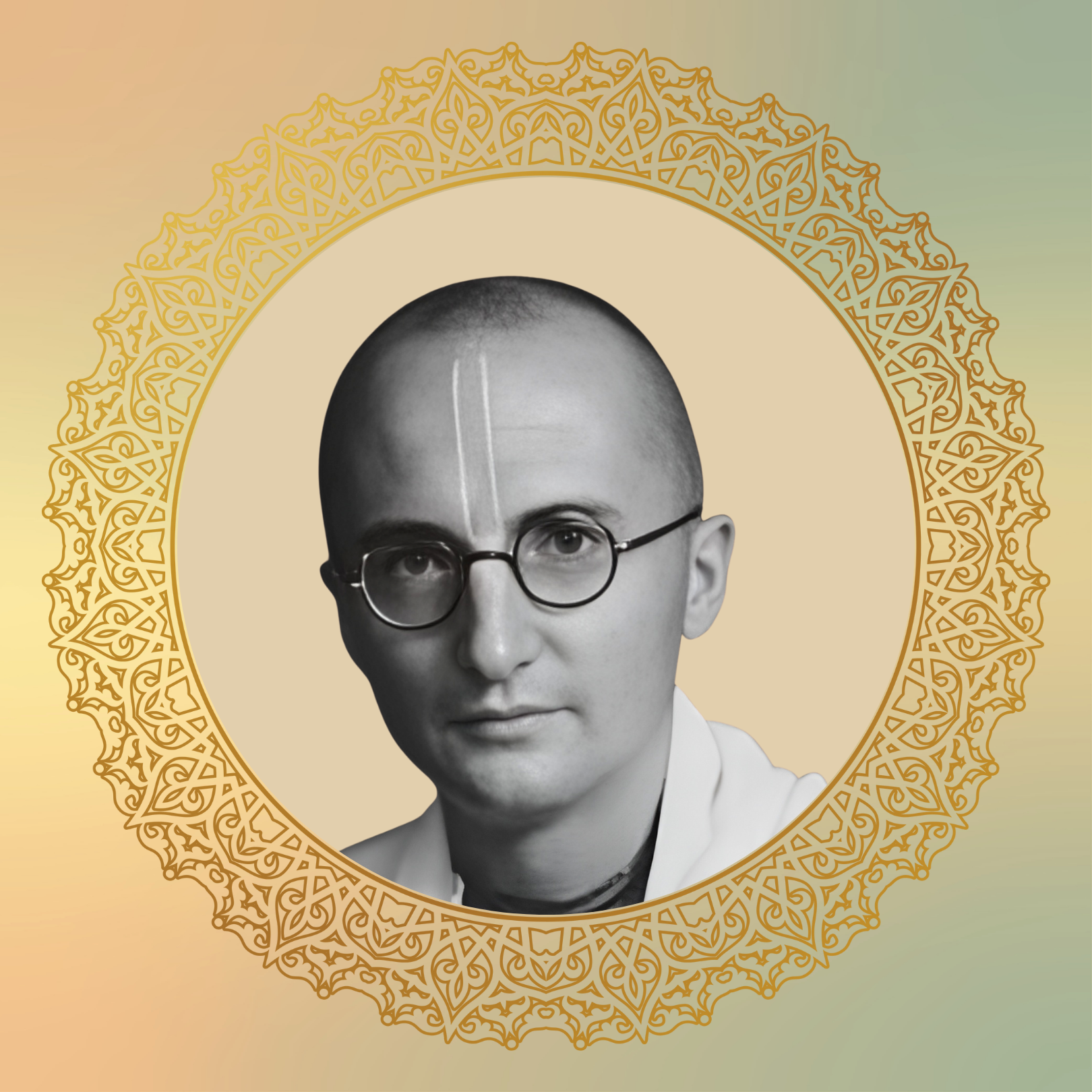
From “Answers to Questions”
Svami Sadananda Dasa 1955
Ṛṣis are seers of the mantra, those who see the mantra. Through Kṛṣṇa’s śakti, which works within them, they experience that word, idea and form are identical. The word rūpa [form] is derived from rup, rupyate, “it is seen”, and what is seen is rūpa. We, however, read and hear a mantra, whose letters at the best convey a vague idea, which at the best condenses into a form. Things that we see, we give names or use names that are already known. But we do not get in contact with things consisting of cit, pure knowledge, pure realisation. The most subtle things [we can experience] are those coming from manas or the mind. I picture a train in which there is a man reading his newspaper, a manomaya-train [a train consisting of manas] etc. I describe it to someone, who just as myself, sees it in his mind. This train has no dimensions, otherwise there would be no room for it in my head or in the room where I sit. But it is not everywhere and always present, by no means. – It is present in my head only, as long as I think of it. That which consists purely of cit, of pure knowledge or realisation, does not even exist in my head: it is simply space- and timeless, beyond space and time, for it belongs to the category of Vaikuṇṭha [the realm without break]. Where is it? It is where time and space does not exist at all, where mahāmāyā has no access at all. And where is this realm of time- and spacelessness? It is eternally present everywhere. Therefore, beside or outside it, there is absolutely no space and no time left for the world of space and time to squeeze into.
To gain a slight insight into this secret, linguistically, it is said that Kṛṣṇa enters the heart and the body through the ear. A 16-year-old youth? Or a mere word consisting of letters? No, Kṛṣṇa’s Own śakti brings about that He, Who is already present, in all places and at all times, becomes abhivyakta, manifested, breaks through into the experienceable, becomes capable of being experienced, if you so want. His Divine bodily form is mantramaya, i.e. consists of Idea that is Word and Form at the same time. This is not to be compared with the Christian idea that the God-given laws of nature are suspended, by no means, because from God’s, from Vaikuṇṭha’s point of view, the world does not exist at all. He and His realm are already eternally present. The world of space and time is only a shadow that veils our sight and prevents us from experiencing the pre-existing world of Vaikuṇṭha. And just as our world is a shadow world, our words are shadow words. To read, study, etc. the śāstras or the Vedas and their words is just as pointless as endeavouring for the apple in the shadow of the tree. One person is sitting in the tree, tasting the apple and talking about it, and I sit in the shadow and talk about the shadow apple the way I experience it, as shadow. The Vedas utter the apple, we read the letters, the shadow of the apple. That is why it is said, regarding every śāstra, that only the person who has śraddhā should and can read, hear, etc., the śāstras. It is śraddhā, His Own śakti, that first gives the sense of what the real apple is, even though the mere words seem identical. Just as Vaikuṇṭha is beyond time and space, it is also free from separation or division of the thing (vastu) into idea, name and form. To clarify this: when Kunti called “Kṛṣṇa”, He was immediately there. Does this mean that in one second He travelled those hundreds of miles from Dvārakā in a jet plane? No, He is already present there, He just becomes abhivyakta [visibly manifested]. He and His Name are identical. Nothing could be further from the truth than to believe that the śāstras want to tell us stories. They contain narratives in order to convey some idea of the realm beyond time and space and to give some indication of the mystery. Another illustration can be found in the account of Jagai-Madhai. When those two behaved like louts, “Caitanyadeva thought of the sudarśana-cakra, and there it was in His hand and struck Jagai and Madhai with terror”. (Caitanya Bhāgavata). This is not a fairy tale for an age without scientific education, it serves to illustrate that 1) in Caitanya, Kṛṣṇa is present, and in Kṛṣṇa, Nārāyaṇa Viṣṇu, who carries the cakra; and that 2) in His realm, idea and thing are identical. Just as little as a religion of the mind, heart and soul can lead to God – only His Own nirguṇa-śakti, bhakti – just as little can the mere uttering or meditation upon the Name Kṛṣṇa, consisting of mundane letters, lead to an experience of Kṛṣṇa and the fact that He is fully identical with His Own Name. In the degree that His śakti, i.e. bhakti, utters the Name, in the same degree the Name, i.e. Kṛṣṇa Himself, is experienced. God does not get Names, He has Names. They are only revealed (e.g. through Garga in Bhāgavatam X.), and these Names are identical with Him. In accordance with the līlā that makes the Names abhivyakta, manifested, the Names are an expression of His Own personality. God does not “play” a līlā, He is līlā; just as it is the nature of the sun to be light, it is His nature to be, to experience and to express Himself, and this is what līlā is. Words cannot express this secret and therefore it is said: He plays this or this līlā – and then again, to avoid any misunderstanding: He is līlāmaya, He consists of līlā.
Please, reflect upon this thoroughly!! Please – dry, yet so important!! Sadananda