
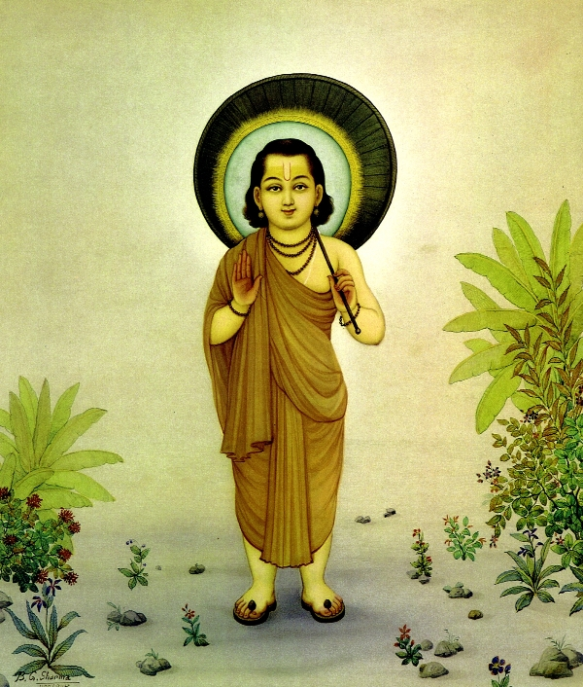
(Taken from Upākhyāne Upadeśa — Vol. 2, Instructive Stories with Purports by Śrīla Bhaktisiddhānta Sarasvatī Ṭhākura Prabhupada)
In the house of sage Kaśyapa, in the lap of Śrī Aditi-devī, the lotus-eyed Śrī Hari descended in the twelfth lunar day of the month of śrāvaṇa wearing yellow garments and holding a conch, disk, mace and a lotus. This twelfth lunar day is well-known as Vijaya.
Immediately after appearing, the Lord revealed himself as a dwarf in front of Aditi and Kaśyapa.
Great sages performed the birth ceremony for the dwarf brāhmaṇa son. At the time of the thread-giving ceremony of the Lord, Śrī Vāmanadeva, the sun-God personally uttered the Gāyatrī mantra. Bṛhaspati offered the sacred thread, and Kaśyapa Muni offered a straw belt.
Mother earth gave Him a deerskin, and the demigod of the moon, who is the king of the forest, gave Him a brahma-daṇḍa. His mother, Aditi, gave Him cloth for underwear, and the deity presiding over the heavenly kingdom offered Him an umbrella. Lord Brahmā offered a waterpot; the seven sages offered Him kuśa grass, and mother Sarasvatī gave Him a string of rudrākṣa beads. Kuvera gave Him a pot for begging alms, and mother Satī gave Him His first alms.
Elsewhere, Bali—the grandson of best of the devotees Prahlāda Mahārāja—was performing aśvamedha-yajña on the north bank of river Narmadā in a field called Bhṛgukaccha. The brāhmaṇas performing the sacrifice were from the esteemed lineage of Bhṛgu. Lord Vāmanadeva appeared in that place of sacrifice. The brāhmaṇas welcomed Lord Vāmana and Bali Mahārāja provided a sitting place to Him, washed His lotus feet, and worshiped him with various religious services. Lord Śiva, the best of the demigods, who carries the emblem of the moon on his forehead, receives on his head with great devotion the Ganges water emanating from the toe of Viṣṇu. Bali Mahārāja also effortlessly got the great fortune of placing that same water that washed the Lord’s lotus feet on his head. Bali offered prayers to Lord Vāmanadeva and said, “Since You have mercifully appeared in my house, my forefathers are now satisfied. Due to Your presence, my dynasty has now been purified and the sacrifice we are performing has been perfected. I can see a begging bowl on your hand. It seems like You have come here to ask for something. Please accept from me whatever it is that You like.”
Hearing Bali’s words, Śrī Vāmanadeva said, “On material subject matters, you have instructions from authorities like Śukrācārya, and on spiritual subject matters, you have Prahlāda Mahārāja as your instructing authority. So far, no such miserly persons have taken birth in your dynasty who have rejected a brāhmaṇa beggar or denied charity after promising one. Your father gave his life in response to the prayers of the demigods, even though he knew them as his enemy. You have taken birth in such a family. All I am asking from you is three pieces of land measured by my own feet. Even though you are broad-minded and capable of giving many things in charity, I am not going to ask for anything else from you since it is improper for a wise person to ask for more than what is necessary.”
Since Lord Vāmana only asked for three pieces of land measured only by his own small feet, Bali Mahārāja repeatedly requested Lord Vāmana to ask for more. Śrī Vāmanadeva said, “Whatever dear things exist in the three worlds cannot fulfill the desire for a person whose senses are not controlled. If I am unsatisfied even after receiving the land spanning three paces of my feet, then my desire will remain strong. Even if I get one island with nine varṇas, I will still desire to get the seven islands. Even though kings like Pṛthu, Gayā, and others got sovereignty over the seven islands, they could not find the end of thirst for wealth, things and desire. Our duty is to be satisfied by whatever we get as per the manifestation of the result of our previous actions. Only then will we be peaceful at heart. A dissatisfied person without any control over his senses cannot be happy even after getting the three worlds. For a living entity dissatisfaction with wealth and lust is the cause of existence in this material world.”
King Bali prepared to offer the requested land in charity to Lord Vāmana, saying with a smile, “Please accept whatever you desire.” With this intention, Mahārāja Bali accepted the water pot. However, prudent Śukrācārya could understand the intention of Lord Vāmana. He said to his disciple, Mahārāja Bali, “Without knowing his deceptive intentions, you have promised to give land in charity to him. I do not think this is good. This deceptive celibate will take away your kingdom, riches, beauty, effulgence, fame, and knowledge. After taking everything, he will give it to Indra. He is going to embezzle everything that belongs to you. You are a crass fool. How will you maintain your livelihood if you give everything to Viṣṇu? A charity which endangers one’s own occupation is not appreciated in the scriptures. In order to maintain religion, respect, wealth , material desire, and relative, wise persons divide their wealth in five parts. This way, they live happily in this world and in the next. If you give everything to Lord Viṣṇu, what other means will you have to be able to do the other activities?
Can any dutiful householder see their family relatives suffering due to starvation or taking up a begging bowl in hand? You have promised to give charity to Viṣṇu. However, only that which is promised along with words like ‘om’ is true; promises made with words like ‘No’ is not true.
In this world, even truth cannot exist without a little bit of falsity. One cannot live life by rejecting falsity completely. When the root of a tree is uprooted, the tree becomes dry and falls to the ground. Similarly, when falsity is destroyed, the body immediately becomes dry.
Scriptures dealing with logic say, ‘False words are not blameworthy if they are used to subdue ladies, as a joke, in marriage, for the purpose of one’s livelihood, in a crisis of life, for the benefit of the cow and brāhmaṇas, or if somebody is exposed to violence.’”
Instructing in this way, the priest of the demoniac family, the great logician Śukrācārya, tried to prevent King Bali from serving Lord Viṣṇu. For a moment, Bali remained silent and weighed the advice of the family priest in his mind. Then, he spoke to his spiritual master, “I consider whatever you have stated as the duty of a householder to be true. However, as the grandson of the great Prahlāda Mahārāja, how can I act like a deceptive person and deny that which I have already promised? Great souls like Dadhīci, Lord Śiva, and others have offered their life to benefit others. Even if one becomes bereft of everything in trying to fulfill the desire of great personalities—who are knowers of the Supreme Truth—that is also beneficial to the soul. Therefore, I will definitely fulfill the desire of this Vāmanadeva.”
Seeing that his disciple was intent on acting against his instructions, the priest of the demoniac family, Śukrācārya, cursed his disciple Bali, “You are very proud of your scholarship; you are not humble and have become disobedient to the orders of the family priest! You will very soon lose all your opulence.” Despite being thus cursed by the family priest, Bali Mahārāja did not hesitate to keep his promise and worshiping Lord Vāmana, offered Him the promised land. At that time, there was a shower of flowers from the sky on Bali Mahārāja. Anantadeva Lord Hari, in the form of Lord Vāmana, then, started growing in size. His form was so gigantic that by His first step, He covered the whole earth; with His body He covered the sky; and with His arms, He covered all directions! With His second step, He covered the heavenly realm, including Satyaloka. After the second step, there was no space remaining that King Bali could offer for Him to place His third step.
Meanwhile, the demons witnessing this entire affair, became very anxious to see all the land and property of Bali being robbed by this deceptive person. They thought that it is their duty and an appropriate service to their master to take the life of Lord Viṣṇu, who was in the form of Vāmana. Against the will of Bali Mahārāja, the demons—armed with their weapons—charged forward to kill Lord Vāmanadeva. The associates of Lord Viṣṇu forbade them from taking such actions, but they paid no heed. The associates of Lord Viṣṇu eventually destroyed the demons. Understanding the desire of his master, Garuḍa, the associate of Lord Viṣṇu, bound King Bali with the ropes of Varuṇa. By the influence of Śukrācārya’s curse, the greatly powerful Bali appeared as though he was bereft of all opulence. A pure devotee who has surrendered everything in the service of Śrī Hari, even if he is in apparent danger or becomes bound, his intelligence remains uncorrupted; his attachment towards the service of the Lord does not diminish by the slightest. He passes the test the Lord has orchestrated and gets engaged in the service of the Lord with a higher level of attachment.
Lord Vāmanadeva said to the Varuṇa rope-bound Bali Mahārāja, “You promised to offer me three pieces of land. All the land has been covered by my first two steps. Please oblige and provide for me the land on which to place my third step. If you are not able to offer the promised charity, the scriptures dictate that you should remain in the pātāla realm. Your spiritual master Śukrācārya also advised you similarly. You should enter the realm of pātāla. You were proud to consider yourself very rich. Now, you have deprived me after promising charity to me. You will have to suffer the reaction of this false statement for one year.”
From a common man’s perspective, it may seem that Lord Vāmana acted very cruelly towards Bali. However, Bali remained undisturbed in his mind and engaged his body, mind, and words for the pleasure of Lord Viṣṇu. King Bali said to Vāmanadeva, “Bhagavān! Please kindly bless me by placing Your third step on my head! The punishment not provisioned by mother, father, brother or friends, dear worshippable Lord, I consider that punishment sanctioned by You to be most commendable for a living entity. You accomplish many activities by doing just one activity. My worshippable grandfather Prahlāda—one of Your devotees—took Your shelter, despite being continually harassed by Hiraṇyakaśipu in different ways. What is the need for such a body which leaves the living entity at the end of life? What is the need for service to the robbers in the guise of relatives, who are thieves of the wealth of devotional service? What is the fruit of association with a wife who is the cause of household life? What is the use of such a house where nothing but one’s lifespan is reduced; what is the use of such household life? Due to being engrossed in materialistic intelligence, a living entity cannot understand the temporary nature of life. Now, I have been brought to Your lotus feet, being forcefully dislodged from that material wealth, by Your divine intervention.”
While Mahārāja Bali was speaking these words to Lord Vāmana, Prahlāda Mahārāja who was very dear to the Lord, appeared on the scene. Since he was still bound by the ropes of Varuṇa, Bali could not show appropriate respect to his grandfather he would normally do before. With tears in his eyes, he still paid obeisances with his head. Prahlāda bowed down to the lotus feet of Vāmanadeva and said, “You awarded the position of Indra to this Bali and again today, You have taken it away. By doing so, you have shown great mercy to Bali. Learned persons, although they may be controlled in their senses, get deviated from the path of auspiciousness if there is madness about wealth.”
The wife of Bali, Vindhyāvali, with her palms folded prayed to Lord Vāmanadeva and said that only the Lord is auspicious. Those who are under illusion try to apply their intelligence in enjoying the things belonging to the Lord. Brahmā prayed to Vāmanadeva, “Non-deceptive persons attain the best of destinations just by offering water and buds of durba (a kind of small grass) to the lotus feet of the Lord. Therefore, why should this Bali who has offered the three worlds unto Your lotus feet without any hesitation, suffer the sorrow of being bound?”
In order to teach all living entities of the world, Śrī Bhagavān said to Brahmā, “Being mad with pride of wealth and coming under the influence of materialistic thought process, human beings ignore the three worlds, and even Me, who am the maintainer of all living entities. They forget about their eternal benefit. Therefore, I take away that kind of wealth from one to whom I bestow my mercy. After travelling through millions of species, birth after birth, one becomes fortunate enough to get a rare human birth. In this human life, if one does not become proud of one’s high birth, occupation, youth, beauty, knowledge, opulence, wealth etc., then that is my mercy to the living entity. However, there is also a reason behind My giving wealth to devotees like Dhruva and others. When I do this, I am demonstrating that despite having a high birth, knowledge, and wealth—which are counterproductive to all auspiciousness and are the root cause pride and lack of humility—My unalloyed devotees are not enamored by these things. King Bali has won over the unconquerable māyā. Even after being deprived of wealth, he did not deviate from the path of eternal good. Bali did not deviate from the truth and remained fixed in his vow even when being bereft of wealth, followers, and position; even after being insulted by his enemies and rejected by the elderly and his relatives; even while suffering the pain of being tightly bound by Varuṇa, and even after being criticized and cursed by his spiritual master. Despite some deceptive religious principles suggested to him, Bali still remained fixed on his vow.”
The main teaching from the character of Bali is full surrender. Without any condition whatsoever, he was causelessly offering himself unto the lotus feet of Śrī Bhagavān. Bali has taught the principle that even if the Lord deceives or deprives, one should not feel deprived by that but should sacrifice oneself on the lotus feet of the Lord. Even though Śrī Bhagavān may apparently put us in different kinds of dangers, deprive us of opulence, deprive us of wealth and beauty, bind us in ropes, take everything away, or from a materialistic point of view even show the extreme limit of cruelty, we should endeavor to follow in the footsteps of His pure servants, like Bali who sacrificed himself in the service of Śrī Bhagavān without getting evenly slightly disturbed such obstacles.
The family priest’s mindset was averse to the Lord, even though he may have been a very capable and great logician. Even if such apparently great personalities create different kinds of obstacle in offering everything onto the lotus feet of Lord Viṣṇu—even to the extent of cursing and depriving one of material wealth—a pure devotee would still offer everything onto the lotus feet of Lord Viṣṇu without getting perturbed. A spiritual master should not be called a spiritual master if he does not offer everything of his disciple’s in the service of Viṣṇu, who is the only enjoyer. Even though such persons may be revered as a family priest from a worldly perspective, one should leave aside his ill advice and serve a bona fide spiritual master who instructs us on offering everything on the lotus feet of Śrī Viṣṇu. Even if Śrī Viṣṇu may usurpt everything of the living entity’s, that is in fact ultimately beneficial for him. Bali Mahārāja is the emblem of an uncontaminated heart offered onto the lotus feet of Śrī Bhagavān.
Extra–
The Prabhupāda further also wrote that–
With our lips we may all pray for guileless mercy. Yet if hidden within the recesses of our hearts there remain ulterior motives and secret material ambitions, then at the time of receiving results we become enveloped by Kṛṣṇa-śakti’s deceptive mercy. We become bewildered by gain, worship, prestige, influence, followers, and worldly success, mistaking these for divine favour.
Therefore, every person who truly desires the welfare of the soul should ceaselessly pray from the deepest chamber of the heart at the lotus feet of Śrī Hari, Śrī Guru, and the Vaiṣṇavas:
“Let whatever misfortunes, reversals, humiliations, losses, or sufferings may come upon me; but may I never become deceived by Your deceptive mercy. If my spiritual welfare must be delayed, then let it be delayed. Yet may I become qualified to receive Your amāyāya dayā (Your guileless, causeless mercy).”
To our beginningless outward-facing vision, that amāyāya dayā may appear harsh, merciless, severe, or even cruel. We may be utterly unfit to receive it. Nevertheless, this alone should remain our prayer at the lotus feet of Hari, Guru, and Vaiṣṇavas:
“Even if it takes birth after birth, may I someday become harmonized with that supremely auspicious, guileless mercy. May my life be properly adjusted to its current.”
“May I never be deceived by Your deceptive mercy, but may I attain Your amāyāya dayā.”
(Excerpt from Gauḍīya Prabandha-mālā, Volume 1)