
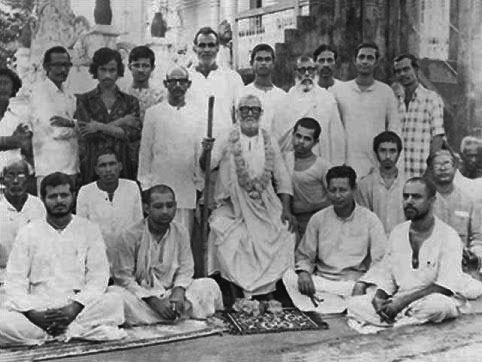
Below you can find some very interesting interviews covering topics and questions that are frequently discussed among devotees—such as the protective role of kavacas, astrology, and different approaches and strategies for preaching.
Śrīla Guru Mahārāja, in the Ganesh-kanda section of Brahma-vaivarta Purana, the history of Sri Paraśurāma is related. I read there that Lord Śiva gave to Paraśurāma a protective mantra, a kavaca: Kṛṣṇa-kavaca. But one devotee told me that in this Age, Kali-yuga, the only kavaca which is really potent is Nṛsiṁha-kavaca, so that is the only one it is possible to accept. My question is: what is true about these kavacas? Is it possible in the present day for anyone to be given, or to accept, these kavacas which appear in the ancient scriptures? Is it necessary, or practical?
Śrīla Sridhar Mahārāja: The use of kavacas is, on the whole, an external affair. The Mantram (Gāyatrī) and the Nāma (Hare Kṛṣṇa) they are all-useful and all-powerful, and using the kavaca to help externally, is a thing of minor importance. The nāma, the Lord’s Name, and the Lord whose Name it is, they are one and the same; and that is enough. It is sufficient, complete. Here in the mundane world, to help us, we can sometimes accept the kavacas but that is not a thing of very great importance. Either kṛṣṇa-kavaca, or nṛsiṁha-kavaca, we may accept, to help our bhajan (worship); but not at the cost of faith in the divine Name, nāma-bhajana, that is the best of all; even the (Gāyatrī) mantram is to help nāma-bhajana.
krsna-mantra haite habe samsara-mocana
krsna- nāma haite pabe krsnera carana
(Cc. Ādi-līlā 7.73)
“Simply by chanting the Holy Name of Kṛṣṇa one can obtain freedom from material existence. Indeed, simply by chanting the Hare Kṛṣṇa mantra one will be able to see the lotus feet of the Lord”.
The worship of the Name, nāma-bhajana, is the highest, and with our whole concentration, we shall stick to that. And to see or to look for other things to help it, may be allowed to a certain extent. But not much attention should be given to those external things; they are only something like a varna, a kind of dress, a covering, for protection. So, there is not much harm if we take kṛṣṇa-kavaca or nṛsiṁha-kavaca, with the intention: “It has come to help my nāma-bhajana life”. If meant in this way, it may be allowed, but it is not the highest standard.
The purpose of using the kavaca is, generally, that external difficulty may not come to us; it is to protect us from the external difficulties, superficial difficulties. But the pure devotees, the extreme devotees of Kṛṣṇa, they won’t be afraid of any external difficulties. Rather, they may invite them, like Kuntī devi, Queen Kuntī, who told: “External dangers let them come and attack me. I don’t care for them; I shall go on with my service.”
In using the kavaca there is some karmana, some karmic connection, but if that is to help the good, then its use may be acceptable. Still, in the highest form of bhajan, everything is depending on His will: the devotee thinks, “Whether I may be in danger or in happiness, I shall go on with my nāma-bhajana uncaring, without any care for the external conditions that may come to me according to my previous karma. I may be in hell, or I may be in heaven, or anywhere else; I won’t waste my energy going to any other direction, but I will go on with nāma-bhajana.” Bhajan done in this mood is of the higher quality. Do you follow?
Student: Yes.
Śrīla Sridhar Mahārāja: In Prahlāda Mahārāja, and others, we see such an attitude: “Dangers may come, at their wish, with their extreme power to disturb me; I don’t care.” So, pasu-pakhi haya tabe wherever my karma may take me, even to the body of bird or beast, I won’t pray to Kṛṣṇa for favourable circumstances. I shall utilise my energy best only if it is towards Him; and I shall only want from Him, that: “Your sweet will may be victorious. You can make or mar; You can kill me, or save me. If it is necessary for Your sweet enjoyment to kill me, You can do that. I am a slave; You have got every right over me, to do anything and everything.” With this conception in the background we have to make our approach towards Him, and that will be of the highest quality. Our bhajan should be in this line.
In our worship we are not seeking any comfort from anything outside, or from Him, also. We won’t pray: “O Kṛṣṇa, You please create protection. I am going towards You, so please create protection for me, please manage for my protection”. Our bhajan should be of this purest type: “You may do whatever you like; I want your service. I want only that Your sweet will may be satisfied by me.” There is to be such self-forgetfulness, total self-forgetfulness in the service of Kṛṣṇa. The whole concentration will be: “How can I satisfy You?”
And whatever troubles may come upon us on the way, we must not deviate our attention from that main purpose to any of those external things, for then the quality of our bhajan will be less. Its quality and also its intensity will be less, if we are very eager to maintain our safety as we are going on in the path of our devotional life, as we are proceeding to our destination. Such concerns should be uncared for, as much as possible, and our only concern will be: “I want Your satisfaction”. And in that attempt, one must be self-forgetful, as much as possible.
But according to their adhikāra, capacity, the practitioners may sometimes take the help of some protection on their way, and that may be tolerated. It may be tolerated, but it is not the highest ideal. To seek protection on the path in this way, is not the ideal. “I am going to You, please protect me on my way, please manage for me, for my protection” our fundamental attitude should not be such. But rather, we should think: “Whatever comes to me, it is Your sweet will; I won’t pray for protection.”
𝐆𝐈𝐅𝐓𝐈𝐍𝐆 𝐌𝐄 𝐀 𝐍𝐑𝐒𝐈𝐌𝐇𝐀-𝐊𝐀𝐕𝐀𝐂𝐀
(A short excerpt from the book “My Beloved Masters” by Śrī Śrīmad Bhakti Vijñāna Bhāratī Gosvāmī Mahārāja)
One day, during the time I was dealing with a lawsuit to remove the tenants illegally occupying the appearance place of Śrīla Prabhupāda in Purī, Śrīla Siddhāntī Gosvāmī Mahārāja approached me with concern for my wellbeing. With the affection of a guardian, he said, “I will have a nṛsiṁha-kavaca made for your protection. You must wear it at all times. You have no idea what harm these people might do to you.” Sure enough, some days later he brought me a nṛsiṁha-kavaca prepared by his godbrother, Śrīpāda Kṛṣṇa-keśava Brahmacārī. When he gave it to me, he showed me his arm, which bore a nṛsiṁha-kavaca, and said, “Look, I too wear one.”
Although I accepted the nṛsiṁha-kavaca he gave me, I faced an internal dilemma about whether I should wear it. I thought it over and concluded that if I were truly surrendered and if all my efforts were intended purely for the service of Bhagavān, then indeed, no one would be able to cause me the least bit of harm or even so much as bruise me as long as He wishes to accept my service. Furthermore, since Bhagavān is the one accepting my service, the responsibility of my protection lies with Him alone. Why should I independently endeavor to protect myself? For these reasons, I was unenthusiastic about wearing the nṛsiṁha-kavaca. However, since it was affectionately given to me by Śrīla Siddhāntī Gosvāmī Mahārāja, I always kept it with me. To this day, it is stored safely in my closet.
When we eventually won the lawsuit, Śrīla Siddhāntī Gosvāmī Mahārāja told me, “You have snatched this meal right out of the tiger’s mouth.”
“Mahārāja,” I replied, “what capacity do I possess to snatch a meal from the jaws of a tiger? It is by the power of Śrīla Prabhupāda’s disciples such as yourself- by your good wishes and mercy- that we have become instruments in fulfilling our gurupāda-padma’s desire.”
Śrīla Mahārāja then said, “Maintaining this kind of submissiveness is the key to gain rightful and eternal entry into vaiṣṇava-dharma.”
Under the guidance of Guru Mahārāja, a huge festival was organized at Śrīla Prabhupāda’s appearance place in 1978 to commemorate his vyāsa-pūjā. At that time, Śrīla Siddhāntī Gosvāmī Mahārāja was the first to donate toward the construction of a maṭha there. As he handed me one thousand rupees, he expressed his happiness and bestowed many instructive blessings upon me.
𝐑𝐞𝐠𝐚𝐫𝐝𝐢𝐧𝐠 𝐕𝐞𝐝𝐢𝐜 𝐚𝐬𝐭𝐫𝐨𝐥𝐨𝐠𝐲
Student: I have another question, in this connection. I am now studying Indian astrology, Vedic astrology. In my studies I have made some astrological charts for devotees. I see the natal chart is like a photograph of the karma of the person. So my question is: what is the use of astrology for a devotee, or in devotional service? It has some use, or not?
Śrīla Sridhar Mahārāja: Just as general education, money, learning, physical health and other things are necessary for the purpose of preaching, so in a particular situation knowledge of astrology may be, also. But all such items are subsidiary, they are not the all-important thing. Generally, the public is attracted by the astrological statement, so it may be used like bait to capture people, so as to gradually convert them. Just as one devotee when asked by Śrīla Swami Mahārāja Prabhupada to go to China, to preach, told him: “I shall go there and open a hostel; in this way, men will come, and I shall capture them, for Kṛṣṇa’s service!” This is, in itself, not śuddha-bhakti, pure devotion, but it is ānukūlyasya-saṅkalpa: it may be favourable for the cause. Nāmacarya Haridas Thakur used to give sweets to the children, and then ask them, “Take the Name, the Name of the Lord, Kṛṣṇa. Say ‘Kṛṣṇa’!” First he is distributing sweets and then telling them “Say ‘Kṛṣṇa’!” It is a kind of strategy like that.
So, astrology may be utilised to create some confidence in the general public, that they will think: “This man is super-class, so I should be as a disciple to him”; and in this way gradually they may be taken towards the real path. Such an approach is ānukūlyasya-saṅkalpa it may be anukūla, favourable, a favourable step towards devotion proper. But pure devotion, śuddha-bhakti, is not dependent on any such things.
Even jñāna, knowledge, and also vairāgya abnegation, indifference, renunciation, the renouncing nature they are also not a part of real devotion: jñāna-vairāgyādi bhaktira kabhu nahe ‘anga’ (Cc.Madhya 22:145).
Vairāgya means abnegation, “I don’t want anything”, to have no taste for all the things of this world. For example, someone may be taking food only once in a day; or even he may not be using any dress, any clothes, in all such matters he is indifferent. ‘Virāga’ means indifference, indifference to everything in this world; but that also is not intrinsically a part of devotion. And it is so also with jñāna, knowledge: na jñānam na ca vairāgyam, prayah sreyo bhaved iha (S.Bhag. 2:32-33). Both jñāna and vairāgya, which are the real property of the Jñānī and Yogī Schools, are not a part and parcel of devotion; then what to speak of other things.
vasudeve bhagavati bhakti-yoga prayojitah
janayaty asu vairāgyam jñānam ca yad ahaitukam
(Srimad Bhāgavatam 1:2:27)
Here it is told that real jñāna and vairāgya will come as the consequence of bhakti. As a result of devotion, the proper abnegation and proper knowledge will come. Otherwise, through the empirical method, ordinary knowledge and ordinary apathy towards worldly things cannot create devotion proper. “By trying, by my self-abnegation, or by my learning all these worldly things, gradually I shall attain bhakti” it is not so. But, bhaktyā sañjātayā bhaktyā bhakti is the cause of bhakti. Devotion is its own cause. When I get devotion proper, the real vairāgya, self-abnegation, and real knowledge, will come in its retinue, naturally; that is natural, it is normal. Otherwise, neither ordinary self-abnegation, the mood or tendency of renunciation, nor knowledge of the worldly matters, can produce devotion proper, real devotion.
So the knowledge of astronomy, or astrology, or mathematics, or all the great achievements of science, like those of Einstein, they may be utilised to capture the ordinary people who may then be introduced to pure devotion to Kṛṣṇa. They are a kind of bait, like laddu, sweets: by distributing the sweets one may attract the person, and then tell him, who is the Lord, who is Kṛṣṇa: “The sweetest thing is Kṛṣṇa!” That is in the line of ānukūlyasya-saṅkalpa, favourability to the cause. And this should not be misinterpreted to mean that we should try to acquire some special power, like the knowledge of hypnotism, and whoever will come, we will hypnotise them, and then give them the mantram that is all artificial, it is a misunderstanding. But to capture the mind of the other party with such attractions like astrology, and thereby to defeat their mental pride, to crush their vanity, and then to help them to come forward with surrender, so the true thing can be distributed to them in this way, such knowledge may be utilised. Is it clear?
Student: Very clear, Mahārāja. There is something else I would ask. I have now passed three years of sannyāsa, three years in the sannyāsa ashram. So I want to ask, to pray to your Divine Grace for some instruction, some practical advice about sannyāsa life.
Śrīla Sridhar Mahārāja: Keep the association of the higher Vaiṣṇava, and go on with your duty. Always keep in association with the higher Vaiṣṇava, the Vaiṣṇava of higher plane, in order to keep yourself healthy, to supply yourself vitality. Whatever you do whether it is preaching, or any other service you may do all-important is to keep the vitality within you, and that can come from the different ‘dynamos’, the Vaiṣṇavas, from their association. That is the main idea: to keep your life intact, and then go on with work. Because if the vitality diminishes, then everything will go, it will be lost. So most important is the spiritual vitality, and its supply; and the source of that supply, the dynamo, is the Vaiṣṇava. And when the Vaiṣṇava is absent, we can receive nourishment from the scripture the Gītā, the Bhāgavatam, and other books, and the writings of Gurudeva.
Student: I am very satisfied, hearing from your Divine Grace.
Śrīla Sridhar Mahārāja: I consider myself fortunate, if I can render some service to you in this way.
Student: No, no, I consider myself to be fortunate to sit at your feet. I cannot express my satisfaction…
Śrīla Sridhar Mahārāja: So, I think you are genuine, a sincere person; you have got connection with that which is unlimited, of infinite character. That is your fortune.
Student: I would like to ask another question if I may. In my country I have contact with a very influential man, he is President of a Karate Association and himself a very expert martial artist. He likes Kṛṣṇa Consciousness and wants to be a devotee but he is not so much of a brahminical type, he likes the kṣatriya dharma. Also, he is attracted to mystic powers and apparently he has them, also. What is your Divine Grace’s view of these things? What instruction would you give to your Mission about dealing with, or accomodating them? Perhaps you could give some advice as to what way I should introduce Kṛṣṇa Consciousness to this person. What would be your Divine Grace’s guidance in this case, to help a person of such nature?
Śrīla Sridhar Mahārāja: Just as you have already asked, regarding the learning of jyotiṣa, astrology, so it may be in this case also. It is of a very lower order to take physical strength, to utilise physical strength to fulfil our purpose. It is of a lower order. Mahāprabhu did not accept that. Śrīla Swami Mahārāja also, when his Math here in Māyāpura, Sri Candradoya Mandir, was attacked by a party of gundas, gangsters, did not oppose them with physical force. He was inside the building at the time, and he sent a kīrtana party out: “Go, and offer yourself to be prey of those gundas.” Those ruffians had come, entered the compound, and created some disturbance; Swami Mahārāja asked his devotees, “Go out and challenge them, with kīrtana; without any weapon, unarmed, go with the kīrtana party, and offer yourself to be prey of the gundas.” And thereby, that danger subsided. So Mahāprabhu’s weapon is passive resistance. Not physical attack, offensive for offensive, but to show a passive attitude in order to conquer the offensive thing that will be better, and that is the policy of Mahāprabhu.
But when that is not possible, for one in a lower stage of realisation, one can take physical help for his protection, self-protection. And sometimes, if we see that the Deity or the Vaiṣṇava is going to be prey to the rowdies, if They are being attacked, or are going to be demolished, then we are justified in using any measure against them the stick, or even the gun, or any other weapon available to us. At that time, whatever force possible we can assert. But generally, such measures we may not use for ourself; for our own protection, we depend fully on Kṛṣṇa, rakṣiṣyatīti-viśvāso: “He will protect me”. But in the case of Vaiṣṇava, Guru, or Deity, we can assert ourselves as far as possible, and with all our resources; and we will be ready to give our own life, also. If sincerity of purpose is there, then in extreme cases such use of physical force may be accepted. But it is question of realisation; according to one’s own realisation, the proper adjustment in understanding and applying these principles will come.