

Srila Bhakti Sourabh Bhaktisar Goswami Maharaj’s birth name was Sri Nanda Gopal. His decision for taking renounced life is a perfect example for us. Sri Nanda Gopal was born in a reputed Brahmin (Bandopadhyaya) family in 1902 at the village of Chandani Mohal, Khulna district in Bangladesh. His father’s and mother’s names are Sri Shashadhar Bandopadhyaya and Srimati Shailabala Devi, respectively.
Since childhood, Nanda Gopal was a good student in his school. In his matriculation examination, Sri Nanda Gopal passed with reputed academic results. Later, in order to proceed towards further study, he got admission at Cuttack Engineering college, Odisha. During his studies in the Cuttack Engineering college, he often used to visit Sri Gaudiya Math in Cuttack. At the Gaudiya Math, he met Srila Brajabihari Das Babaji Maharaj and eventually, got the opportunity to study many spiritual books which were published by Srila Prabhupada. Sri Nanda Gopal had not even met Srila Prabhupada personally but the devotional and logical information in Srila Prabhupada’s books took all of his attention and inspired him to meet Srila Prabhupada. His father, Shashadhar Bandopadhyaya, realized that his son, Nanda Gopal, had become interested in studying Sri Gaudiya Math’s books instead of academic engineering.
We know from Srimad Bhagavatam that a person is qualified to become a real father if he inspires his children to practice spirituality. In order to establish the example of becoming a real father, Shashadhar Bandopadhyaya took his son to Sri Caitanya Math at Mayapur. It was a few days before Lord Caitanya’s appearance day ceremony, which is famously known as the Gaura-Purnima festival at Mayapur. Sri Nanda Gopal and his parents came together for attending the festival. Here, all three saw Srila Prabhupada and experienced heartfelt attraction for taking shelter of Srila Prabhupada. During the day of the Gaura Purnima festival, Srila Prabhupada gave them 1st initiation (Harinam) and 2nd initiation (Brahman-Diksha), together. After the initiation, Sri Nanda Gopal became Nanda Dulal Das Brahmachari and decided to stay forever under the shelter of Srila Prabhupada and to not return home with parents.
Gradually, Sripad Nanda Dulal Das Brahmachari’s service attitude made all the temple devotees happy. They all gave favorable recommendations about Nanda Dulal Prabhu to Srila Prabhupada. Eventually, Nanda Dulal Prabhu got the title ‘Bhaktitul’, which means devotional inspiration, from Srila Prabhupada. Later on, Nanda Dulal Brahmachari was engaged by Srila Prabhupada as a teacher in Sri Bhaktivinode institute. For a long time, he continued this teaching service. After Srila Prabhupada’s physical departure, in order to spread the loving message of Lord Sri Caitanya Mahaprabhu elaborately, most of the godbrothers gradually split and established different units of Lord Caitanya’s preaching mission. In order to establish another preaching mission of Lord Caitanya, Sripad Nanda Dulal Brahmachari decided to take sannyasa initiation from his dearmost godbrother, Srila Bhakti Saranga Goswami Maharaj. After sannyasa initiation, his name became Srila Bhakti Saurabh Bhaktisar Goswami Maharaj (Srila Bhaktisar Goswami Maharaj). Eventually, he established a few units of Lord Sri Caitanya’s preaching mission in the name of Sri Gauranga Gaudiya Math at Mayapur, Sri Nityananda Gaudiya Math at Birbhum, Sri Radha Govinda Gaudiya Math, Kendran, Burdwan, Sri Bhaktisar Gaudiya Math at Vrindavan, and Sri Narasimha Gaudiya Math, at Puri, Odisha.
Srila Bhaktisar Goswami Maharaj’s nature was to stay away from all material worship, name, fame and recognition. At his old age, he was fully absorbed in chanting the Holy Name (Hare Krishna Mahamantra). During that period, he used to say to whoever came to hear harikatha from him, “Do you know that I spoke lots and all of you listened from me lots. Now, please do something as I told you before. If you follow what I said, then I am sure that all of you will go ahead with your spiritual practice properly and gradually and reach your final destination the abode of Sri Sri Radha Krishna in Goloka Vrindavan.”
On the 14th day of July 1995 at 5:10 AM in the early morning at Sri Gauranga Gaudiya Math, Mayapur in the presence of his favorite disciples such as Bhakti Lalit Madhav Goswami Maharaj, Bhakti Sundar Sadhu Goswami Maharaj, Bhakti Sudhir Acharya Goswami Maharaj etc., Srila Bhaktisar Goswami Maharaj physically left all of us. According to Srila Bhaktisar Goswami Maharaj’s desire, his visible transcendental physical body was buried in his Mayapur temple campus. Presently, his favourite disciple, Srila Bhakti Sudhir Acharya Goswami Maharaj is continuing the mission as his successor.
:::::::::::::::::::::::::::::::::::::::::::::::::::::::::::::::::::::::::::::::::::::::::::::::::::::::::
Śrī Śrīmad Bhakti Saurabha Bhaktisāra Gosvāmī Mahārāja
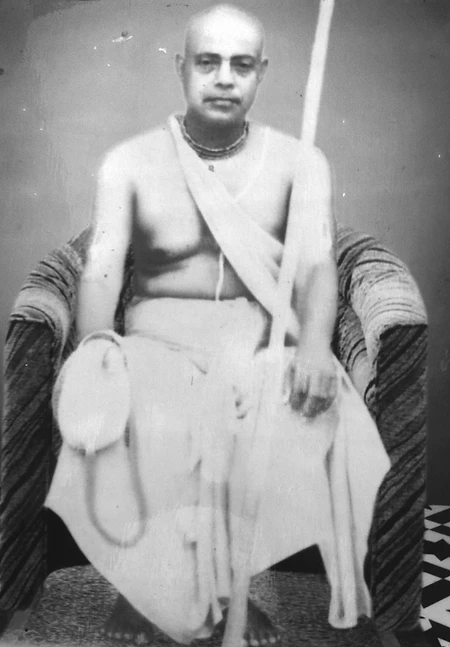
[January 13, 2021 is the appearance day of Śrī Śrīmad Bhakti Saurabha Bhaktisāra Gosvāmī Mahārāja in Vṛndāvana, India. Below is an excerpt of his glories from ‘My Beloved Masters’ by Śrī Śrīmad Bhakti Vijñāna Bhāratī Gosvāmī Mahārāja.]
ACCEPTING THE SHELTER OF SRILA PRABHUPADA’S LOTUS FEET
Śrī Śrīmad Bhakti Saurabha Bhaktisāra Gosvāmī Mahārāja appeared in the Khulna district of East Bengal (present-day Bangladesh) and was given the name Nanda-dulāla. He studied engineering at Ravenshaw College in Cuttack, where he came in contact with Śrī Śrīmad Vraja-bihārī dāsa Bābājī Mahārāja, the in-charge of the local maṭha established by Śrīla Prabhupāda.
Although Śrīla Bābājī Mahārāja was not well educated, he lectured daily on Śrī Caitanya-caritāmṛta, as per Śrīla Prabhupāda’s order. Because of his illiteracy, his manner of presenting discourses was not particularly scholarly. Nevertheless, illustrious academics and English professors were so moved by his simplicity that they joined the Gauḍīya Maṭha and became initiated devotees. He often told his listeners, “I am but a peon of my gurudeva and Śrī Caitanya Mahāprabhu. My delivery may be inadequate, but I always put forth my best effort in making sure their message reaches your ears. Since you are learned, kindly correct whatever mistakes I may have made.”
Impressed by Śrīla Vraja-bihārī Bābājī Mahārāja’s simplicity, Śrī Nanda-dulāla took full advantage of his daily association. Thus, a strong desire arose within him to take shelter of Śrīla Prabhupāda’s lotus feet. Through this pastime, Śrī Nanda-dulāla taught that the worldly knowledge of platform speakers can never infuse devotion in a person’s heart. Although a well-spoken politician may expertly prepare a moving speech in less than half an hour, the effect of his rhetoric is merely temporary. Conversely, the incoherent speech of an entirely illiterate but surrendered devotee is so courageous that it inspires devotion in the hearts of those who hear it, even though it may be devoid of any scriptural references. It was with such surrendered devotees in mind that Śrīla Prabhupāda wrote in his poem Vaiṣṇava Ke? (17),
“prāṇa āche tā’ra, se hetu pracāra—he who has life can preach.”
When Śrī Nanda-dulāla notified his greatly pious mother and father of his desire to accept the shelter of Śrīla Prabhupāda, his father encouraged him to join the maṭha. “If you want to perform hari-bhajana,” he told his son, “I will personally take you to Śrīla Prabhupāda and offer you at his lotus feet.” Śrī Nanda-dulāla accepted this proposal, and his mother and father both accompanied him to Śrīdhāma Māyāpura, where Śrīla Prabhupāda agreed to award the three of them harināma and dīkṣā initiations. Henceforth, Śrī Nanda-dulāla became known as Śrī Nani-gopāla Brahmacārī. After offering his son at the lotus feet of Śrīla Prabhupāda, Śrī Nanda- dulāla’s father told his son, “I am very pleased you have decided to surrender yourself to Śrīla Prabhupāda. May you always serve our gurudeva’s lotus feet. I beg you: please forget me and never return home. It would make me proud if you were to follow this instruction of mine.” In this way, Śrī Nanda-dulāla’s father proved himself to be his son’s true guardian:
sei se parama-bandhu se pitā-mātā
śrī-kṛṣṇa-caraṇe jei prema-bhakti-dātā
Śrī Caitanya-maṅgala (Madhya-khaṇḍa)
He who gives you loving devotion for the lotus feet of Śrī Kṛṣṇa is your ultimate friend, your father and your mother.
That very year, in 1930, Śrī Nani-gopāla Brahmacārī was appointed as a teacher at the Ṭhākura Bhaktvinoda Institute in Śrīdhāma Māyāpura and assigned to the editorial team of the Gauḍīya Maṭha’s daily newspaper, Dainika Nadiyā Prakāśa. Eventually, on the order of Śrīla Prabhupāda, he went on to preach in many cities in India.
After Śrīla Prabhupāda’s disappearance, Śrī Nani-gopāla Brahmacārī remained under the guidance of Śrīla Bhakti Sāraṅga Gosvāmī Mahārāja, who awarded him sannyāsa and gave him the name Śrīmad Bhakti Saurabha Bhaktisāra Gosvāmī Mahārāja. He became the editor of Śrī Sārasvata Gauḍīya, a monthly magazine published by Śrī Gauḍīya Saṅgha, the institution Śrīla Bhakti Sāraṅga Gosvāmī Mahārāja established. By authoring many articles that were printed in various Gauḍīya Maṭha magazines, Śrīla Mahārāja contributed to the service of Śrīla Prabhupāda’s bṛhat-mṛdaṅga, his printing press. Additionally, in Vṛndāvana, he managed the Imlitalā maṭha for a long time and is largely responsible for its stunningly beautiful preservation.
Whenever my Guru Mahārāja, Śrī Śrīmad Bhakti Dayita Mādhava Gosvāmī Mahārāja, would visit Vṛndāvana, Śrīla Bhaktisāra Gosvāmī Mahārāja would always visit him. Their relationship was very sweet and respectful. Without fail, Śrīla Mahārāja would always insist on bringing Guru Mahārāja to Imlitalā, where he would serve Guru Mahārāja and all his devotees prasāda.
After Śrīla Gosvāmī Mahārāja’s disappearance, Śrīla Bhaktisāra Gosvāmī Mahārāja was appointed the ācārya of Śrī Gauḍīya Saṅgha, but upon encountering various disturbances, he regarded his appointment as unfavorable for his practice of bhakti and promptly resigned. He submitted his resignation letter in person to the concerned parties, thus demonstrating his complete lack of conceit and selfishness. His simplicity was boundless, and he was entirely niṣkiñcana; he accepted Kṛṣṇa as his only wealth.
Through his personal example, Śrīla Mahārāja established that a sādhaka must give up all that is unfavorable for the practice of bhakti. He was not attached to the prestige that comes with a high-ranking position. Rather, he was interested only in rendering service to Śrī Hari, guru and Vaiṣṇavas.
We should be careful not to conclude that Śrīla Bhaktisāra Gosvāmī Mahārāja gave up his service; he simply decided to perform that service in a situation he found more favorable for the execution of bhakti. After resigning from his post as ācārya of Śrī Gauḍīya Saṅgha, he established a maṭha in Siuḍi, West Bengal, where he once invited Guru Mahārāja to deliver a series of lectures.
SERVING SRI HARI, GURU, AND VAISNAVAS BY ANY MEANS POSSIBLE
Śrī Śrīmad Bhaktyāloka Paramahaṁsa Mahārāja donated half of his property in Śrīdhāma Māyāpura to his godbrother Śrīla Bhaktisāra Gosvāmī Mahārāja so that Śrīla Bhaktisāra Gosvāmī Mahārāja could construct a maṭha there. However, as soon as Śrīla Bhaktisāra Gosvāmī Mahārāja began laying the foundation, some Bangladeshi refugees pitched tents and began squatting on that land, citing the authority of a particular police officer. Śrīla Bhaktisāra Gosvāmī Mahārāja was unconcerned about the situation. He told his godbrother Śrīpāda Kṛṣṇa-keśava Brahmacārī, “I will not build anything there. Who wants to get involved in all these problems? I will simply stay with one of my godbrothers.”
One day, when Śrīpāda Kṛṣṇa Keśava Brahmacārī accompanied me to the ghāṭa to take a boat to Kṛṣṇanagara, he showed me Śrīla Bhaktisāra Gosvāmī Mahārāja’s land and said, “Look. Some people are camping there with the support of the police, and Śrīla Bhaktisāra Mahārāja is not very motivated to deal with the matter. Can you help him with this?”
“Certainly,” I said. “It wouldn’t take me more than half an hour to evict all these people. Send word to the father of that policeman. Tell him Bhāratī Mahārāja says, ‘If your son wants to keep his job, the place should be totally empty by the time I return to Māyāpura. Otherwise, you must teach your son a lesson by filing a lawful complaint against him.”
Śrīpāda Kṛṣṇa Keśava Prabhu did as I requested, and the squatters left the next day after receiving a small compensation for the cost of their tents.
Once his land was cleared of all refugees, Śrīla Bhaktisāra Gosvāmī Mahārāja told me, “Due to my godbrother Śrī Kṛṣṇa Keśava Brahmacārī’s concern for me, you delivered a harsh message to that policeman’s father. Generally speaking, it is inappropriate for someone wearing the garb of a sādhu to speak in such a manner. However, it is your duty to extend yourself as far as necessary in order to serve śrī guru, Vaiṣṇavas and Bhagavān. There is no fault if such service requires you to resort to threats.”
A FRANK REPROACH
Guru Mahārāja regularly held religious assemblies in many places, including Kolkata, Purī and Vṛndāvana. On the invitation cards, he always included the names of his invited godbrothers, along with brief introductions. Once, one of Guru Mahārāja’s godbrothers became angry to see that Guru Mahārāja had not included an introduction next to his name. He told some of his other godbrothers, “Why hasn’t Mādhava Mahārāja included an introduction of me? He has introduced himself and his other godbrothers as the Founder-ācāryas of their respective institutions, but he has not mentioned any details about me. This is entirely improper.”
In reply, Śrīla Bhaktisāra Gosvāmī Mahārāja, who was straightforward and without malice, said, “You have only recently acquired a small place that has but two rooms. You have not held any festival there, so Śrīpāda Mādhava Mahārāja has no way of knowing where it is. Are you a sādhu? If so, then you must always remain humble. Does your disposition reflect the meaning of tṛṇādapi sunīcenā, the quality of being humbler than a blade of grass? In the past, Śrīpāda Mādhava Mahārāja has shown you great respect, even though you are his junior. Why, then, are you so angry? You cannot even imagine the depth to which Śrī Hayagrīva Brahmacārī has entered the innermost region of Śrīla Prabhupāda’s heart. Do not pay attention to all these trivialities and thus cheat yourself of the essence, which is association with and service to sādhus.”
WHOSE SERVICE IS MOST SUPERIOR?
Śrīla Bhaktisāra Gosvāmī Mahārāja told me he once posed a question to his godbrothers: “According to their respective capacities, the many sannyāsīs and brahmacārīs of the maṭha are busily engaged from morning to night in various services. Śrīla Prabhupāda’s gṛhastha and vānaprasthī disciples, also, perform many different services. Do considerations of superiority and inferiority apply to the activities of service? If so, then which service is considered most exalted, and whose service is topmost?”
After an extensive discussion, they could not reach a solid conclusion, and so they relayed the question to Śrīla Prabhupāda via Śrī Paramānanda Prabhu. Śrīla Prabhupāda answered with one sentence: “The more love one has for the Vaiṣṇavas, the more exalted one’s service is.”
In other words, there are no big or small services. Rather, it is the servant’s mood that makes his service either first, second or third class.
FIVE INSTRUCTIONS
One day, while giving darśana to his disciples, Śrīla Bhaktisāra Gosvāmī Mahārāja said, “I have spoken many things, and you have all heard so much. Remain engaged in spiritual activities. Thus, you will go somewhere and one day obtain what you seek.”
Speaking this much, he fell silent. After a few moments, he got up from his chair and as he went into his room, he asked one of disciples to speak hari- kathā. His disciple spoke on the rather unlimited subject his śrī gurudeva had just conveyed in only a few words:
“I have spoken many things. Despite his advanced age, Śrīla Guru Mahārāja has tirelessly and repeatedly explained, at great length and in a simple manner, the scriptural truths pertaining to bhajana-sādhana and the process to attain the lotus feet of Śrī Hari.
“You have all heard so much. Here, Śrīla Guru Mahārāja is saying, ‘Day after day, morning, noon and night, I have unfailingly spoken hari-kathā, sometimes addressing easy subject matters, and at other times tackling difficult ones. You have all heard so much and grasped something, some more than others. Because of your extensive hearing, your path towards the ultimate goal of life has been without difficulty.’
“Remain engaged in spiritual activities. Now that you have understood many profound concepts concerning spiritual life, go forward and follow those teachings properly with firm conviction and according to the guidance offered by the scriptures.
“Thus you will go somewhere. If you can daily and attentively serve—that is, worship the deities, behold Them, study scripture, perform kīrtana, chant japa and meditate—under the guidance of śrī guru and Vaiṣṇavas, then the day will surely come when you will attain your prime objective.
“You will one day obtain what you seek. If you heed the previous four instructions, then in this fifth stage, you will surely attain the rarely attained and eternally revered Divinity, Śrī Śrī Rādhā-Kṛṣṇa. You will leave behind this temporary, inferior earthly realm and reach Śrī Goloka Vṛndāvana, where all abide in a perpetual, blissful spring. Then, your life will be a success. You will be happy, peaceful, immortal and forever liberated, eternally full of sweetness and laughter.”