
shri-vishakha-kritam gitam gayanti smadya ta matah
govinda-madhavananda-vasudeva yatha-kramam
(Gaura-ganoddesha-dipika 188)
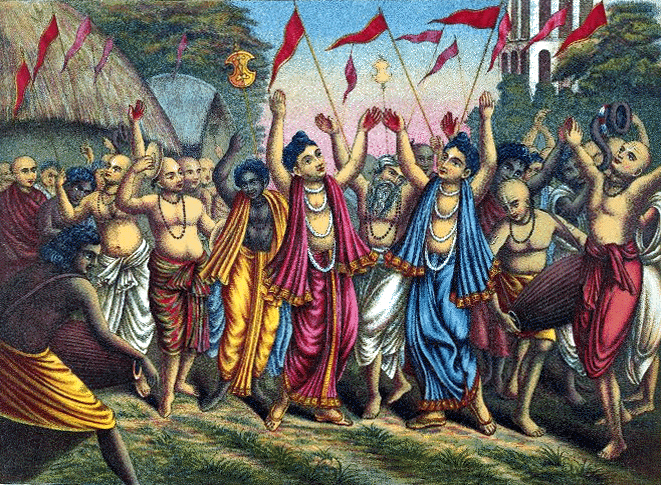
These three brothers were born in an upper class kayastha family from northern Rarha. All three were singers famed for the sweetness of their voices.
The meritorious Madhava Ghosh devoted himself to kirtan. There was no singer on earth who was his equal. It was said of him that he was a singer from Vrindavan. He was most dear to Nityananda Prabhu. The three brothers, Govinda, Madhava and Vasudeva began to sing while Lord Nityananda danced.
(Chaitanya Bhagavat 3.5.257-9)
Chaitanya Mahaprabhu and Nityananda Prabhu danced to the kirtan of the three brothers, Govinda, Madhava and Vasudeva.
(Chaitanya Bhagavat 1.15.115)
When Nityananda returned to Gaudadesha to preach, he was accompanied by Vasudeva and Madhava Ghosh. Meanwhile, Govinda remained in Nilachala with Mahaprabhu.
Govinda Ghosh
Govinda is counted amongst the branches of Chaitanya Mahaprabhu (Chaitanya Charitamrita 1.10.118). Eventually, he made his home in Agradvipa, Vasudeva in Tamluk, and Madhava Ghosh in Dain Hat. Govinda Ghosh Thakur´s house is not far from Agradvipa in Kashipura Vishnutala. Some are of the opinion that Vaishnavatala was his birthplace. Govinda Ghosh participated in Mahaprabhu´s lilas in Srivasa Angan, in the nagara-sankirtan to the Kazi´s house, and in the house of Raghava Pandit. During the Rathayatra festival, he was the lead singer in the fourth kirtan group, accompanied by his two brothers, Junior Hari Das, Vishnu Das and Raghava Pandit. Vakresvara Pandit joined this group as the principal dancer.
On Mahaprabhu’s direction, Govinda revealed the Gopinath deity from a black stone in Agradvipa. Mahaprabhu also instructed him to get married. The story goes that Govinda Ghosh’s wife and son both died untimely. As he grew older, Govinda began to wonder who would perform the last rites for him, as it is considered important for one to have a son who can do the shraddha ceremony on his behalf. He had a dream in which Gopinath appeared to him and said, Don’t worry about this. I will perform the shraddha ceremony for you myself.
When Govinda Ghosh finally died, Gopinath offered the pinda on his behalf. Gopinath continues to perform this ceremony every year on the anniversary of Govinda Ghosh’s departure from this world. This takes place on the krishna trayodashi of the month of Chaitra. Vasudeva Ghosh´s disappearance day is on the second day of the waxing moon in the month of Karttik.
Two Songs Written by Govinda Ghosh
pranera mukunda he
ki aji shunilu acambite?
kahite parana jaya mukhe nahi bahiraya
shri gauranga chariibe navadvipa
ihato na jani mo rasakale milinun gora
avanata mathe ache basi
nijhare nayana jhare buka bahi dhara parie
malina haiyache mukha shashi
dekhite takhana prana sada kare ana cana
sudhaite nahi avasara
kshaneka sambita haila tabe mui nivedila
shuniya dilena e uttara
ami ta vivasha haiya tare kichu na kahiya
dhaiya ailun tuwa pasha
ei ta kahilun amije karite para tumi
mora nahi jivanera asha
shuniya mukunda kande hiya thira nahi bandhe
gadadharera vadana heriya
e govinda ghosha kaya iha jena nahi haya
tabe muïi jainu mariya
O Mukunda! My life! What did I suddenly hear today? If I say it I will die… the words do not want to come out of my mouth. Gauranga is really going to leave Nabadwip.
We didn’t know this, but we saw Gora this morning; he was sitting with his head bowed in thought. Streams of tears flowed from his eyes and washed over his chest, and his moon-like face had lost its luster.
When we saw him like that, our own hearts fluttered and we could not ask him anything. For a moment I regained consciousness and humbly asked him the question and that is what he told me.
Becoming disturbed, I ran here to you right away without saying anything further to him. I have told you this and now do what you can. As far as we are concerned, I don’t think that we have any hope of continuing to live.
When he heard this, Mukunda started to cry. He could no longer keep his calm as he looked at Gadadhara. Govinda Ghosh says, Let it not be, for if he leaves, I will die.
hede re nadiya vasi kara mukha cao
bahu pasariya goracande phirao
to sabare ke ara karibe nija kore
ke jaciya dibe prema dekhiya katare
ki shela hiyaya haya ki shel hiyaya
parana putali nabadvipa charii jaya
ara na jaiba mora gaurangera pasha
ara na kariba mora kirtana vilasa
kandaye bhakata-gana buka vidariya
pashana govinda ghosha na jaya miliya
O people of Nabadwip, at whom are you staring?
Spread your arms to stop Gora, make him come back!
Who is there now who will clasp you to his chest?
Who will come and beg you to take love of Krishna?
A shaft has pierced my heart! A shaft has pierced my heart!
The image of my life has abandoned Nabadwip and gone.
No longer will we be able to go and sit with Gauranga;
no longer will we be able to enjoy kirtan the way we did.
All the devotees are crying; their hearts are bursting
and, like a stone, Govinda Ghosh does not go to join them.
[Excerpted from “Sri Chaitanya: His Life & Associates” by Srila Bhakti Ballabh Tirtha Maharaj]
:::::::::::::::::::::::::::::::::::::::::::::::::::::::::::::::::::::::::::::::::::::::::::::::::::::::::::::::.
Śrī Govinda Ghoṣa Ṭhākura
[April 8, 2021 is the disappearance day of Śrī Govinda Ghoṣa Ṭhākura, in Vṛndāvana, India. The following is a bhāva anuvāda of the kathā given by Śrīla Bhakti Vijñāna Bhāratī Gosvāmī Mahārāja on the same tithi on March 25, 2017. Editors’ input: Additional text has been included in square brackets to facilitate the flow of content.]
Today is a special day. On this day a festival called Śubha-vijaya is celebrated at Varāha-nagara in honor of Śrīman Mahāprabhu’s auspicious arrival there. Wherever Mahāprabhu went, the people celebrate at those places on that day in remembrance of Him.
Since the time of Mahāprabhu’s arrival at Varāha-nagara, the residents of Varāha-nagara would go to Jagannātha Purī for His darśana every year. Along the way, they would also carry Rāghava Paṇḍita’s jhāli (bags of goods) with them for Mahāprabhu.

Also today is the disappearance of Govinda Ghoṣa Ṭhākura or ‘Ghoṣa Ṭhākura’s tirobhāva’ as he was popularly referred as Ghoṣa Ṭhākura. Govinda Ghoṣa, Mādhava Ghoṣa and Vāsudeva Ghoṣa were three brothers who were all excellent kīrtanīyas. At the time when Caitanya Mahāprabhu used to dance in front of Lord Jagannātha during the Ratha-yātrā, the devotees would divide into seven groups and sing kīrtana. There were four groups in the front, one on each side and one at the back of the ratha. One of those kīrtana groups included the three Ghoṣa brothers [with Govinda Ghoṣa appointed as the leader by Caitanya Mahāprabhu].
Govinda Ghoṣa had a son, who left his body at a young age. Following his son’s death, Govinda Ghoṣa, who used to serve a Deity of Lord Gopīnātha, stopped His sevā. Seeing this, Gopīnātha inquired, “Why have you stopped

serving Me?” Govinda Ghoṣa replied, “As my [only] son is no more, and my brothers live in different places, there is nobody to continue Your service after me and there is no one to serve me or perform my last rites either. After I leave this body Your sevā will be stopped anyways. Considering this, I have stopped Your sevā.” Then Lord Gopīnātha said, “Why don’t you consider Me as your son? From today, I am your son eternally. I will perform your last rites.” Thus during the tirobhāva tithi of Ghoṣa Ṭhākura, a carnival takes place at Ghoṣa Ṭhākura’s residence (a place not very far from Māyāpura – one railway station away), and Lord Gopīnātha takes kuśa grass and performs the śrāddha ceremony for Ghoṣa Ṭhākura. Every year after Mahāprabhu’s appearance day, fourteen vigrahas (Deities) from Kṛṣṇanagara, are brought together there. I remember the king of Kṛṣṇanagara used to bring all the vigrahas (Deities) and have a grand festival there.
I had never visited Lord Gopīnātha, until once, while we were visiting Kṛṣṇanagara for the annual festival [of the maṭha], Lord Gopīnātha appeared in my śikṣā guru, Pūjyapāda Śrīmad Bhakti Pramoda Purī Gosvāmī Mahārāja’s dream, and expressed His desire to accept some kṣīra (sweet rice made from milk) from him. So Purī Gosvāmī Mahārāja went there and arranged for the offering of kṣīra bhoga. On that occasion, I had the fortune to visit and have darśana of Lord Gopīnātha.

From Ghoṣa Ṭhākura’s incident we can see how the Lord is subservient to His devotees. Just because His devotee thought, ‘O! Who will perform my last rites?’, Gopīnātha Himself proclaimed ‘I will do it’, thus, on this day, Gopīnātha Himself performs the śrāddha ceremony. To this day many from Māyāpura attend the festival, but not as much to see Gopīnātha, as to see the carnival (melā). The festival is popularly known as ‘Ghoṣa Ṭhākura’s melā.’ It is quite a grand festival. Many people put up stalls there, stay for two days to earn well and leave. There was one person who was working on our fields. He once asked for three days of leave, as he wanted to participate in Ghoṣa Ṭhākura’s melā. The deity of Mahāprabhu for each of our maṭhas came from there. Guru Mahārāja would like it that way as it was symbolic of the fact that we worship Mahāprabhu of Navadvīpa. It has been almost 375 years now, and the carnival still happens in a grand fashion.
On his disappearance day today, I pray at the lotus feet of Govinda Ghoṣa Ṭhākura that if we develop similar firm faith and complete surrender as he had in the Lord’s lotus feet, then our human birth will be successful.