
Vamshivadanananda Thakur was KrishnaÂ’s flute in Vraja.
(Gaura-ganoddesha-dipika 179)
Vamshivadanananda Thakur was known by five names in Gaudiya Vaishnava society: Vamshivadana, Vamshidas, Vamshi, Vadana, and Vadanananda. He was a well-known writer of devotional songs. His appearance took place on the day of the spring full moon (in the month of Chaitra) in either 1416 (according to Vamshi-shiksha) or 1427 of the Shaka era (1495 or 1506 AD.).
Vamshivadanananda’s Home in Nabadwip
The two villages known as Kuliya and Pahariapura were side by side. Vamshivadana, Kavidatta and Saranga Thakur lived there. As the town grew, it was known as Kuliya Pahariapura.
Vamshivadanananda ThakurÂ’s home was in Koladvipa, i.e., the present-day town of Nabadwip which was formerly known as Kuliya Pahariapura. Kuliya had four neighborhoods known as Teghari, Bneciyaria, Bedariaparia and Cinedanga. Shrikara Cattopadhyaya came from Bilvagrama to live in Bneciyaria. Amongst the descendants of Shrikara Cattopadhyaya was Yudhishthira Cattopadhyaya who had three sons: Madhava Das (nicknamed Chakarii), Hari Das (Tinakarii) and Krishnasampatti (Dukarii) Cattopadhyaya. Chakarii Cattopadhyaya was VamshivadanaÂ’s father. His motherÂ’s name was Candrakala Devi. When Mahaprabhu passed through Kuliya on his trip through Bengal which ultimately ended at Kanair Natashala, he stayed at Chakarii CattopadhyayaÂ’s house for seven days. During this time he gave his blessings to all the residents of Nabadwip and in particular to Devananda Pandit. This information comes from Kavi KarnapuraÂ’s Chaitanya-candrodaya Nataka.
It is said that both Mahaprabhu and Advaita Acharya were present when Vamshivadanananda was born. After Mahaprabhu took sannyas, Vamshivadanananda was engaged as Sachi Mata and Vishnupriya’s servant and protector. When Srinivas Acharya came to Nabadwip to see the LordÂ’s family, Vamshi embraced him emotionally. This is described in the Bhakti-ratnakara:
Though he had not been introduced, Vamshivadanananda guessed that this must be Srinivas. He approached him and asked him who he was. Srinivas told him everything about himself. Vamshivadanananda embraced him and washed his body with his tears. Srinivas wanted to fall to the ground and pay obeisances to Vamshi Thakur, but Vamshi would not let him. He then went and told Vishnupriya Ishvari and Sachi Ma that Srinivas had come. (Bhakti-ratnakara 4.20-24)
Vamshivadanananda Thakur lived as a householder. He had two sons, Chaitanya Das and Nityananda Das. His deity’s name was Pranavallabha. Later, at Vishnupriya Devi’s request, he established the worship of the Mahaprabhu deity. He also worshiped the Gopinath deity of his forefathers. He spent the last part of life in his ancestral village of Bilvagrama. The Bhattacharyas of that village are said to be his descendants.
Ramai Thakur
Vamshivadanananda ThakurÂ’s family received the mercy of Jahnava Thakurani. The following comment is found in the Gaudiya magazine (22.30-37):
A Song by Vamshivadanananda
ara na heriba prasara kapale alaka tilaka kaca
ara na heriba sonara kamale nayana khajana naca
ara na nacibe shrivasa mandire bhakata cataka laiya
ara na nacibe apanara ghare amara dekhiba caiya
ara ki duÂ’ bhai nimai nitai nacibe ek thai
nimai kariya phukari sadai nimai kothao nai
nidaya keshava bharati asiya mathaya pariila baja
gauranga sundara na dekhi kemane rahiba nadiya maja
keba hena jana anibe ekhana amara gauranga raya
shashurii vadhura rodana shuniya vamshi gariagarii jaya
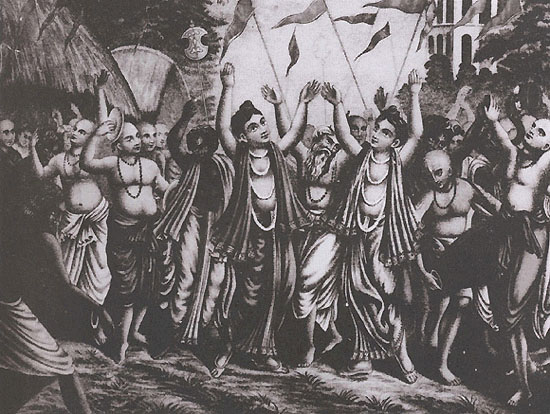
No more will I see his broad forehead, decorated with tilaka and sandalwood dots; no more will I see his eyes dance like hummingbirds in the golden lotus of his face. No longer will he dance in SrivasaÂ’s house with his sparrow-like devotees; no more will he dance in his own home, while looking upon me.
Will Nimai and Nitai, those two divine brothers ever dance together again? I call out NimaiÂ’s name, but Nimai is nowhere to be seen.
The heartless Keshava Bharati came and threw a thunderbolt on all of our heads. How can we now stay in Nabadwip, now that we cannot see Gauranga here?
Who is there here who can now bring my Gauranga back?
When Vamshi hears his young wife and her mother-in-law crying, he rolls on the ground in his pain.
[Excerpted from “Sri Chaitanya: His Life & Associates” by Srila Bhakti Ballabh Tirtha Maharaj]