
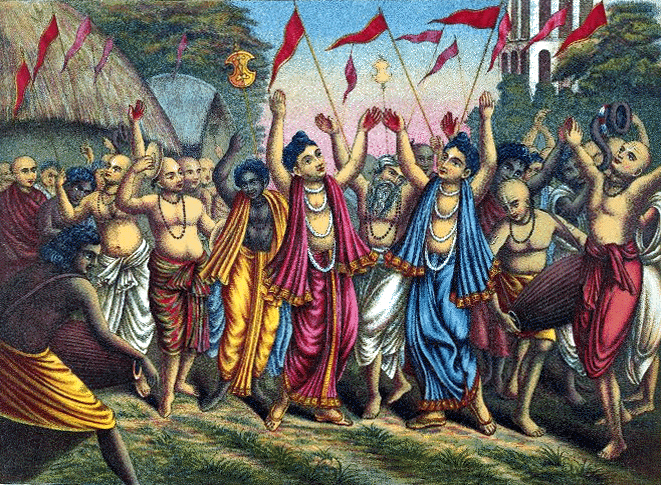
Śrī Śyāmānanda Prabhu was a servant of a servant of Subala in Kṛṣṇa-līlā. He was the disciple of Hṛdayānanda or Hṛdaya Caitanya, who was a disciple of Gaurīdāsa Paṇḍita. Gaurīdāsa was Subala in Kṛṣṇa-līlā.
yam loka bhuvi kīrtayanti hṛdayānandasya śiṣyaṁ priyam
sakhye śrī-subalasya yaṁ bhagavataḥ preṣṭhānuśiṣyaṁ tathā
sa śrīmān rasikendra-mastaka-maṇiś citte mamāharniśam
śrī-rādhā-priya-narma-marmasu ruciṁ sampādayan bhāsatām
Śrī Śyāmānanda was known in this world as Hṛdayānanda’s dear disciple; he was the grand-disciple of Subala sakhā, the most dear friend of the Supreme Lord; he was the crest-jewel of the enjoyers of sacred rapture. May he appear day and night in my mind, bringing an appreciation for the essence of the joys of the beloved of Śrī Rādhā.
(Śyāmānanda-śataka)
Śyāmānanda Prabhu was born on the full moon day of Caitra in 1456 of the Śaka era (1534 AD) in the town of Dharenda Bahādurapura, which is near the Kharigapura railway station in Medinipura. His father was Śrī Kṛṣṇa Maṇḍala and his mother, Dūrikā. Kṛṣṇa Maṇḍala’s home town was Daṇḍeśvara which lies on the banks of the Suvarṇarekhā River. The following statement is found in the Gauḍīya Vaiṣṇava Abhidhāna: Śrī Kṛṣṇa Maṇḍala used to live in a place called Ambuwā, near Daṇḍeśvara. He formerly lived in Gauḍa (the part of Bengal which lies on the banks of the Bhāgīrathī River) and only later moved to Daṇḍeśvara, is just across the present-day border in Orissa. Śyāmānanda’s disciples have established five principle seats in the towns of Dharenda, Bahādurapura, Rāyānī, Gopīvallabhapura, and Nṛsiṁhapura.
Śyāmānanda Prabhu was born in the Sadgopa subcaste, which fits in the category of jala-cala, i.e., Brāhmaṇas are permitted to take water touched by its members. Of course, a Vaiṣṇava is beyond the material qualities and may take birth in a family of any race or caste. If anyone thinks badly of Vaiṣṇavas or judges them on the basis of their race or caste is destined for hell.
arcye śilā-dhīr guruṣu nara-matir vaiṣṇave jāti-buddhir
viṣṇor vā vaiṣṇavānāṁ kali-mala-mathane pāda-tīrthe ambu-buddhiḥ
śrī-viṣṇor nāmni mantre sakala-kaluṣa-he śabda-sāmānya-buddhir
viṣṇau sarveśvareśe tad-itara-samadhir yasya vā nārakī saḥ
Anyone who considers the deity to be nothing but stone, the guru to be an ordinary human being, or the Vaiṣṇava to be a member of a particular caste or race, who takes the holy water which has washed Viṣṇu or the Vaiṣṇava’s feet and can destroy all the sins of the age of Kali, to be ordinary water, who thinks that the name or mantra of Viṣṇu, which destroys all evils, is the same as any other sound, or who takes Viṣṇu to be equal to anything other than Him, has a hellish nature.
(Padma-purāṇa)
One who takes birth in a low-class family is not disqualified from performing devotional service, nor is one who born in a pure, high-class brāhmaṇical family automatically qualified for such service. Whoever engages in the worship of the Lord is a great person; one who does not worship is rejected.
(Caitanya-caritāmṛta 3.4.66-7)
na me bhaktaś caturvedī mad-bhaktaḥ śvapacaḥ priyaḥ
tasmai deyaṁ tato grāhyaṁ sa ca pūjyo yathā hy aham
Simply being a knower of the four Vedas does not make someone My devotee. An outcaste who is My devotee is dear to Me. One should exchange gifts and food, etc., with such a devotee for he is verily as worshipable as I.
(Quoted in Hari-bhakti-vilāsa.)
Prior to Śyāmānanda’s birth, his parents had lost several children in childbirth and they vowed to surrender their next child to Viṣṇu if it survived. Having suffered so much grief in the loss of their previous children, they first named Śyāmānanda Duhkhī, or unhappy, to ward off further distress.
Śyāmānanda’s parents Dūrikā and Śrī Kṛṣṇa Maṇḍala made their home in Daṇḍeśvara. His father was the best of the Sadgopa caste, of impeccable character. Kṛṣṇa was everything to him and Kṛṣṇa’s devotees were very dear to him. We cannot describe the virtues of his parents for fear of increasing the volume of this book. They had previously lived in Dharenda and Bahādurapura and some people say that Śyāmānanda’s birth took place there. Nothing could stop his birth, for he came after many other children had been still-born to his parents. Because of their previous losses, his parents brought him up in sadness and so they called him Duhkhī.
(Bhakti-ratnākara 1.351-5, 359)
Śyāmānanda Prabhu’s parents performed the appropriate rituals when the time came: the first eating of solid food, the cutting of hair, etc. As he grew older, he studied Sanskrit grammar, etc. His parents were overjoyed to see his talents and his religious proclivity. After having carefully listened to the glories of Gaurāṅga and Nityānanda from devotees, he was able to repeat them to others. When listening to the activities of Gaura-Nitāi or those of Rādhā and Kṛṣṇa, tears would flow in waves from his eyes. He also devotedly served his parents and they told him to get initiated so that he could fully commit himself to the service of the Lord. Duhkhī agreed and told them that he wished to take dīkṣā from Hṛdaya Caitanya, the disciple of Nityānanda and Gaurāṅga’s associate, Gaurīdāsa Paṇḍita. When going to Kālnā for that purpose, he would also have the good fortune to see the Gaṅgā and to bathe in it. His parents happily gave him permission to go there.
When Duhkhī arrived in Ambikā Kālnā, he threw himself at the feet of Hṛdaya Caitanya, who upon learning his identity, happily gave him Kṛṣṇa-mantra and named him Kṛṣṇa Dāsa. From then on Duhkhī was known as Duhkhī Kṛṣṇa Dāsa. Hṛdaya Caitanya ordered him to go to Vṛndāvana to engage in bhajana. Though he did not like being separated from his gurudeva, Duhkhī Kṛṣṇa Dāsa set off for Vraja, first visiting Nābadvīpa and other places in Gauḍa-maṇḍala where he sought the blessings of the Vaiṣṇavas. Finally, after spending much time on pilgrimage, he finally arrived in Vṛndāvana where he became completely absorbed in the worship of Rādhā and Śyāmasundara.
In Vṛndāvana, Duhkhī Kṛṣṇa Dāsa studied the Vaiṣṇava scriptures under Śrī Jīva Gosvāmī, who was the leading scholar of the sampradāya. When Hṛdaya Caitanya heard of the enthusiasm with which Duhkhī Kṛṣṇa Dāsa was leading the devotional life in Vraja, he wrote a letter to Jīva Gosvāmī in which he said that Duhkhī should consider Jīva to be an extension of himself. Jīva gave titles to his three most prominent students, Śrīnivāsa, Narottama and Duhkhī Kṛṣṇa Dāsa, bestowing Śyāmānanda on the latter. The reasoning behind this name was that he brought great joy to Rādhā and Śyāmasundara.
While in Vṛndāvana, he was given the name Śyāmānanda because he brought great joy to Śyāmasundara. When Jīva saw his charming activities, he kept him nearby and instructed him in the Vaiṣṇava scriptures.
(Bhakti-ratnākara 1.401-2)
Jīva Gosvāmī sent Śrīnivāsa Ācārya, Narottama Dāsa Ṭhākura and Śyāmānanda back to Bengal with the Vaiṣṇava scriptures in 1504 of the Śaka era (1582-3 AD). The idea was to spread the teachings found in these books throughout Bengal and Orissa. The events which took place when Vīra Hambīra had the books stolen in Viṣṇupura have been related in the chapter on Śrīnivāsa Ācārya.
Narottama went to northern Bengal and Śyāmānanda went to Orissa. Midnapore district was previously under the rule of the Orissan king. Today there is a branch Gauḍīya Maṭha in Midnapore city named the Śyāmānanda Gauḍīya Maṭha which is meant to preserve his holy memory.
Rādhārāṇī’s Special Mercy on Śyāmānanda
Even though Śyāmānanda Prabhu was Hṛdaya Caitanya’s initiated disciple, his guru had entrusted him to the care of Jīva Gosvāmī Prabhu. Through the association of Jīva and service to him, Śyāmānanda developed a taste for serving Rādhā and Kṛṣṇa in the conjugal mood. Hṛdaya Caitanya Prabhu himself was a disciple of Gaurīdāsa Paṇḍita, who was one of the twelve Gopālas, Subala Sakhā. He worshiped Gaura-Nitāi in the mood of friendship. Those who think that Śyāmānanda committed an offense to his initiating spiritual master by abandoning his mood and trying to directly serve Kṛṣṇa in a higher mood, are wrong. The mood of friendship is contained within the conjugal mood. If a disciple makes further progress in spiritual life it enhances the reputation of his teacher.
An extraordinary incident, which took place in Vṛndāvana prior to his being ordered by Jīva to return to Orissa, demonstrates how dear Śyāmānanda was to Rādhārāṇī. One day, Śyāmānanda Prabhu was sweeping the Rāsa-maṇḍala in Vṛndāvana, absorbed in ecstatic trance. Suddenly, by Rādhārāṇī’s transcendental mercy, he found her ankle bracelet lying on the ground. In his excitement, he touched the ankle bracelet to his forehead, where it left a mark which is preserved to this day as the tilaka marking of the disciple descendants of Śyāmānanda. It is known as nūpura-tilaka.
Śyāmānanda Prabhu’s Preaching
Narottama Ṭhākura and Śyāmānanda primarily preached the message of Mahāprabhu through kīrtana. Śrīnivāsa sang kīrtana in a style called Manohara-sāhī, Narottama in Garāṇahāṭī, and Śyāmānanda in Reṇeṭī. He would enchant the listeners with his heartfelt singing of kīrtana. These styles of kīrtana are no longer extant.
As a result of his preaching in Orissa, many Muslims also became Śyāmānanda’s disciples. The most important of his innumerable disciples was Rasika Murāri. Rasikānanda was the son of Acyutānanda, the zamindar of Rohiṇī village. He had another name, Murāri, and was thus most commonly known as Rasika Murāri. He was a very powerful preacher and his fame is still widespread through the villages of Orissa. A list of some of Śyāmānanda’s prominent disciples is given in the Bhakti-ratnākara:
Śyāmānanda made disciples all over the place. A person can be purified by hearing their names: Rādhānanda, Puruṣottama, Manohara, Cintāmaṇi, Balabhadra, Jagadīśvara, Uddhava, Akrūra, Madhuvana, Govinda, Jagannātha, Gadādhara, Ānandānanda, and Rādhāmohana. Śyāmānanda was constantly immersed in the joys of kīrtana in the association of these disciples. Poets have described his wonderful pastimes for the pleasure of everyone.
(Bhakti-ratnākara 15.62-66)
Other than these disciples, Śyāmānanda converted a yogī named Dāmodara. Narahari Cakravartī has written the following account of that conversion:
There was a practitioner of yoga named Dāmodara. Śyāmānanda mercifully flooded him with devotional rasa. After becoming Śyāmānanda’s disciple, Dāmodara cried and chanted the names of Nitāi-Caitanya. Who could remain untouched by his ecstatic absorption. He danced, crying out bhakti is the best of all! After delivering Dāmodara, Śyāmānanda continued to travel about, distributing the jewel of devotion to all.
(Bhakti-ratnākara 15.55-8)
Śyāmānanda put on a large festival at Dharenda with Rasika Murāri and Dāmodara which is still remembered today. When he left the world, Śyāmānanda turned over the service of Govinda at Gopīvallabhapura. Śyāmānanda’s disciples and their descendants still worship his deity Rādhā-Śyāmasundara in Vṛndāvana. This temple is still one of the principle pilgrimage sites in Vṛndāvana.
Śyāmānanda Prabhu lived the last part of his life in Nṛsiṁhapura in Orissa where he continued preaching Vaiṣṇavism. His earthly pastimes came to an end on the first day of the waning moon in the month of Āṣāḍha in 1552 of the Śaka era (1630 AD).
—Excerpted from Śrī Caitanya: His Life & Associates by Śrīla Bhakti Ballabha Tīrtha Mahārāja