

sarajani-nagare gauda-bhupadi-patrad
brahmanyad visnu-bhaktad
api suparicitat sri-ciranjiva-senat
yah sri-ramendu-nama samajani paramah
sri-sunandabhidhayam
so-yam sriman narakhye sa hi kavi-nrpatih
samyag asid abhinnah
Chiranjiva Sen was a resident of Srikhanda, whose wife’s name was Sunanda. They had two sons, the older was Ramachandra, the younger Govinda. Ramachandra was a disciple of Srinivas Acharya who took the title Kaviraj. His siddha name was Karuna Manjari.
(Verses quoted in Gaudiya Vaisnava Abhidhana)
After the death of his father, Ramachandra went to live in Kumar Nagar with his maternal grandfather, Damodar Kaviraj, who was a disciple of Narahari Sarkar. Later he went with his younger brother Govinda to live in the village of Telia Budhari in Murshidabad district. This place has the distinction of being his Sripat.
The Kaviraj Title
Srinivas Acharya was so overcome with affection for Ramachandra that he gave him the diksha mantra and engaged him as his personal servant. Though Bir Hambir became Srinivas Acharya’s disciple, Ramachandra acted as his siksha guru. Ramachandra also visited Vrindavan where he associated with Jiva Goswami and the other Vaishnavas, receiving their blessings. They were very pleased to hear his poetry, so much so that Jiva Goswami gave him the Kaviraj title. He thus became one of the eight Kavirajs (asta-kaviraja). He was Narottama Thakur’s favored companion for preaching activities and spiritual association.
Paramananda Bhattacharya, an ocean of love, Jiva Goswami and the other residents of Vraja, listened to Ramachandra recite his own poetic compositions and they joyfully awarded him the title of kaviraja. Ramachandra Kaviraj was full of all virtues and Narottam Das’ second self.
(Bhakti-ratnakara 1.267-9)
Kamsari Sen, Rama Sen, Ramachandra Kaviraj, and the three Kavirajs, Govinda, Sriranga and Mukunda, are Nityananda’s branches.
(Chaitanya Charitamrita 1.11.51)
Ramachandra wrote several books, including Smarana-camatkara, Smarana-darpana, Siddhanta-candrika, and Srinivasa Acaryera Jivana-carita.
Ramachandra in Vrindavan
Narahari Chakravarti has written an extensive description of Ramachandra and his visit to Vrindavan in the ninth wave of Bhakti-ratnakara. All the residents of Vraja who saw him were attracted by his physical beauty. When Ramachandra visited the Radha-Damodar temple with Jiva Goswami and saw Rupa Goswami’s samadhi, he experienced ecstatic transformations that were a source of amazement to all. Gopal Bhatta Goswami, Lokanatha Goswami and Bhugarbha Goswami gave him their blessings. He went to bathe in Radha Kund and Shyama Kund and met Raghunath Das Goswami there. When he paid obeisances to Raghunath, the venerable saint affectionately embraced him.
Ramachandra’s friendship with Narottam Das Thakur has been immortalized by Narottam Das’ prayer to Srinivas Acharya for his association:
daya kara sri-acarya prabhu srinivasa ramachandra sanga mage narottama dasa
“Please be merciful, Prabhu Srinivas Acharya! Narottam Das begs for Ramachandra’s association.”
(Prarthana)
hau sasvad-bhagavat-parayana-parau-samsara-parayanau
samyak satvata-tantra-vada-paramau nihsesa-siddhantagau
sasvad-bhakti-rasa pradana-rasikau pusanda-hrn-mandalav
anyonya-priyatabharena yugali-bhutav imau tau numah
“I pay my obeisances to Narottam and Ramachandra, who are devoted to all those who have dedicated their lives to the Supreme Lord, who help people cross over the ocean of material life, who know all the scriptures completely and have understood all the transcendental doctrines, who most generously distributed bhakti-rasa and won the hearts of the atheists, who are deeply attached to each others’ affectionate company.”
(Sangita-madhava-nataka, quoted at Bhakti-ratnakara 1.277)
Ramachandra’s disappearance day is the Krsna triya in the month of Magh. He passed away in Vrindavan after the disappearance of Srinivas Acharya.
[Excerpted from “Sri Chaitanya: His Life & Associates” by Srila Bhakti Ballabh Tirtha Maharaj]
::::::::::::::::::::::::::::::::::::::::::::::::::::::::::::::::::::::::::::::::::::::::::::::::::
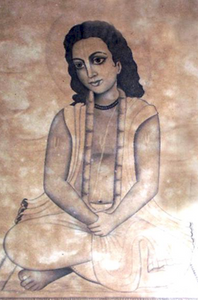
Śrīla Rāmacandra Kavirāja Gosvāmī
[January 31, 2021 is the disappearance day of Śrīla Rāmacandra Kavirāja Gosvāmī in Vṛndāvana, India. The following is an excerpt of a bhāva anuvāda of a discourse by Śrīla Bhakti Vijñāna Bhāratī Gosvāmī Mahārāja on January 17, 2015. Editors’ input: Additional text has been included in square brackets to facilitate the flow of content. A few portions have been taken from the following article for the purpose of detailed elaboration – https://www.visuddhacaitanyavani.com/single-post/2018/10/28/Srila-Narottama-Dasa-Thakura]
VAIṢṆAVAS ARE PARA-DUKHA-DUKHI
ONLY BY VAIṢṆAVA’S MERCY
The brother of Śrīla Rāmacandra Kavirāja was Govinda Dāsa. He was a śākta (worshiper of śakti). When Govinda Dāsa fell ill and his final moments were approaching, Śrīla Rāmacandra Kavirāja began to pray for his brother, ‘ante nārāyaṇa smṛtiḥ’ – that in his final moments, he should leave his body having remembrance of [Bhagavān] Nārāyaṇa.
etāvān sāṅkhya-yogābhyāṁ sva-dharma-pariniṣṭhayā janma-lābhaḥ paraḥ puṁsām ante nārāyaṇa-smṛtiḥ
Śrīmad-Bhāgavatam 2.1.6
[The highest perfection of human life, achieved either by complete knowledge of matter and spirit, by practice of mystic powers, or by perfect discharge of occupational duty, is to remember the Personality of Godhead at the end of one’s life.]
As a result, Śrīla Rāmacandra Kavirāja prayed to Śrīla Narottama Dāsa Ṭhākura, “You are parama-vaiṣṇava. By your desire my brother will attain the mercy of Bhagavān. For his auspiciousness, kindly recite the Śrīmad-Bhāgavatam for him”. Śrīla Narottama Dāsa Ṭhākura, however, not considering himself a Vaiṣṇava, summoned Śrīnivāsa Ācārya by a handwritten letter requesting him to recite the Śrīmad-Bhāgavatam to Govinda Kavirāja. By hearing the Śrīmad-Bhāgavatam, Govinda Kavirāja was transformed, and in the process, this kīrtana sprang forth from his lips as he became a Vaiṣṇava: ‘bhajahū re mana śrī-nanda-nandana abhaya-caraṇāravinda re – [O mind just worship the lotus feet of the son of Nanda, which make one fearless].
KHETURĪ MAHOTSAVA
Once, following the dictates of a dream, Narottama Dāsa Ṭhākura visited an abandoned granary belonging to a brāhmaṇa and asked for permission to access it. Despite being forewarned that nobody dared to venture there, as the place was infested with many poisonous serpents, Narottama affirmed that he didn’t mind and was not harmed by any snakes as he entered. Rather, there he discovered six Deities which were actually being guarded by those poisonous serpents [The six Deities discovered were: Śrī Gaurāṅga-deva, Śrī Vallabhī-kānta, Śrī Vraja-mohana, Śrī Rādhā-kānta, Śrī Rādhā-ramaṇa and Śrī Kṛṣṇa].
At that time, Śrī Jāhnavā-mātā was the chief amongst the Gauḍīya Vaiṣṇavas. So when Śrīla Narottama Dāsa Ṭhākura turned to her for guidance, she instructed, “These deities are self-manifest and hence no formal installation [prāṇa-pratiṣṭhā] is necessary. Only mahā-abhiṣeka need be performed. Invite Śrīnivāsa Ācārya to perform the mahā-abhiṣeka, while Śyāmānanda, Rāmacandra Kavirāja and you do the service of performing kīrtana. Invite all the Vaiṣṇavas in and around Gauḍa-maṇḍala, Kṣetra-maṇḍala and Vraja-maṇḍala, and befittingly arrange everything.”
A festival of that stature has never been held anywhere to date. Even to this day the Kheturī Mahotsava [the great festival of Kheturī] is very famous and unprecedented.

PRĀRTHANĀ AND PREMA-BHAKTI-CANDRIKĀ
In the mood of great separation on the disappearance day of Rāmacandra Kavirāja, two great works sprang from the lotus mouth of Śrīla Narottama Dāsa Ṭhākura. One is Prema-bhakti-candrikā and other one is Prārthanā.

In this regard, Śrīla Narottama Dāsa Ṭhākura said, ‘If I get a human birth, I must get an associate like Śrīla Rāmacandra Kavirāja’. Later he resided in Vṛndāvana and at the end of his life he established himself in Jagannātha Purī, where devotees in his disciplic succession still serve in his maṭha.
VAIṢṆAVA SEVA GRANTS THE ULTIMATE
So the āvirbhāva and tirobhāva of Vaiṣṇavas – are both auspicious. Je vaiṣṇava sevile acintya kṛṣṇa pāya tāhā hoite baḍo āra kichu nāi… Who said this? Śrīla Vṛndāvana dāsa Ṭhākura. Just as glorifying the activities and qualities of Bhagavān is auspicious, so is the glorification of the activities and qualities of Vaiṣṇavas. Actually, the glorification of the activities and qualities of the Vaiṣṇavas has been given more importance. Je vaiṣṇava sevile acintya kṛṣṇa pāya – That personality whom we cannot perceive or conceive of with our [materially contaminated] senses becomes conceivable by serving the Vaiṣṇavas.
NAVADVĪPA PAÑJIKĀ
That is why Vaiṣṇava Sārvabhauma Śrīla Jagannātha Dāsa Bābājī Mahārāja instructed my parama-gurudeva, Śrī Śrīmad Bhaktisiddhānta Sarasvatī Gosvāmī Ṭhākura, to prepare the Navadvīpa Pañjikā (Vaiṣṇava Pañjikā) – to include all the auspicious occasions like Janmāṣṭamī, Ekādaśī, and other important tithis such as the appearance and disappearance days of various Vaiṣṇavas. Under his guidance we also publish a pañjikā and by seeing the descriptions [of the respective tithis] therein, we speak [glorify] about the Vaiṣṇavas.