
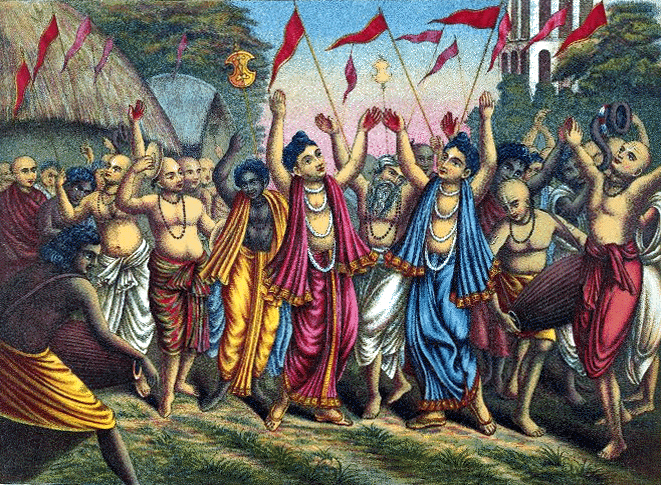
The following is an excerpt from the book “Sri Chaitanya: His Life and Associates” by Srila Bhakti Ballabh Tirtha Maharaj.]
Family life
Locana Das Thakur was born in 1523 in Kograma, in the Katwa block of Burdwan district. This village is about ten miles north of Guskara train station. The Thakur’s home is situated near the Ajaya River.
His birth tithi is given by some as the first day of the fortnight of the waxing moon in Paush. He was born in the Raahéya clan of the physician caste (vaidya). His father’s name was Kamalakara Das, his mother’s Sadanandé. Locana Das studied at his maternal grandfather’s house. He displayed devotion for Mahaprabhu from his childhood.
Locana Das was married at a very young age, according to the customs of that Epoque. His in-laws’ household was in the village of Amedpura Kakuwa. However, though he had entered the married station, he was extremely renounced and spent all his time discussing Krishna-katha with other devotees of Gauranga.
Since Locana Das was married at a very early age, his wife at first remained with her parents, but as the time approached when she was to join him, they began to worry because of Locana Das’s indifference to material life. They approached his guru Narahari Sarkara and told him of their disquiet. As a result, Narahari ordered Locana Das to go to his in-laws’ home.
When Locana arrived in their village he was unable to remember where their house was, since it had been so long since he had visited. He asked a young girl in the street for directions, addressing her as “Ma”, or “mother”. When he arrived at his in-laws’ house, he learned that the girl whom he had addressed as his mother was in fact his wife. From that day on, he always looked upon his wife as a mother, worshiping Guru and Gauranga in an attitude of renunciation.
The Chaitanya Mangala
Narahari Sarakara Thakur, Mahaprabhu’s famous associate from Çrékhaëòa, was very affectionate to Locana Das and gave him initiation. Locana Das enthusiastically took up residence with his guru in Çrékhaëòa. His guru taught him the art of kirtan and later ordered him to write Mahaprabhu’s sacred biography. Locana Das took this order seriously and wrote the Chaitanya Mangala, the events of which are based on Murari Gupta’s Chaitanya-carita.
The word mangala means auspicious and this title reflects the fact that hearing Mahaprabhu Sri Chaitanya’s divine pastimes is the most auspicious activity for all the living beings. Vrindavan Das Thakur’s biography of the Lord was first named Chaitanya Mangala and was only later known as Chaitanya Bhagavat. Locana Das gives an indication of this in the introductory portion of his book:
I attentively pay my obeisances to Vrindavan Das Thakur; his Bhagavat’s songs have enchanted the entire universe. (CM Sutrakhanda, 1.35)
Some people believe that Locana Das and Krishnadas Kaviraj Goswami gave the name Chaitanya Bhagavat to Vrindavan Das’s book. In the Chaitanya Mangala, Locana Das prays for his guru’s blessings as follows:
Narahari Das Thakur is the proprietor of my life, and out of the hope of attaining his lotus feet, I desire to sing the glories of Gauranga, even though I am the lowest of the low. This is my ambition. (CM Sutrakhanda, 1.9)
I offer my reverences to Narahari Das, the ocean of Gauranga’s qualities. Other than him, I have no friend in the three worlds. (Ibid., 1.33)
My lord and master is Narahari Das. I prostrate myself in humility to him. May he fulfill my desires. (Ibid., 1.61)
Locana Das wrote the Chaitanya Mangala in Eastern Bengal’s Païcalé style, completing it in in 1537 AD. There is a legend that he wrote the book while sitting on a stone under a flowering tree. In his new Bengali dictionary, Ashutosh Deb has underlined Locana Das’s contribution by stating that he was the first to write Bengali poetry using moric metres as well as being one of the first historical writers in Bengali. The original manuscript of the Chaitanya Mangala is said to be found in the personal library of Praëakåsëa Chakravarti of Kandaåa near the the Guskara train station.
Other titles attributed to Locana Dâsa are Prarthana, Durlabha-sara, Dhamalé, and Bengali verse translations of Ramananda’s Jagannath-vallabha-naöaka and the Rasa-païcadhyaya.
According to the Bhakti-ratnakara, Locana Das was present at Narahari Sarakara Thakur’s disappearance festival and greeted guests by giving them sandalwood and garlands.
Locana Das’s songs glorifying Nityananda
In the Chaitanya Mangala, Locana Das describes his guru Narahari as being Mahaprabhu’s dearest associate. He does not describe Nityananda’s glories as extensively. Fearful that the neglect of Nityananda might be taken as offensive to his feet, he later wrote a few songs in his praise. These songs are particularly well appreciated by the devotees.
(1)
nitai gunamani amara nitai gunamani
aniya premera banya bhasala abani
premera banya laiya nitai aila gauda-deze
dubila bhakata-gana dina hina bhase
dina-hina-patita-pamara nahi bache
brahmara durlabha prema sabakare jace
abaddha karuna-sindhu (nitai) katiya muhana
ghare ghare bule prema amiyara bana
locana bole mora nitai jeba na bhajila
janiya zuniya sei atma-ghati haila
Nitai is the jewel of virtue, my Nitai is the jewel of virtue. He brought the deluge of love of God and flooded the world.
He brought the deluge of love of God to Gauòadeça, flooding the devotees. The lowly and deprived are also floating.
He excluded not the lowly and deprived, nor the sinful and atheistic, but insisted that everyone take the gift of love which is beyond the reach of even Brahma.
Nitai cut the floodgates which held back the ocean of compassion, and went from door to door to give the nectar of love to everyone.
Locana Das says that anyone who has not worshiped my Nitai has committed suicide in full knowledge.
(2)
akrodha paramananda nityananda ray
abhimana sunya nitai nagare beday
adhama patita jiver dvare dvare giya
hari nama maha -mantra deno bilaiya
jare dekhe tare kohe dante trna dhori ‘
amare kiniya loho bhajo gaura-hari
eto boli ‘nityananda bhume gadi jay
sonara parvata jeno dhulate lotay
heno avatare jar rati na janmilo
locan bole seri papi elo ar gelo
Lord Nityananda is free from anger and the embodiment of supreme joy. He wanders throughout the town without any pride or arrogance.
He knocks on every fallen person’s door and bestows the maha-mantra of the Holy Names on him.
Placing straw between his teeth, he says to everyone he sees, “Worship Gaura Hari and you will purchase me and make me your slave.”
Then he falls to the ground, looking like a golden mountain rolling in the dust.
Whoever lacks faith in such a compassionate incarnation is a sinner who will go as he has come, says Locana Das.
(3)
parama karuna pahun dui jana
nitai gaurachandra
saba avatara, sara shiromani
kevala ananda kanda
bhaja bhaja bhai, chaitanya nitai
sudhrida visvasa kori
vishaya chariya se rase majiya
mukha bolo hari hari
dekho ore bhai, tribhuvane nai
emona doyala data
pashu-pakhi jhure, pashana vidore
shuni yar guna gantha
samsare majiya, rahile pariya
se pade nahilo asha
apana koroma, bhunjaye shamana,
kohoye locana dasa
Nitai and Gauracandra, are the two most compassionate lords. They are the essence of all incarnations, the crest-jewels of the avatars, the source of the unique joy of prema.
O brother! I implore you to worship Gaura-Nitai with firm faith. Give up your attachment to sense gratification and merge into this nectar by chanting the names of Hari.
Look, O brother! There is no benefactor in the three worlds who is as merciful as they. Even birds and animals are fulfilled by hearing their qualities, and stones melt.
Absorbed in the cycle of birth and death, you have fallen by the wayside without any hope for achieving their company. The lord of death will come and make you suffer the results of your activities – so sings Locana Das.
Gaura-nagara doctrine condemned
Followers of certain heterodox groups or apasampradayas say that the Gaura-nagara doctrine is found in the Chaitanya Mangala. This is not true, however. Vrindavan Das Thakur writes in his Chaitanya Bhagavat: gauranga nagara hena stava nahi bale — “No one should praise the Lord by calling him the golden playboy.” Srila Bhaktisiddhanta Saraswati Goswami Thakur comments: “Gaurasundara is Krishna who has been endowed with Radha’s bodily hue and her mood of love. Thus he never abandoned the qualities of the heart of Radha and the other gopis, i.e., the character of the açraya of devotion in the erotic mood. This means that he never acts like the visaya (‘object’) or bhokta (‘enjoyer’) of madhura-rasa by looking at other women in the spirit of a playboy.”
Locana Das ended his pastimes in this world in 1589 AD. A brick samadhi at his sripad marks the place where his remains are buried.
::::::::::::::::::::::::::::::::::::::::::::::::::::::::::::::::::::::::::::::::::::::::::::::::::::::::
Glories Of Śrīla Locana Dāsa Ṭhākura
[January 14, 2021 is the appearance day of Śrīla Locana Dāsa Ṭhākura in Vṛndāvana, India. The following is the bhāva anuvāda of the kathā given by Śrīla Bhakti Vijñāna Bhāratī Gosvāmī Mahārāja on Śrīla Locana Dāsa Ṭhākura,on different occasions*. Editors’ input: Additional text has been included in square brackets to facilitate the proper flow of content.]
EARLY LIFE

Locana Dāsa Ṭhākura was married at a very young age, but was disinterested in material life. In those days, marriages would take place by the age of 5 to 7 [however the bride would come to reside with her in-laws only after a few years]. Such an arrangement is incomprehensible in today’s world. He would spend most of his time in Śrīkhaṇḍa, the śrīpāta of his guru, Śrī Narahari Sarkāra (who is Madhumatī Sakhī in Vraja-līlā). When it was time to bring the daughter-in-law home, the concerned parents, seeing Locana Dāsa Ṭhākura’s indifference towards family life, approached Narahari Sarkāra [and requested him to convince their only son to be a gṛhastha]. Thus his spiritual master ordered him, “Accept the gṛhastha āśrama and do your bhajana. There is no loss in this.”
Following his order, Locana Dāsa Ṭhākura proceeded to his in-laws’ place to bring his wife home, but he could not recall its exact location since he was very young when he had gotten married. So he asked a young girl passing by, for directions, addressing her as mātājī. Later, upon arriving at his in-laws’, he realized that in fact it was his wife who he had inquired from. Thenceforth, he always treated his wife as his mother because of once having mistakenly addressed her as mātājī. Such was his dṛḍha pratijñā (firm resolve).
VAIṢṆAVA ETIQUETTE
Locana Dāsa Ṭhākura composed a book named Śrī Caitanya-maṅgala. Around that time, Vṛndāvana Dāsa Ṭhākura happened to author another book with the same title. To resolve this, the Vaiṣṇava community renamed the latter’s work, being bigger in volume, as Śrī Caitanya-bhāgavata, while the former’s composition remained as Śrī Caitanya-maṅgala.
The Vaiṣṇava etiquette of those times is noteworthy. [Although, at the time there were three Vaiṣṇavas authoring books on a similar theme – the life and precepts of Śrī Caitanya Mahāprabhu – they all acknowledged and revered each other’s contribution]
Locana Dāsa Ṭhākura has addressed Vṛndāvana Dāsa Ṭhākura in his maṅgalācaraṇa in Caitanya-maṅgala-
[I whole-heartedly glorify Śrī Vṛndāvana Dāsa Ṭhākura, who enchanted the world with the words of his Caitanya-bhāgavata.]
śeṣa-khaṇḍe, caitanyera ananta vilāsa vistāriyā varṇite āchena veda-vyāsa
(Caitanya-bhāgavata, Ādi 1.180)
[The unlimited pastimes of Śrī Caitanya in the Antya-khaṇḍa will be described by Vyāsadeva in the future.]
And in Śrī Caitanya-caritāmṛta, Śrīla Kṛṣṇadāsa Kavirāja Gosvāmī said –
caitanya-līlāte ‘vyāsa’ – vṛndāvana-dāsa tāṅra kṛpā vinā anye nā haya prakāśa
(Śrī Caitanya-caritāmṛta, Ādi, 8.82)
[Śrīla Vṛndāvana dāsa Ṭhākura is the authorized writer on the pastimes of Lord Caitanya. Without his mercy, therefore, one cannot describe these pastimes.]
caitanya-maṇgale ih’ā likhiyāche sthāne-sthāne satya kahena,—‘’age vyāsa kariba varṇane’
Caitanya-caritāmṛta, Antya 2.87
[In the Caitanya-maṅgala, Vṛndāvana Dāsa Ṭhākura has stated in many places the factual truth that Vyāsadeva has already described them previously.]
Even though Vṛndāvana Dāsa Ṭhākura is the Vyāsa of caitanya-līlā, he proclaimed that in the future, Vyāsa would write more elaborately about the pastimes of Mahāprabhu, whereas Śrīla Kṛṣṇadāsa Kavirāja Gosvāmī said that Vyāsa had already written elaborately about the pastimes of Mahāprabhu but because his book was getting voluminous, he had left some remnants of Mahāprabhu’s pastimes to write about.
This is how Vaiṣṇava etiquette is to be maintained. Otherwise one will be overcome with deceit and fall down.
NIṢṬHA IN ONE’S IṢṬADEVA

Being intensely absorbed in Caitanya-deva, Locana Dāsa Ṭhākura did not speak much about Nityānanda Prabhu in his Caitanya-maṅgala. Nityānanda Prabhu is prakāśa-vigraha [First immediate manifestation or expansion of Kṛṣṇa. Just as Kṛṣṇa manifests Himself through Balarāma, Caitanya-deva manifests Himself through Nityānanda. Thus first one needs to take shelter of Nityānanda Prabhu.] One cannot glorify Śrīmān Mahāprabhu without glorifying Nityānanda Prabhu.
Both, Vṛndāvana Dāsa Ṭhākura and Kṛṣṇadāsa Kavirāja Gosvāmī, have extensively glorified Nityānanda Prabhu in their respective works – Caitanya-bhāgavata and Śrī Caitanya-caritāmṛta. Kṛṣṇadāsa Kavirāja Gosvāmī neither mentioned nor glorified any of his family members. However, he glorified Nityānanda Prabhu by whose mercy he attained Śrī Vṛndāvana-dhāma, otherwise he would have been guilty of being ungrateful towards Nityānanda Prabhu. He didn’t do it for his own prestige, but just to acknowledge Nityānanda Prabhu’s causeless mercy on him.
So in retrospect, Locana Dāsa Ṭhākura felt remorse in his heart for not glorifying Nityānanda Prabhu in his work, and felt that he had committed an offence. In this mood he lamented, “O! Fie on me! I didn’t glorify Nityānanda Prabhu, the one who gives Rādhā-Kṛṣṇa prema and vraja-vāsa!”
nitāiyer karuṇā habe, vraje rādhā-kṛṣṇa pābe, dharô nitāir caraṇa du’khāni
se sambandha nāhi ĵā’ra, bṛthā janma gelô tā’ra, sei paśu baḓô durācāra.
In another place it is said –
guru, vaiṣṇava, bhagavān,–tinera smaraṇa tinera smaraṇe haya vighna-vināśana
This is the recommended sequence of offering respects. First pay obeisances to guru, then to Vaiṣṇavas then Bhagavān. All obstacles go away just by remembering them. What are the obstacles? Anything that checks one’s progress in hari-bhakti is an obstacle.
That is why Locana Dāsa Ṭhākura went on to extensively glorify Nityānanda Prabhu through his many kīrtanas, like Nityānanda-mahimā Socaka, Prārthanā, Durlabha-sāra, Jagannātha-vallabha-nāṭaka, a poetic rendition of Rāsa-pañcādhyāya, to name a few. Those kīrtanas stand testimony to his unprecedented niṣṭhā in Nityānanda Prabhu.
Some of his compositions are –
nitāi guṇa-maṇi āmār nitāi guṇa-maṇi āniyā premera vanyā bhāsāilô avanī
akrodha paramānanda nityānanda rāya abhimāna-śūnya nitāi nagare beḓāya
parama karuṇa, pāhu dui-jana, nitāi gauracandra saba avatāra-sāra-śiromaṇi, kevala ānanda-kanda
In another kīrtana (Nitāi Mora Jīvana-dhana), he said
ĵe-deśe nitāi nāi se-deśe nā ĵā’bô nitāi vimukha janār mukha nā heribô
[I shall never visit any place where Nitāi is absent, and I shall never look upon the face of one who is averse to Him.]
Just see Locana Dāsa Ṭhākura’s sayutha niṣṭhā (niṣṭhā for his guru-varga). Does anyone ordinarily speak like this, with so much resoluteness? But Locana Dāsa Ṭhākura did. On one hand, Vaiṣṇavas are causelessly merciful even to the caṇḍālas and on the other they are not even willing to see the face of anyone who is averse to Nityānanda. This is simply niṣṭhā in Nityānanda and we can get such niṣṭhā only by hearing of their lives and precepts.
He wrote an astonishing line in another song –
locana bôle mora nitāi ĵebā nāhi māne anala bhejāi tā’ra mājha-mukha-khāne
[Locana dāsa declares, “I shall scorch the face of one who has no regard for my Nitāi!”]
Locana dāsa said, “I will set ablaze anyone’s face who doesn’t glorify Nitāi.” Does any sādhu speak like this? Never! But this is just his way of expressing his niṣṭhā towards Nitāi.
[I pray at the feet of Locana dāsa today and beg for his mercy.]
* This lecture includes hari-kathā given on the same tithi on December 25, 2011; January 11, 2016; and December 30, 2016.